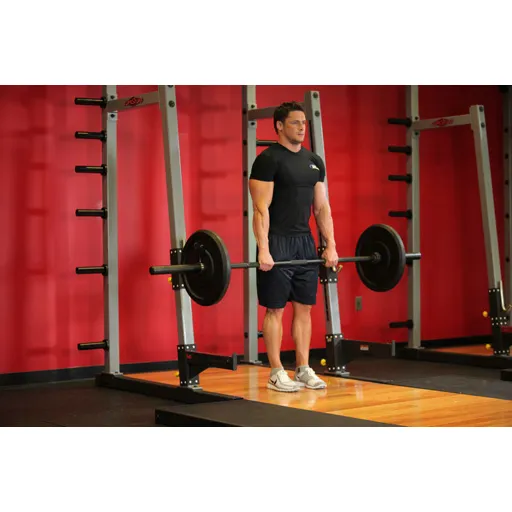
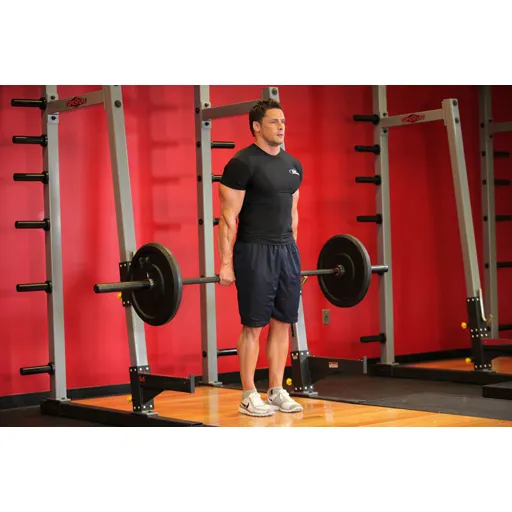
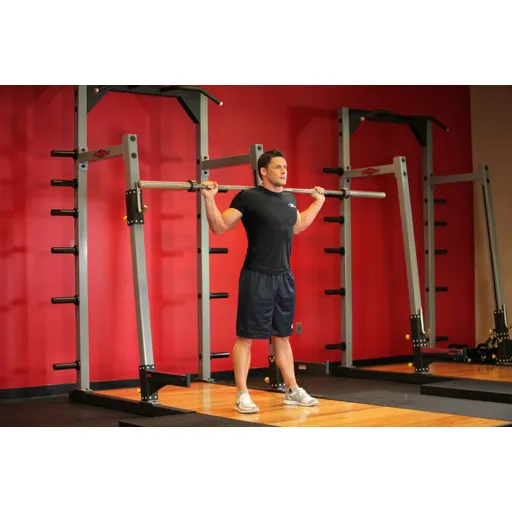
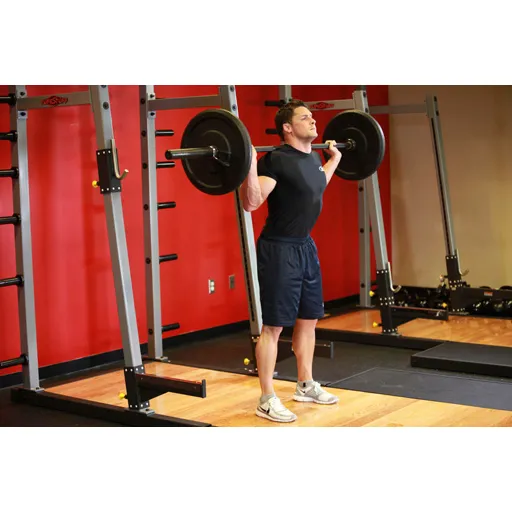
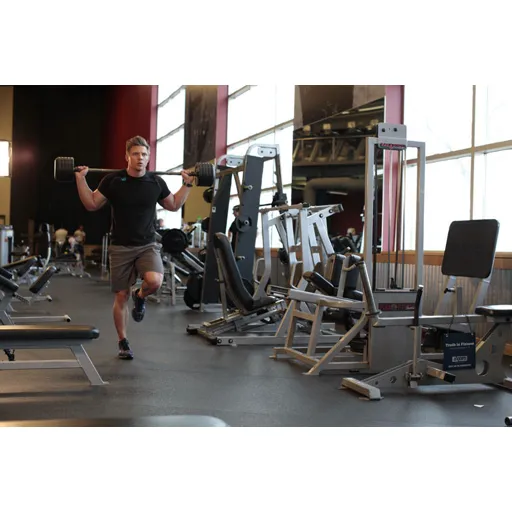
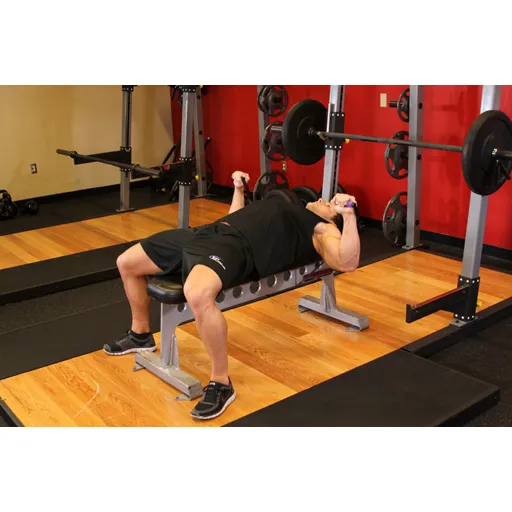
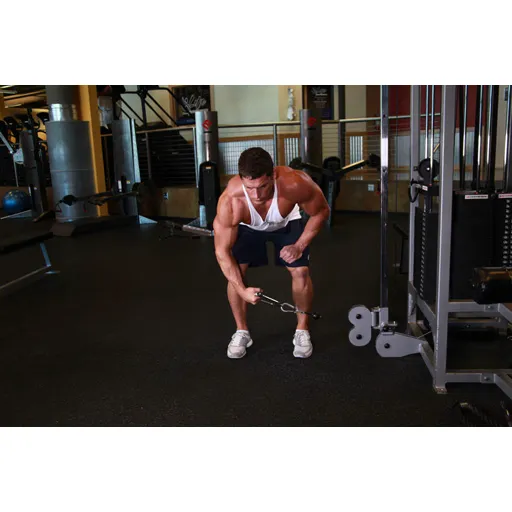
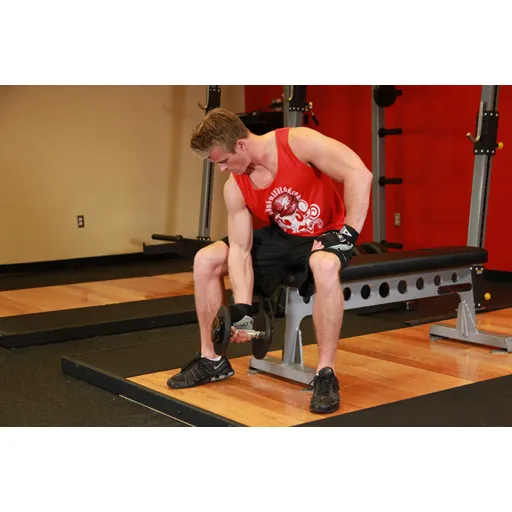
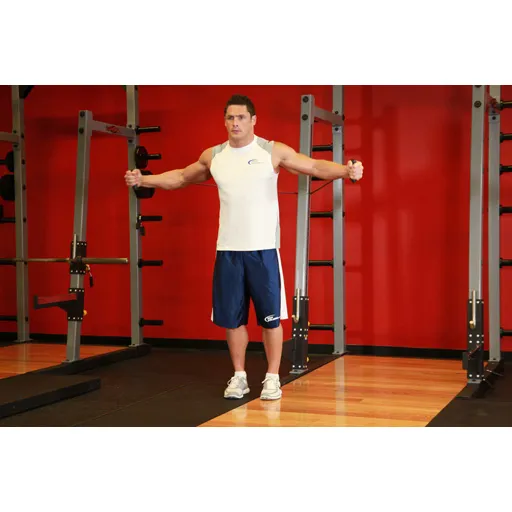
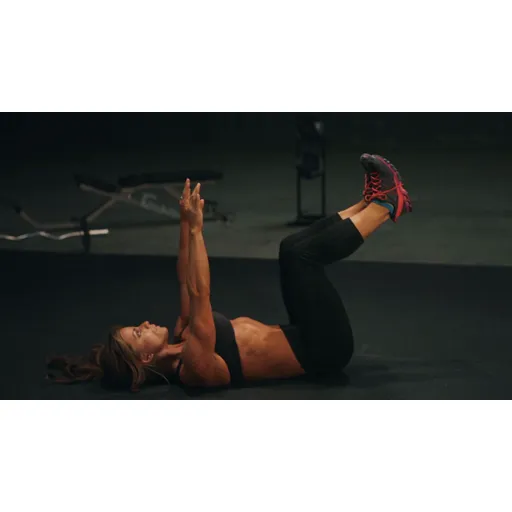
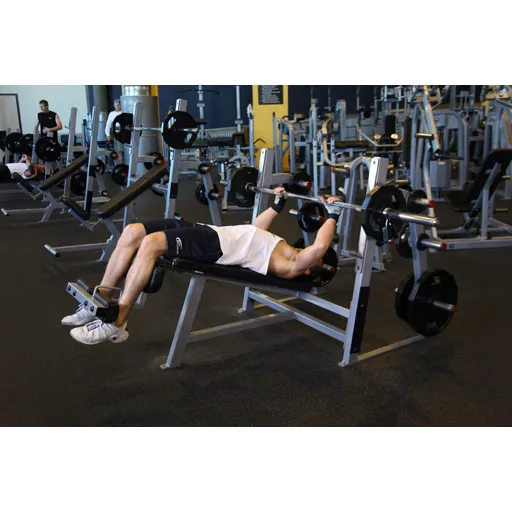
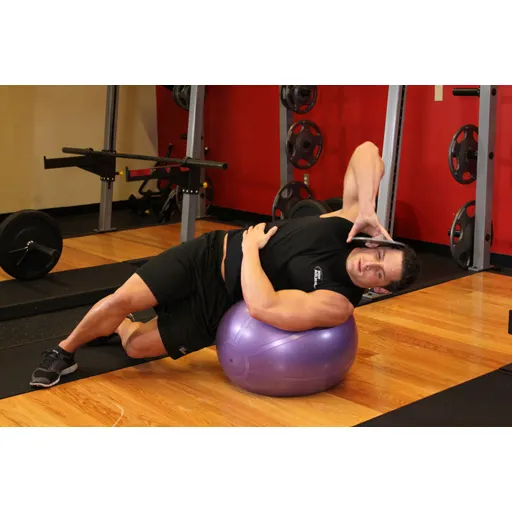
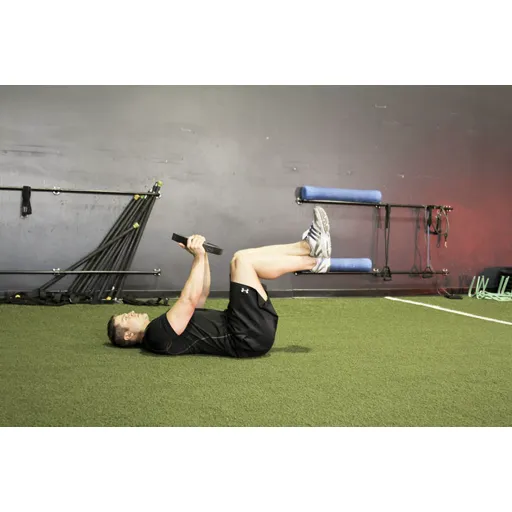
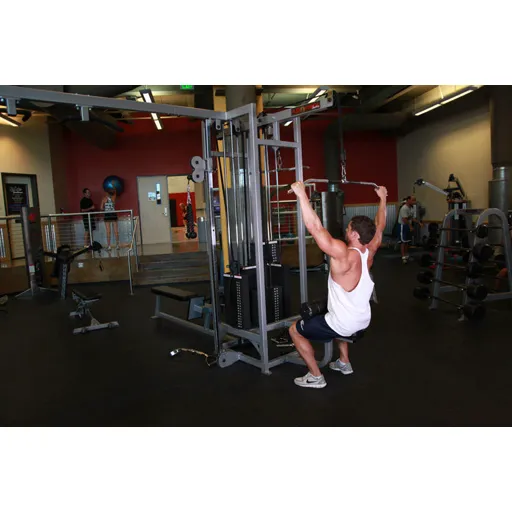
Gym Việt

Thư viện bài tập

200 bài tập với hướng dẫn từng bước và lỗi thường gặp — nguồn ảnh & hướng dẫn: free-exercise-db (miền công cộng), mô tả tiếng Việt do Gym Việt biên soạn.

Nhóm:
Thiết bị:

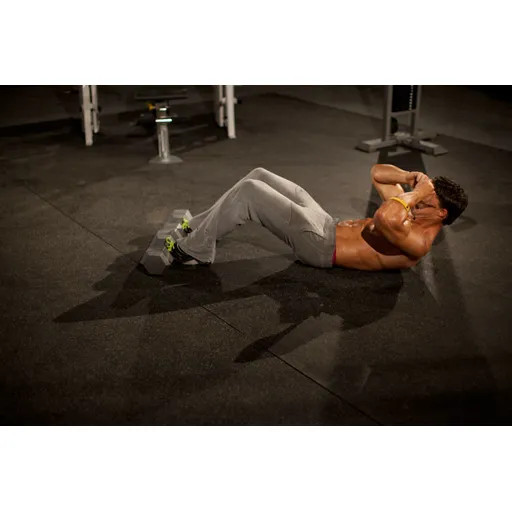
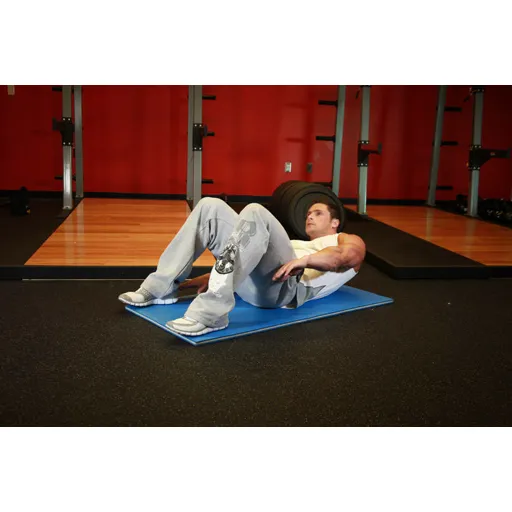
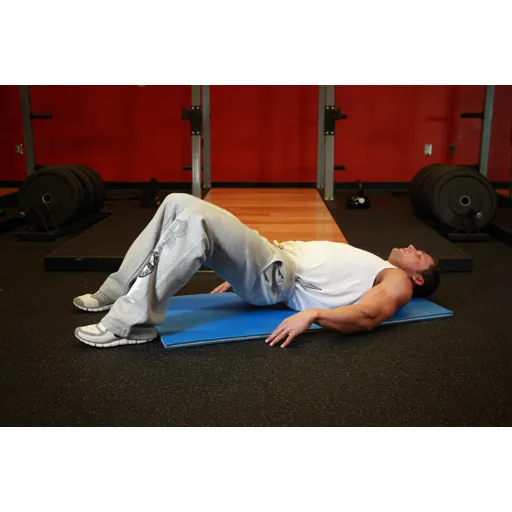
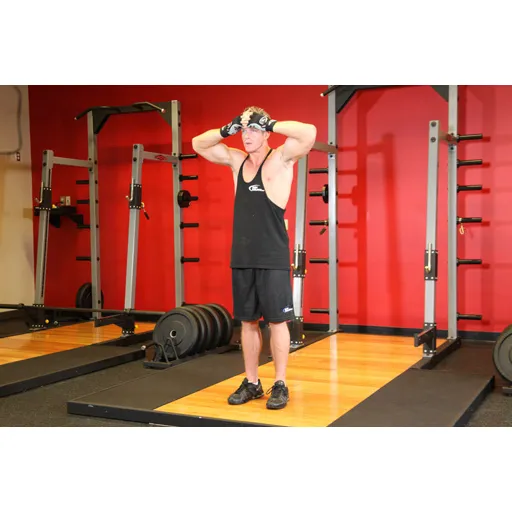
3/4 Sit-Up

3/4 Sit-Up

Bụng — Không tạ

Hướng dẫn & lỗi thường gặp EN
  1. Lie down on the floor and secure your feet. Your legs should be bent at the knees.
  2. Place your hands behind or to the side of your head. You will begin with your back on the ground. This will be your starting position.
  3. Flex your hips and spine to raise your torso toward your knees.
  4. At the top of the contraction your torso should be perpendicular to the ground. Reverse the motion, going only ¾ of the way down.
  5. Repeat for the recommended amount of repetitions.

Lỗi thường gặp

  • Gập bằng cơ bụng, không kéo cổ hoặc vung thân người.
  • Thở ra khi gập, lưng dưới ổn định suốt cử động.
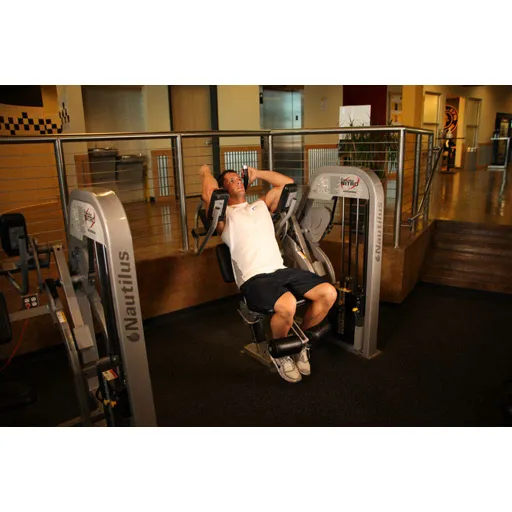
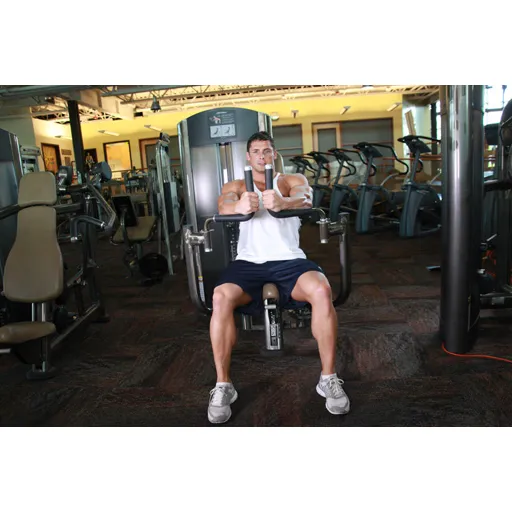
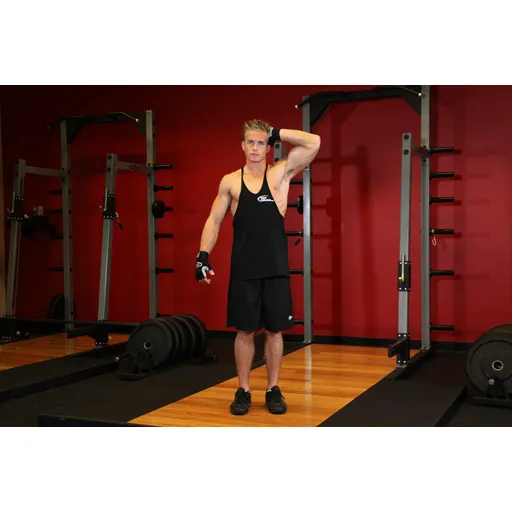
Ab Crunch Machine

Ab Crunch Machine

Bụng — Máy

Hướng dẫn & lỗi thường gặp EN
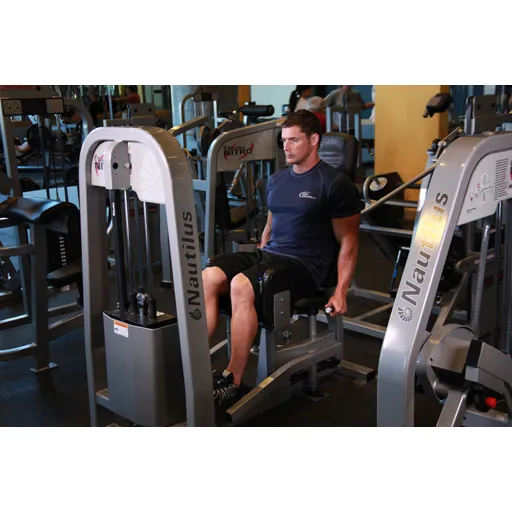
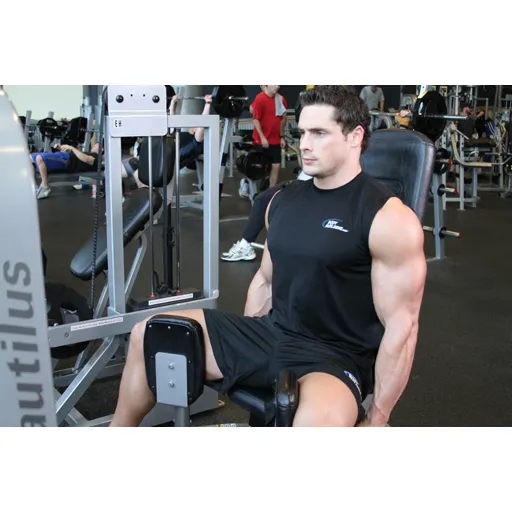
  1. Select a light resistance and sit down on the ab machine placing your feet under the pads provided and grabbing the top handles. Your arms should be bent at a 90 degree angle as you rest the triceps on the pads provided. This will be your starting position.
  2. At the same time, begin to lift the legs up as you crunch your upper torso. Breathe out as you perform this movement. Tip: Be sure to use a slow and controlled motion. Concentrate on using your abs to move the weight while relaxing your legs and feet.
  3. After a second pause, slowly return to the starting position as you breathe in.
  4. Repeat the movement for the prescribed amount of repetitions.

Lỗi thường gặp

  • Gập bằng cơ bụng, không kéo cổ hoặc vung thân người.
  • Thở ra khi gập, lưng dưới ổn định suốt cử động.
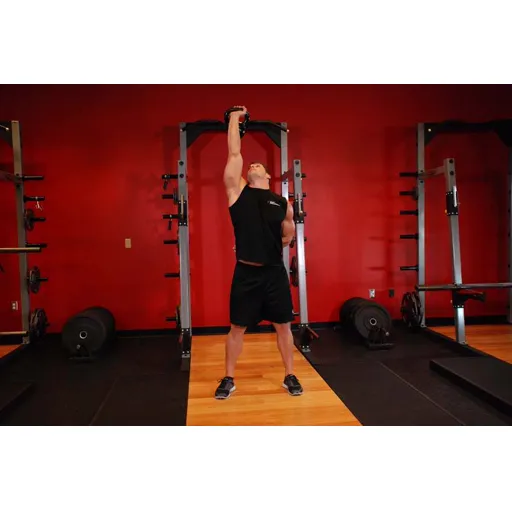
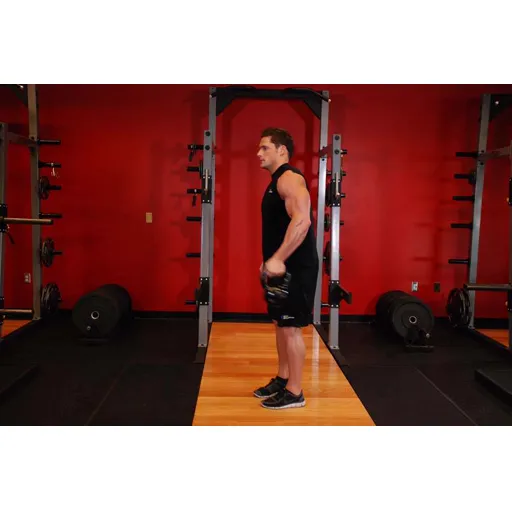
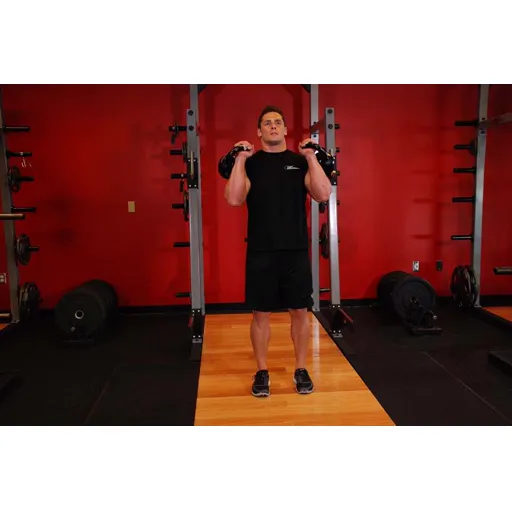
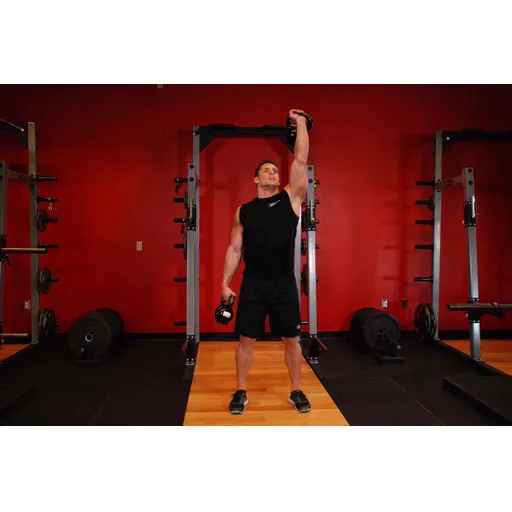
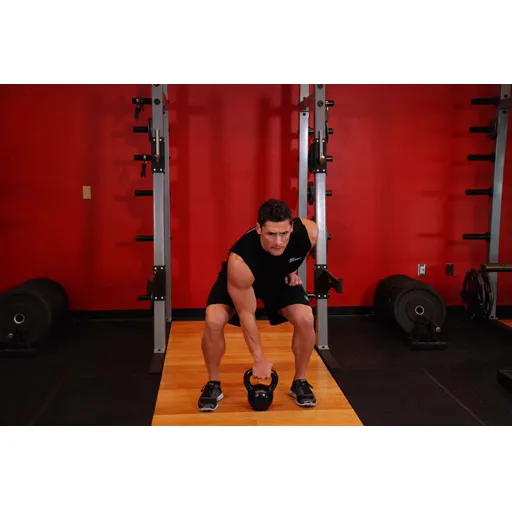
Advanced Kettlebell Windmill

Advanced Kettlebell Windmill

Bụng — Kettlebell

Hướng dẫn & lỗi thường gặp EN
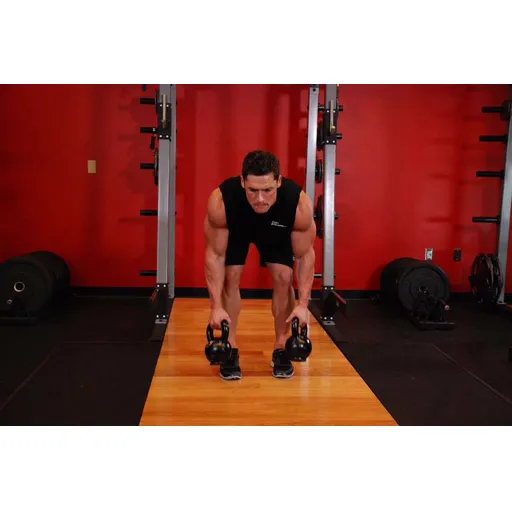
  1. Clean and press a kettlebell overhead with one arm.
  2. Keeping the kettlebell locked out at all times, push your butt out in the direction of the locked out kettlebell. Keep the non-working arm behind your back and turn your feet out at a forty-five degree angle from the arm with the kettlebell.
  3. Lower yourself as far as possible.
  4. Pause for a second and reverse the motion back to the starting position.

Lỗi thường gặp

  • Gập bằng cơ bụng, không kéo cổ hoặc vung thân người.
  • Thở ra khi gập, lưng dưới ổn định suốt cử động.
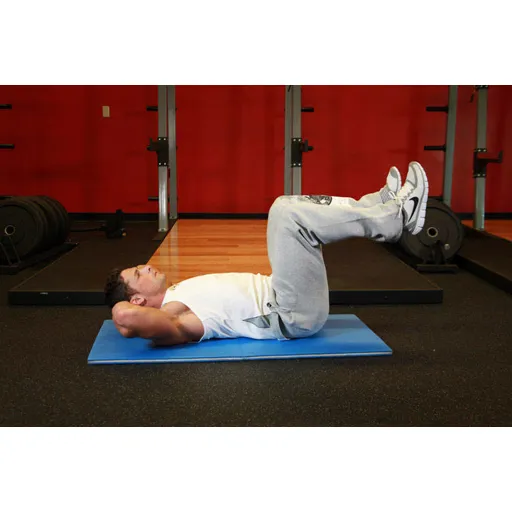
Air Bike

Air Bike

Bụng — Không tạ

Hướng dẫn & lỗi thường gặp EN
  1. Lie flat on the floor with your lower back pressed to the ground. For this exercise, you will need to put your hands beside your head. Be careful however to not strain with the neck as you perform it. Now lift your shoulders into the crunch position.
  2. Bring knees up to where they are perpendicular to the floor, with your lower legs parallel to the floor. This will be your starting position.
  3. Now simultaneously, slowly go through a cycle pedal motion kicking forward with the right leg and bringing in the knee of the left leg. Bring your right elbow close to your left knee by crunching to the side, as you breathe out.
  4. Go back to the initial position as you breathe in.
  5. Crunch to the opposite side as you cycle your legs and bring closer your left elbow to your right knee and exhale.
  6. Continue alternating in this manner until all of the recommended repetitions for each side have been completed.

Lỗi thường gặp

  • Gập bằng cơ bụng, không kéo cổ hoặc vung thân người.
  • Thở ra khi gập, lưng dưới ổn định suốt cử động.
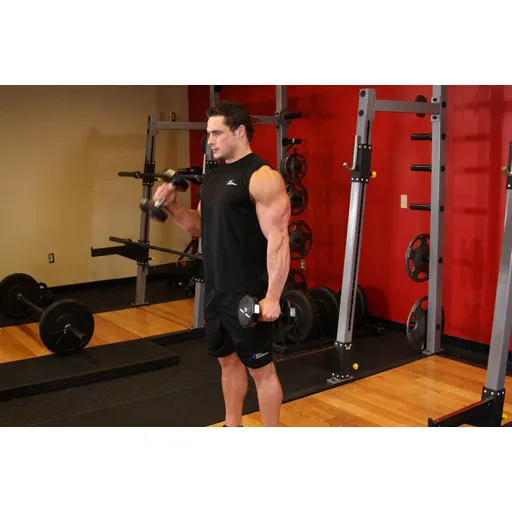
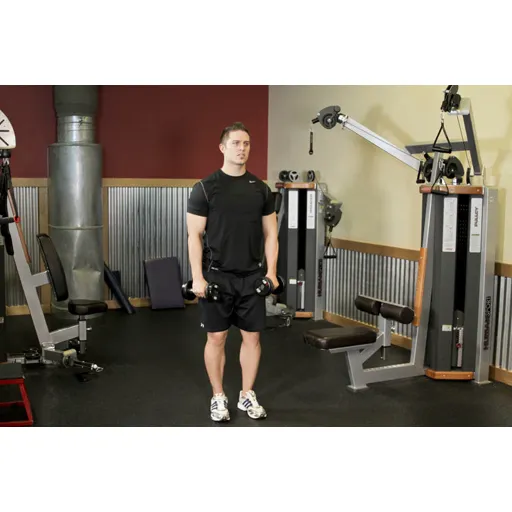
Alternate Hammer Curl

Alternate Hammer Curl

Tay trước — Tạ tay

Hướng dẫn & lỗi thường gặp EN
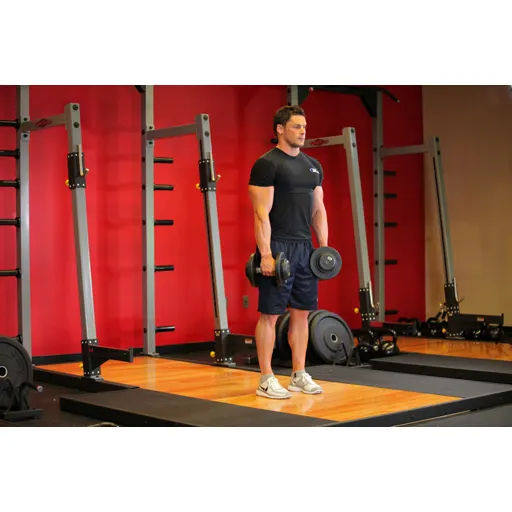
  1. Stand up with your torso upright and a dumbbell in each hand being held at arms length. The elbows should be close to the torso.
  2. The palms of the hands should be facing your torso. This will be your starting position.
  3. While holding the upper arm stationary, curl the right weight forward while contracting the biceps as you breathe out. Continue the movement until your biceps is fully contracted and the dumbbells are at shoulder level. Hold the contracted position for a second as you squeeze the biceps. Tip: Only the forearms should move.
  4. Slowly begin to bring the dumbbells back to starting position as your breathe in.
  5. Repeat the movement with the left hand. This equals one repetition.
  6. Continue alternating in this manner for the recommended amount of repetitions.

Lỗi thường gặp

  • Khuỷu cố định sát thân, không đưa vai hoặc thân người vào nối lực.
  • Hạ tạ chậm bằng kiểm soát, không thả tay theo trọng lực.
Alternate Heel Touchers

Alternate Heel Touchers

Bụng — Không tạ

Hướng dẫn & lỗi thường gặp EN
  1. Lie on the floor with the knees bent and the feet on the floor around 18-24 inches apart. Your arms should be extended by your side. This will be your starting position.
  2. Crunch over your torso forward and up about 3-4 inches to the right side and touch your right heel as you hold the contraction for a second. Exhale while performing this movement.
  3. Now go back slowly to the starting position as you inhale.
  4. Now crunch over your torso forward and up around 3-4 inches to the left side and touch your left heel as you hold the contraction for a second. Exhale while performing this movement and then go back to the starting position as you inhale. Now that both heels have been touched, that is considered 1 repetition.
  5. Continue alternating sides in this manner until all prescribed repetitions are done.

Lỗi thường gặp

  • Gập bằng cơ bụng, không kéo cổ hoặc vung thân người.
  • Thở ra khi gập, lưng dưới ổn định suốt cử động.
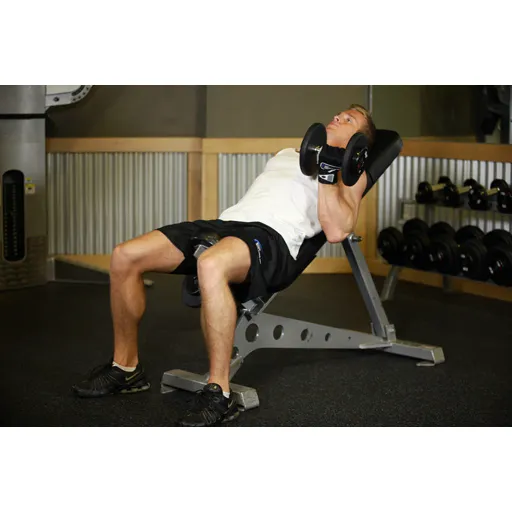
Alternate Incline Dumbbell Curl

Alternate Incline Dumbbell Curl

Tay trước — Tạ tay

Hướng dẫn & lỗi thường gặp EN
  1. Sit down on an incline bench with a dumbbell in each hand being held at arms length. Tip: Keep the elbows close to the torso.This will be your starting position.
  2. While holding the upper arm stationary, curl the right weight forward while contracting the biceps as you breathe out. As you do so, rotate the hand so that the palm is facing up. Continue the movement until your biceps is fully contracted and the dumbbells are at shoulder level. Hold the contracted position for a second as you squeeze the biceps. Tip: Only the forearms should move.
  3. Slowly begin to bring the dumbbell back to starting position as your breathe in.
  4. Repeat the movement with the left hand. This equals one repetition.
  5. Continue alternating in this manner for the recommended amount of repetitions.

Lỗi thường gặp

  • Khuỷu cố định sát thân, không đưa vai hoặc thân người vào nối lực.
  • Hạ tạ chậm bằng kiểm soát, không thả tay theo trọng lực.
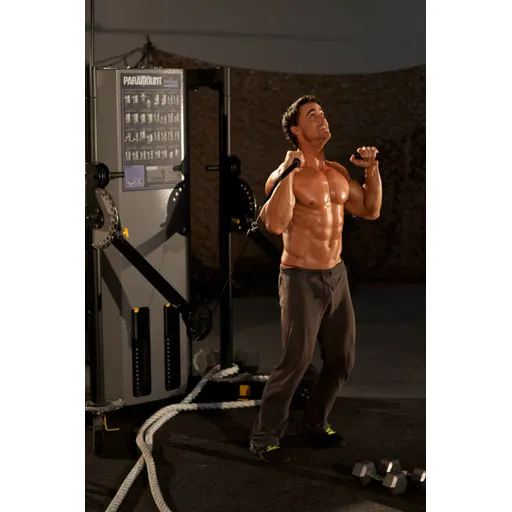
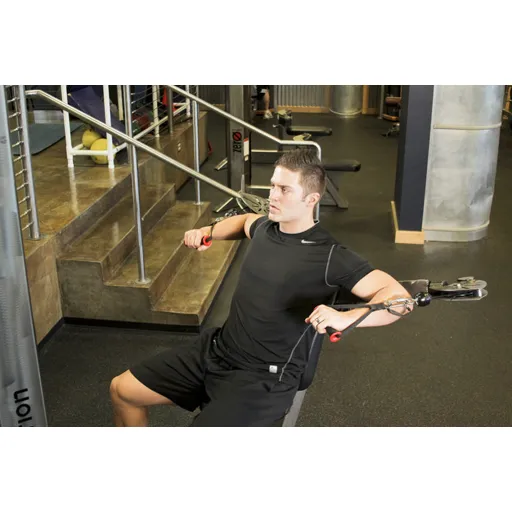
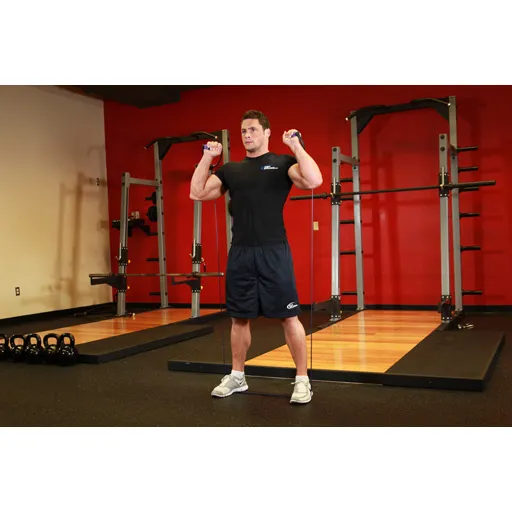
Alternating Cable Shoulder Press

Alternating Cable Shoulder Press

Vai — Cáp

Hướng dẫn & lỗi thường gặp EN
  1. Move the cables to the bottom of the tower and select an appropriate weight.
  2. Grasp the cables and hold them at shoulder height, palms facing forward. This will be your starting position.
  3. Keeping your head and chest up, extend through the elbow to press one side directly over head.
  4. After pausing at the top, return to the starting position and repeat on the opposite side.

Lỗi thường gặp

  • Vai hạ thấp, không shrug lên gần tai khi đẩy hoặc nâng.
  • Khuỷu theo hướng tự nhiên của khớp, không khóa cứng ở đỉnh.
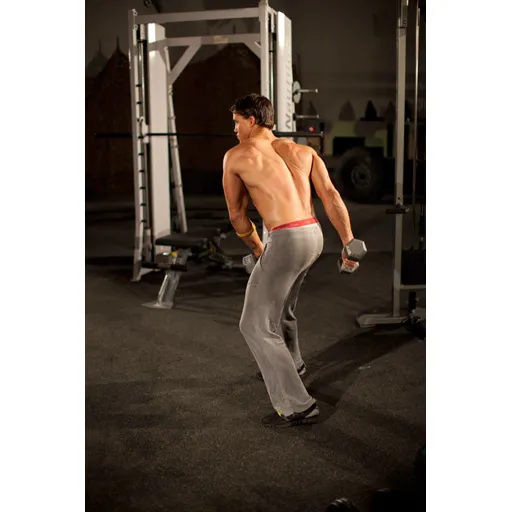
Alternating Deltoid Raise

Alternating Deltoid Raise

Vai — Tạ tay

Hướng dẫn & lỗi thường gặp EN
  1. In a standing position, hold a pair of dumbbells at your side.
  2. Keeping your elbows slightly bent, raise the weights directly in front of you to shoulder height, avoiding any swinging or cheating.
  3. Return the weights to your side.
  4. On the next repetition, raise the weights laterally, raising them out to your side to about shoulder height.
  5. Return the weights to the starting position and continue alternating to the front and side.

Lỗi thường gặp

  • Vai hạ thấp, không shrug lên gần tai khi đẩy hoặc nâng.
  • Khuỷu theo hướng tự nhiên của khớp, không khóa cứng ở đỉnh.
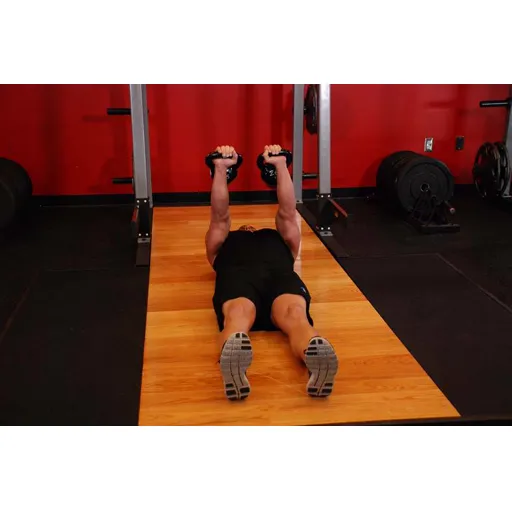
Alternating Floor Press

Alternating Floor Press

Ngực — Kettlebell

Hướng dẫn & lỗi thường gặp EN
  1. Lie on the floor with two kettlebells next to your shoulders.
  2. Position one in place on your chest and then the other, gripping the kettlebells on the handle with the palms facing forward.
  3. Extend both arms, so that the kettlebells are being held above your chest. Lower one kettlebell, bringing it to your chest and turn the wrist in the direction of the locked out kettlebell.
  4. Raise the kettlebell and repeat on the opposite side.

Lỗi thường gặp

  • Khuỷu ~45° so với thân, hạ tạ tới giữa ngực theo kiểm soát.
  • Lưng và vai trên bám ghế, không ưỡn hông để nối lực.
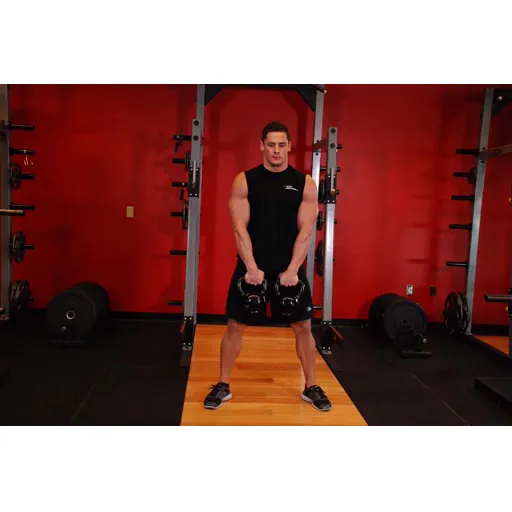
Alternating Hang Clean

Alternating Hang Clean

Đùi sau — Kettlebell

Hướng dẫn & lỗi thường gặp EN
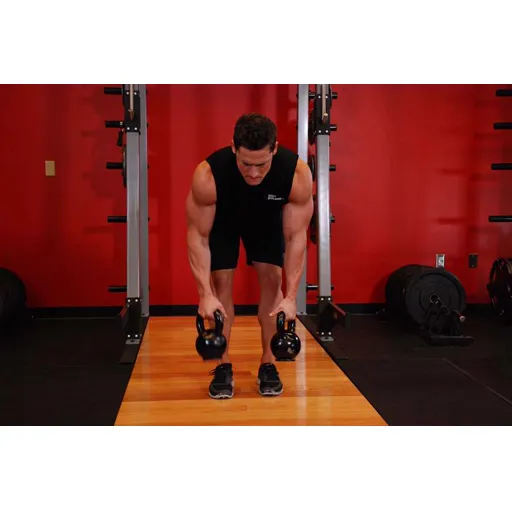
  1. Place two kettlebells between your feet. To get in the starting position, push your butt back and look straight ahead.
  2. Clean one kettlebell to your shoulder and hold on to the other kettlebell in a hanging position. Clean the kettlebell to your shoulder by extending through the legs and hips as you pull the kettlebell towards your shoulders. Rotate your wrist as you do so.
  3. Lower the cleaned kettlebell to a hanging position and clean the alternate kettlebell. Repeat.

Lỗi thường gặp

  • Gập người bằng hông, lưng trung tính — không cong lưng để tạ đi xa hơn.
  • Siết đùi sau ở đỉnh rồi hạ xuống bằng kiểm soát.
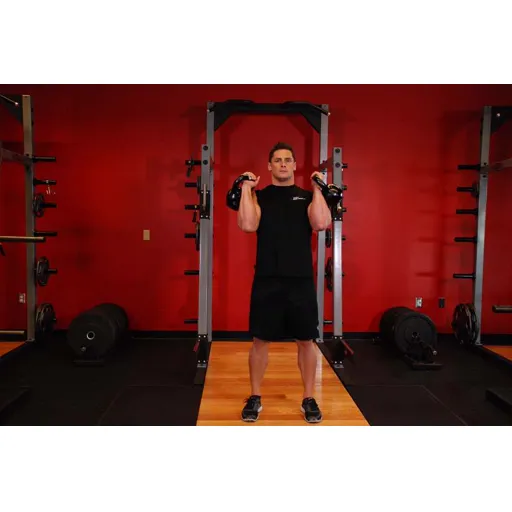
Alternating Kettlebell Press

Alternating Kettlebell Press

Vai — Kettlebell

Hướng dẫn & lỗi thường gặp EN
  1. Clean two kettlebells to your shoulders. Clean the kettlebells to your shoulders by extending through the legs and hips as you pull the kettlebells towards your shoulders. Rotate your wrists as you do so.
  2. Press one directly overhead by extending through the elbow, turning it so the palm faces forward while holding the other kettlebell stationary .
  3. Lower the pressed kettlebell to the starting position and immediately press with your other arm.

Lỗi thường gặp

  • Vai hạ thấp, không shrug lên gần tai khi đẩy hoặc nâng.
  • Khuỷu theo hướng tự nhiên của khớp, không khóa cứng ở đỉnh.
Alternating Kettlebell Row

Alternating Kettlebell Row

Lưng giữa — Kettlebell

Hướng dẫn & lỗi thường gặp EN
  1. Place two kettlebells in front of your feet. Bend your knees slightly and push your butt out as much as possible. As you bend over to get into the starting position grab both kettlebells by the handles.
  2. Pull one kettlebell off of the floor while holding on to the other kettlebell. Retract the shoulder blade of the working side, as you flex the elbow, drawing the kettlebell towards your stomach or rib cage.
  3. Lower the kettlebell in the working arm and repeat with your other arm.

Lỗi thường gặp

  • Kéo về bụng dưới, khuỷu sát thân, vai hạ thấp.
  • Thân người giữ gập ổn định, không đứng dậy theo mỗi lần kéo.
Anti-Gravity Press

Anti-Gravity Press

Vai — Tạ đòn

Hướng dẫn & lỗi thường gặp EN
  1. Place a bar on the ground behind the head of an incline bench.
  2. Lay on the bench face down. With a pronated grip, pick the barbell up from the floor. Flex the elbows, performing a reverse curl to bring the bar near your chest. This will be your starting position.
  3. To begin, press the barbell out in front of your head by extending your elbows. Keep your arms parallel to the ground throughout the movement.
  4. Return to the starting position and repeat to complete the set.

Lỗi thường gặp

  • Vai hạ thấp, không shrug lên gần tai khi đẩy hoặc nâng.
  • Khuỷu theo hướng tự nhiên của khớp, không khóa cứng ở đỉnh.
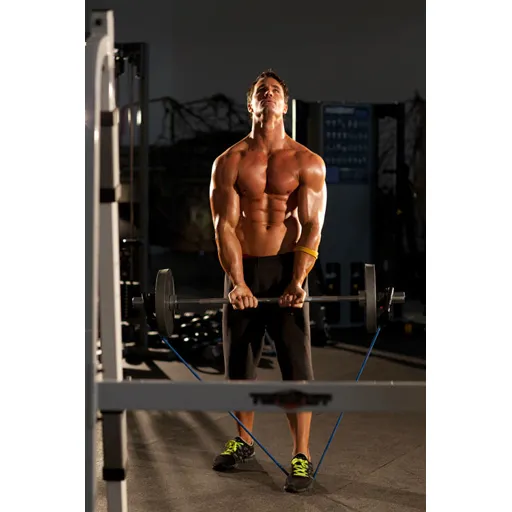
Back Flyes - With Bands

Back Flyes - With Bands

Vai — Dây kháng lực

Hướng dẫn & lỗi thường gặp EN
  1. Run a band around a stationary post like that of a squat rack.
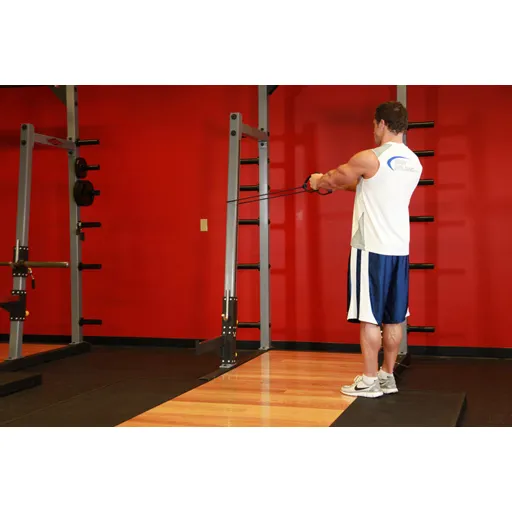
  2. Grab the band by the handles and stand back so that the tension in the band rises.
  3. Extend and lift the arms straight in front of you. Tip: Your arms should be straight and parallel to the floor while perpendicular to your torso. Your feet should be firmly planted on the floor spread at shoulder width. This will be your starting position.
  4. As you exhale, move your arms to the sides and back. Keep your arms extended and parallel to the floor. Continue the movement until the arms are extended to your sides.
  5. After a pause, go back to the original position as you inhale.
  6. Repeat for the recommended amount of repetitions.

Lỗi thường gặp

  • Vai hạ thấp, không shrug lên gần tai khi đẩy hoặc nâng.
  • Khuỷu theo hướng tự nhiên của khớp, không khóa cứng ở đỉnh.
Ball Leg Curl

Ball Leg Curl

Đùi sau — Bóng tập

Hướng dẫn & lỗi thường gặp EN
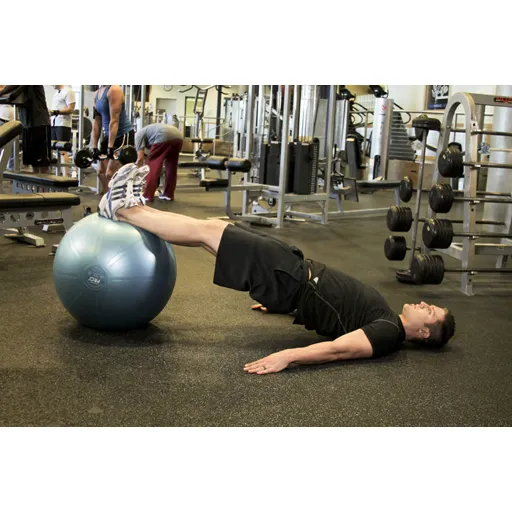
  1. Begin on the floor laying on your back with your feet on top of the ball.
  2. Position the ball so that when your legs are extended your ankles are on top of the ball. This will be your starting position.
  3. Raise your hips off of the ground, keeping your weight on the shoulder blades and your feet.
  4. Flex the knees, pulling the ball as close to you as you can, contracting the hamstrings.
  5. After a brief pause, return to the starting position.

Lỗi thường gặp

  • Gập người bằng hông, lưng trung tính — không cong lưng để tạ đi xa hơn.
  • Siết đùi sau ở đỉnh rồi hạ xuống bằng kiểm soát.
Band Hip Adductions

Band Hip Adductions

adductors — Dây kháng lực

Hướng dẫn & lỗi thường gặp EN
  1. Anchor a band around a solid post or other object.
  2. Stand with your left side to the post, and put your right foot through the band, getting it around the ankle.
  3. Stand up straight and hold onto the post if needed. This will be your starting position.
  4. Keeping the knee straight, raise your right legs out to the side as far as you can.
  5. Return to the starting position and repeat for the desired rep count.
  6. Switch sides.

Lỗi thường gặp

  • Ưu tiên biên độ đầy đủ và nhịp chậm đều trước khi tăng tạ.
  • Giữ thân người ổn định, khu vực đang tập mới là nơi di chuyển chính.
Band Pull Apart

Band Pull Apart

Vai — Dây kháng lực

Hướng dẫn & lỗi thường gặp EN
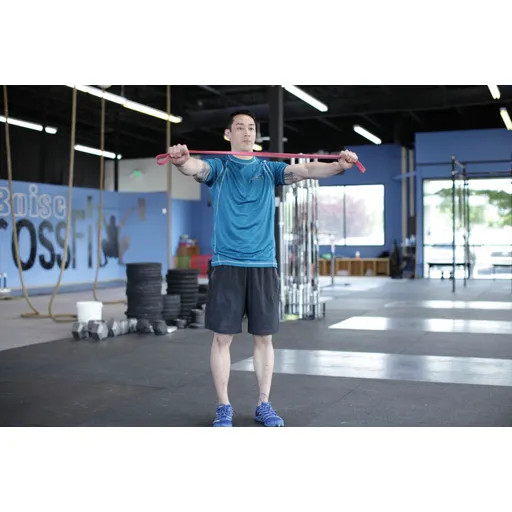
  1. Begin with your arms extended straight out in front of you, holding the band with both hands.
  2. Initiate the movement by performing a reverse fly motion, moving your hands out laterally to your sides.
  3. Keep your elbows extended as you perform the movement, bringing the band to your chest. Ensure that you keep your shoulders back during the exercise.
  4. Pause as you complete the movement, returning to the starting position under control.

Lỗi thường gặp

  • Vai hạ thấp, không shrug lên gần tai khi đẩy hoặc nâng.
  • Khuỷu theo hướng tự nhiên của khớp, không khóa cứng ở đỉnh.
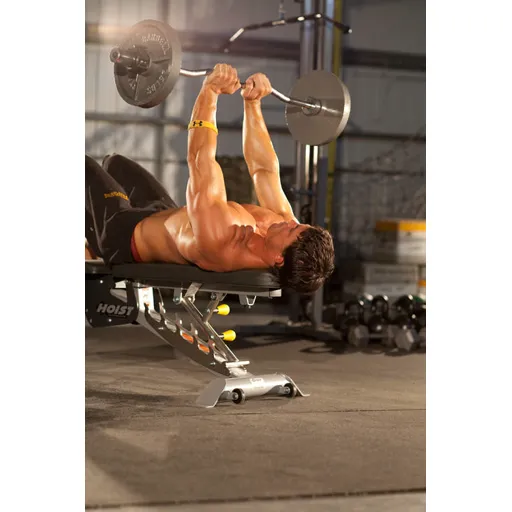
Band Skull Crusher

Band Skull Crusher

Tay sau — Dây kháng lực

Hướng dẫn & lỗi thường gặp EN
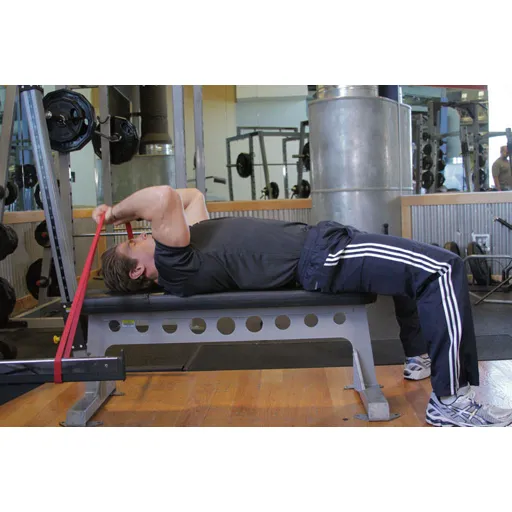
  1. Secure a band to the base of a rack or the bench. Lay on the bench so that the band is lined up with your head.
  2. Take hold of the band, raising your elbows so that the upper arm is perpendicular to the floor. With the elbow flexed, the band should be above your head. This will be your starting position.
  3. Extend through the elbow to straighten your arm, keeping your upper arm in place. Pause at the top of the motion, and return to the starting position.

Lỗi thường gặp

  • Khuỷu giữ một điểm cố định, phần còn lại của cánh tay không di chuyển.
  • Duỗi hết ở đỉnh, siết tay sau rồi hạ chậm.
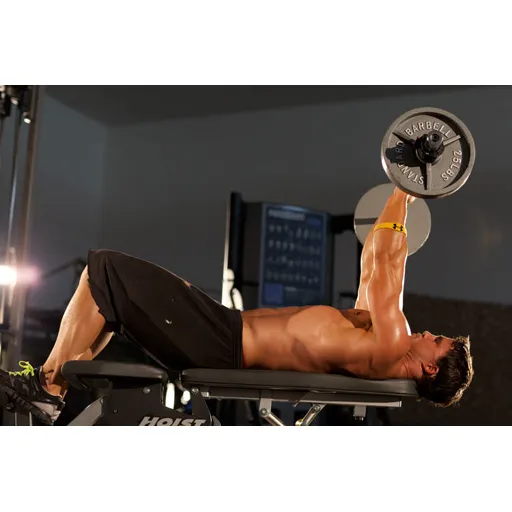
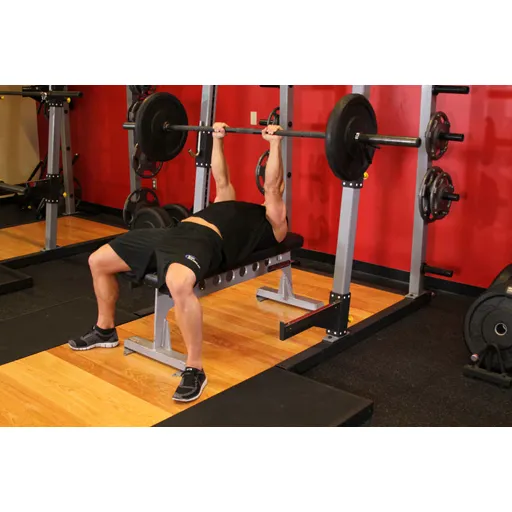
Đẩy ngực với tạ đòn

Đẩy ngực với tạ đòn

Ngực — Tạ đòn

Hướng dẫn & lỗi thường gặp EN
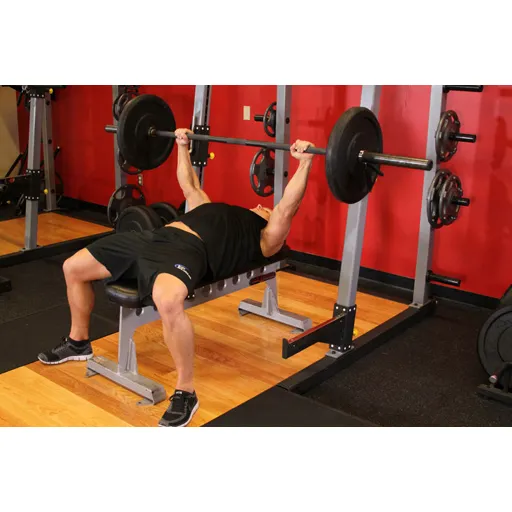
  1. Lie back on a flat bench. Using a medium width grip (a grip that creates a 90-degree angle in the middle of the movement between the forearms and the upper arms), lift the bar from the rack and hold it straight over you with your arms locked. This will be your starting position.
  2. From the starting position, breathe in and begin coming down slowly until the bar touches your middle chest.
  3. After a brief pause, push the bar back to the starting position as you breathe out. Focus on pushing the bar using your chest muscles. Lock your arms and squeeze your chest in the contracted position at the top of the motion, hold for a second and then start coming down slowly again. Tip: Ideally, lowering the weight should take about twice as long as raising it.
  4. Repeat the movement for the prescribed amount of repetitions.
  5. When you are done, place the bar back in the rack.

Lỗi thường gặp

  • Khuỷu khoảng 45° so với thân, không bung ngang vai gây áp lực khớp vai.
  • Đẩy hết cỡ nhưng giữ mông và vai trên bám ghế, không ưỡn hông quá mức.
  • Hạ tạ xuống giữa ngực, không để tạ nảy lên ngực.
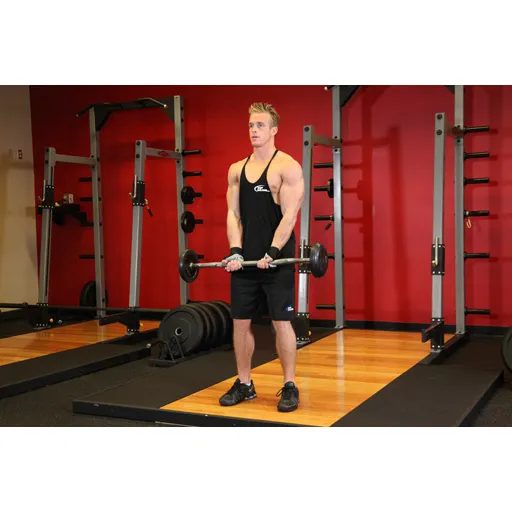
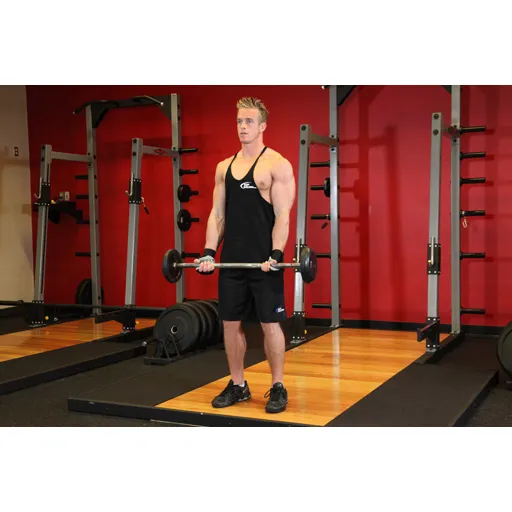
Cuộn tay với tạ đòn

Cuộn tay với tạ đòn

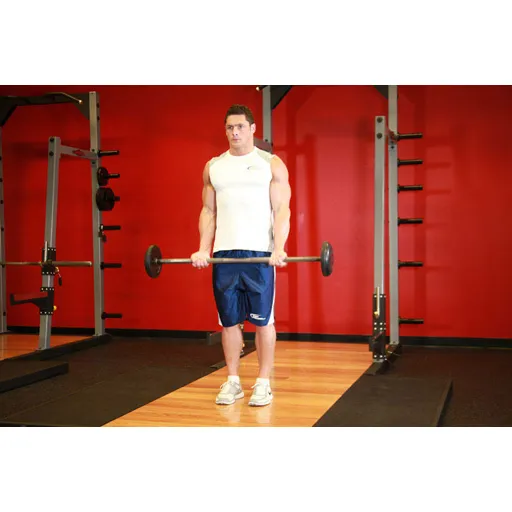
Tay trước — Tạ đòn

Hướng dẫn & lỗi thường gặp EN
  1. Stand up with your torso upright while holding a barbell at a shoulder-width grip. The palm of your hands should be facing forward and the elbows should be close to the torso. This will be your starting position.
  2. While holding the upper arms stationary, curl the weights forward while contracting the biceps as you breathe out. Tip: Only the forearms should move.
  3. Continue the movement until your biceps are fully contracted and the bar is at shoulder level. Hold the contracted position for a second and squeeze the biceps hard.
  4. Slowly begin to bring the bar back to starting position as your breathe in.
  5. Repeat for the recommended amount of repetitions.

Lỗi thường gặp

  • Thân người đứng thẳng, không đung đưa hông để nối lực khi tạ nặng.
  • Cuộn hết biên độ, siết tay trước ở đỉnh rồi mới hạ chậm.
Barbell Curls Lying Against An Incline

Barbell Curls Lying Against An Incline

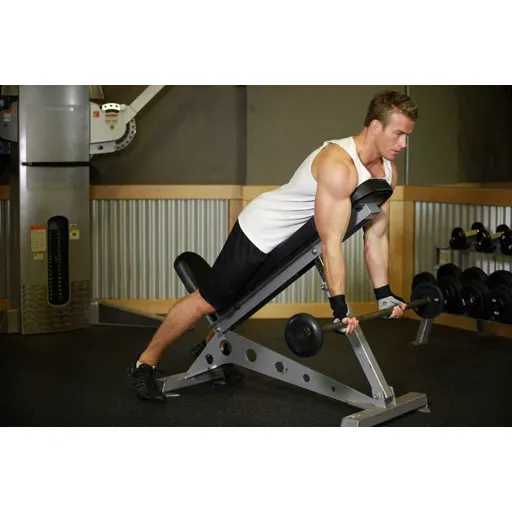
Tay trước — Tạ đòn

Hướng dẫn & lỗi thường gặp EN
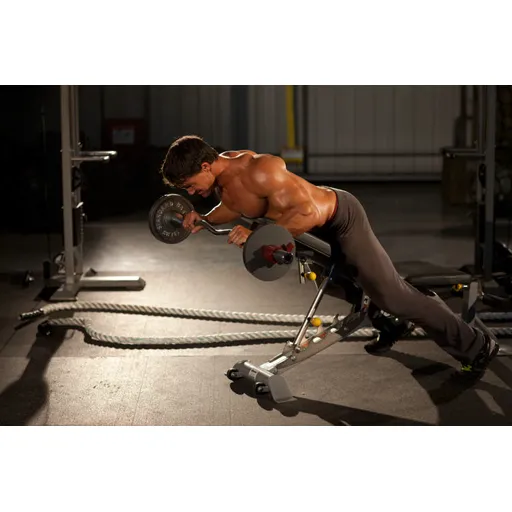
  1. Lie against an incline bench, with your arms holding a barbell and hanging down in a horizontal line. This will be your starting position.
  2. While keeping the upper arms stationary, curl the weight up as high as you can while squeezing the biceps. Breathe out as you perform this portion of the movement. Tip: Only the forearms should move. Do not swing the arms.
  3. After a second contraction, slowly go back to the starting position as you inhale. Tip: Make sure that you go all of the way down.
  4. Repeat for the recommended amount of repetitions.

Lỗi thường gặp

  • Khuỷu cố định sát thân, không đưa vai hoặc thân người vào nối lực.
  • Hạ tạ chậm bằng kiểm soát, không thả tay theo trọng lực.
Barbell Deadlift

Barbell Deadlift

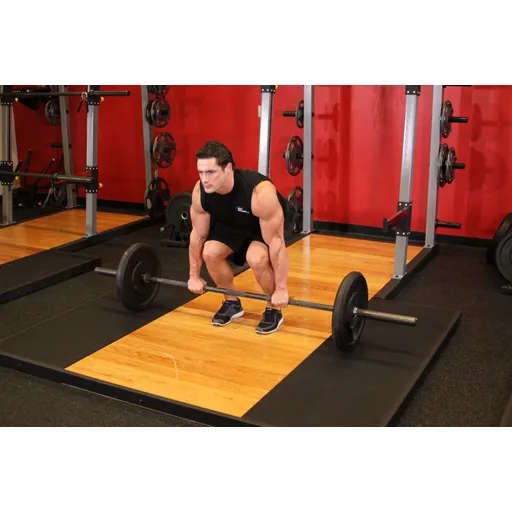
Lưng dưới — Tạ đòn

Hướng dẫn & lỗi thường gặp EN
  1. Stand in front of a loaded barbell.
  2. While keeping the back as straight as possible, bend your knees, bend forward and grasp the bar using a medium (shoulder width) overhand grip. This will be the starting position of the exercise. Tip: If it is difficult to hold on to the bar with this grip, alternate your grip or use wrist straps.
  3. While holding the bar, start the lift by pushing with your legs while simultaneously getting your torso to the upright position as you breathe out. In the upright position, stick your chest out and contract the back by bringing the shoulder blades back. Think of how the soldiers in the military look when they are in standing in attention.
  4. Go back to the starting position by bending at the knees while simultaneously leaning the torso forward at the waist while keeping the back straight. When the weights on the bar touch the floor you are back at the starting position and ready to perform another repetition.
  5. Perform the amount of repetitions prescribed in the program.

Lỗi thường gặp

  • Lưng giữ trung tính suốt cử động, chuyển động đến từ hông.
  • Trọng lượng nhẹ trước, làm đúng hình dáng rồi mới tăng tạ.
Hip thrust tạ đòn

Hip thrust tạ đòn

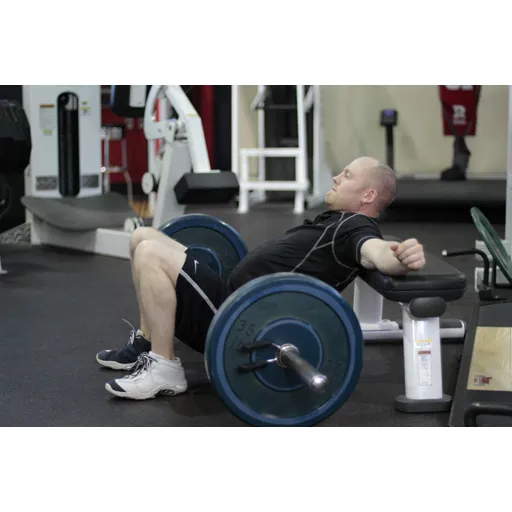
Mông — Tạ đòn

Hướng dẫn & lỗi thường gặp EN
  1. Begin seated on the ground with a bench directly behind you. Have a loaded barbell over your legs. Using a fat bar or having a pad on the bar can greatly reduce the discomfort caused by this exercise.
  2. Roll the bar so that it is directly above your hips, and lean back against the bench so that your shoulder blades are near the top of it.
  3. Begin the movement by driving through your feet, extending your hips vertically through the bar. Your weight should be supported by your shoulder blades and your feet. Extend as far as possible, then reverse the motion to return to the starting position.

Lỗi thường gặp

  • Siết mông ở đỉnh, không ưỡn lưng dưới thay cho việc siết mông.
  • Cằm hơi gập, nhìn về đầu gối để giữ cột sống trung tính.
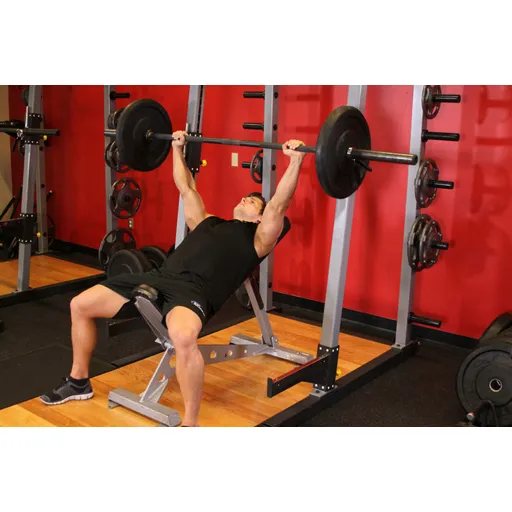
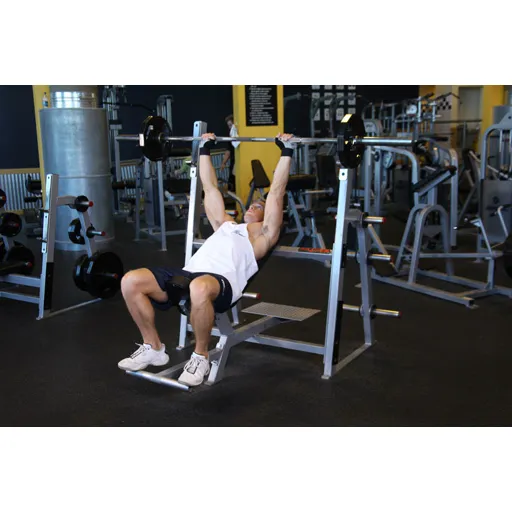
Barbell Incline Bench Press - Medium Grip

Barbell Incline Bench Press - Medium Grip

Ngực — Tạ đòn

Hướng dẫn & lỗi thường gặp EN
  1. Lie back on an incline bench. Using a medium-width grip (a grip that creates a 90-degree angle in the middle of the movement between the forearms and the upper arms), lift the bar from the rack and hold it straight over you with your arms locked. This will be your starting position.
  2. As you breathe in, come down slowly until you feel the bar on you upper chest.
  3. After a second pause, bring the bar back to the starting position as you breathe out and push the bar using your chest muscles. Lock your arms in the contracted position, squeeze your chest, hold for a second and then start coming down slowly again. Tip: it should take at least twice as long to go down than to come up.
  4. Repeat the movement for the prescribed amount of repetitions.
  5. When you are done, place the bar back in the rack.

Lỗi thường gặp

  • Khuỷu ~45° so với thân, hạ tạ tới giữa ngực theo kiểm soát.
  • Lưng và vai trên bám ghế, không ưỡn hông để nối lực.
Barbell Incline Shoulder Raise

Barbell Incline Shoulder Raise

Vai — Tạ đòn

Hướng dẫn & lỗi thường gặp EN
  1. Lie back on an Incline Bench. Using a medium width grip (a grip that is slightly wider than shoulder width), lift the bar from the rack and hold it straight over you with your arms straight. This will be your starting position.
  2. While keeping the arms straight, lift the bar by protracting your shoulder blades, raising the shoulders from the bench as you breathe out.
  3. Bring back the bar to the starting position as you breathe in.
  4. Repeat for the recommended amount of repetitions.

Lỗi thường gặp

  • Vai hạ thấp, không shrug lên gần tai khi đẩy hoặc nâng.
  • Khuỷu theo hướng tự nhiên của khớp, không khóa cứng ở đỉnh.
Barbell Rear Delt Row

Barbell Rear Delt Row

Vai — Tạ đòn

Hướng dẫn & lỗi thường gặp EN
  1. Stand up straight while holding a barbell using a wide (higher than shoulder width) and overhand (palms facing your body) grip.
  2. Bend knees slightly and bend over as you keep the natural arch of your back. Let the arms hang in front of you as they hold the bar. Once your torso is parallel to the floor, flare the elbows out and away from your body. Tip: Your torso and your arms should resemble the letter "T". Now you are ready to begin the exercise.
  3. While keeping the upper arms perpendicular to the torso, pull the barbell up towards your upper chest as you squeeze the rear delts and you breathe out. Tip: When performed correctly, this exercise should resemble a bench press in reverse. Also, refrain from using your biceps to do the work. Focus on targeting the rear delts; the arms should only act as hooks.
  4. Slowly go back to the initial position as you breathe in.
  5. Repeat for the recommended amount of repetitions.

Lỗi thường gặp

  • Vai hạ thấp, không shrug lên gần tai khi đẩy hoặc nâng.
  • Khuỷu theo hướng tự nhiên của khớp, không khóa cứng ở đỉnh.
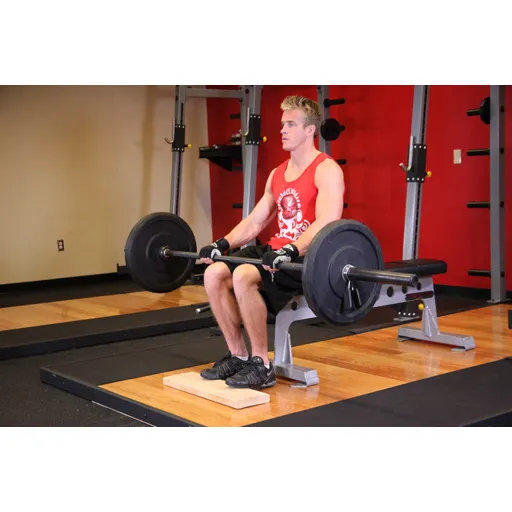
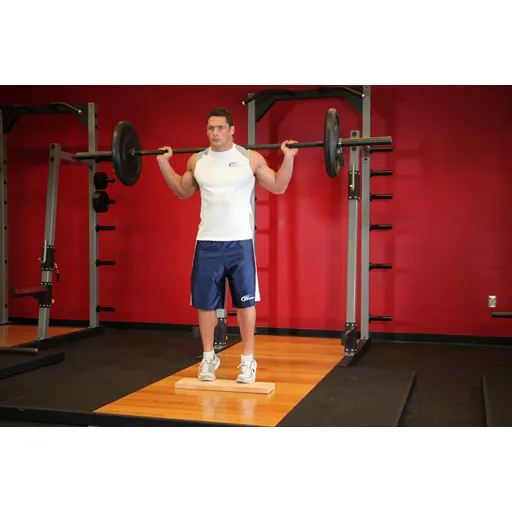
Barbell Seated Calf Raise

Barbell Seated Calf Raise

Bắp chân — Tạ đòn

Hướng dẫn & lỗi thường gặp EN
  1. Place a block about 12 inches in front of a flat bench.
  2. Sit on the bench and place the ball of your feet on the block.
  3. Have someone place a barbell over your upper thighs about 3 inches above your knees and hold it there. This will be your starting position.
  4. Raise up on your toes as high as possible as you squeeze the calves and as you breathe out.
  5. After a second contraction, slowly go back to the starting position. Tip: To get maximum benefit stretch your calves as far as you can.
  6. Repeat for the recommended amount of repetitions.

Lỗi thường gặp

  • Biên độ đầy đủ: hạ gót sâu, nâng cao nhất ở đỉnh, dừng ngắn ở hai đầu.
  • Di chuyển chậm đều, tránh bật nhịp theo quán tính.
Barbell Shrug

Barbell Shrug

Vai - thang — Tạ đòn

Hướng dẫn & lỗi thường gặp EN
  1. Stand up straight with your feet at shoulder width as you hold a barbell with both hands in front of you using a pronated grip (palms facing the thighs). Tip: Your hands should be a little wider than shoulder width apart. You can use wrist wraps for this exercise for a better grip. This will be your starting position.
  2. Raise your shoulders up as far as you can go as you breathe out and hold the contraction for a second. Tip: Refrain from trying to lift the barbell by using your biceps.
  3. Slowly return to the starting position as you breathe in.
  4. Repeat for the recommended amount of repetitions.

Lỗi thường gặp

  • Ưu tiên biên độ đầy đủ và nhịp chậm đều trước khi tăng tạ.
  • Giữ thân người ổn định, khu vực đang tập mới là nơi di chuyển chính.
Barbell Shrug Behind The Back

Barbell Shrug Behind The Back

Vai - thang — Tạ đòn

Hướng dẫn & lỗi thường gặp EN
  1. Stand up straight with your feet at shoulder width as you hold a barbell with both hands behind your back using a pronated grip (palms facing back). Tip: Your hands should be a little wider than shoulder width apart. You can use wrist wraps for this exercise for better grip. This will be your starting position.
  2. Raise your shoulders up as far as you can go as you breathe out and hold the contraction for a second. Tip: Refrain from trying to lift the barbell by using your biceps. The arms should remain stretched out at all times.
  3. Slowly return to the starting position as you breathe in.
  4. Repeat for the recommended amount of repetitions.

Lỗi thường gặp

  • Ưu tiên biên độ đầy đủ và nhịp chậm đều trước khi tăng tạ.
  • Giữ thân người ổn định, khu vực đang tập mới là nơi di chuyển chính.
Barbell Side Bend

Barbell Side Bend

Bụng — Tạ đòn

Hướng dẫn & lỗi thường gặp EN
  1. Stand up straight while holding a barbell placed on the back of your shoulders (slightly below the neck). Your feet should be shoulder width apart. This will be your starting position.
  2. While keeping your back straight and your head up, bend only at the waist to the right as far as possible. Breathe in as you bend to the side. Then hold for a second and come back up to the starting position as you exhale. Tip: Keep the rest of the body stationary.
  3. Now repeat the movement but bending to the left instead. Hold for a second and come back to the starting position.
  4. Repeat for the recommended amount of repetitions.

Lỗi thường gặp

  • Gập bằng cơ bụng, không kéo cổ hoặc vung thân người.
  • Thở ra khi gập, lưng dưới ổn định suốt cử động.
Barbell Side Split Squat

Barbell Side Split Squat

Đùi trước — Tạ đòn

Hướng dẫn & lỗi thường gặp EN
  1. Stand up straight while holding a barbell placed on the back of your shoulders (slightly below the neck). Your feet should be placed wide apart with the foot of the lead leg angled out to the side. This will be your starting position.
  2. Lower your body towards the side of your angled foot by bending the knee and hip of your lead leg and while keeping the opposite leg only slightly bent. Breathe in as you lower your body.
  3. Return to the starting position by extending the hip and knee of the lead leg. Breathe out as you perform this movement.
  4. After performing the recommended amount of reps, repeat the movement with the opposite leg.

Lỗi thường gặp

  • Đầu gối đi cùng hướng mũi chân, không gập vào trong.
  • Hạ chậm, không bật nảy ở đáy; gót (hoặc đệm) bám chắc suốt cú đẩy.
Squat tạ đòn

Squat tạ đòn

Đùi trước — Tạ đòn

Hướng dẫn & lỗi thường gặp EN
  1. This exercise is best performed inside a squat rack for safety purposes. To begin, first set the bar on a rack to just below shoulder level. Once the correct height is chosen and the bar is loaded, step under the bar and place the back of your shoulders (slightly below the neck) across it.
  2. Hold on to the bar using both arms at each side and lift it off the rack by first pushing with your legs and at the same time straightening your torso.
  3. Step away from the rack and position your legs using a shoulder width medium stance with the toes slightly pointed out. Keep your head up at all times and also maintain a straight back. This will be your starting position. (Note: For the purposes of this discussion we will use the medium stance described above which targets overall development; however you can choose any of the three stances discussed in the foot stances section).
  4. Begin to slowly lower the bar by bending the knees and hips as you maintain a straight posture with the head up. Continue down until the angle between the upper leg and the calves becomes slightly less than 90-degrees. Inhale as you perform this portion of the movement. Tip: If you performed the exercise correctly, the front of the knees should make an imaginary straight line with the toes that is perpendicular to the front. If your knees are past that imaginary line (if they are past your toes) then you are placing undue stress on the knee and the exercise has been performed incorrectly.
  5. Begin to raise the bar as you exhale by pushing the floor with the heel of your foot as you straighten the legs again and go back to the starting position.
  6. Repeat for the recommended amount of repetitions.

Lỗi thường gặp

  • Thanh tạ nằm cân trên vai trên, gông gối là lỗi phổ biến nhất — đầu gối cùng hướng mũi chân.
  • Ngực mở, lưng trung tính, không đổ người về trước quá sớm.
Barbell Walking Lunge

Barbell Walking Lunge

Đùi trước — Tạ đòn

Hướng dẫn & lỗi thường gặp EN
  1. Begin standing with your feet shoulder width apart and a barbell across your upper back.
  2. Step forward with one leg, flexing the knees to drop your hips. Descend until your rear knee nearly touches the ground. Your posture should remain upright, and your front knee should stay above the front foot.
  3. Drive through the heel of your lead foot and extend both knees to raise yourself back up.
  4. Step forward with your rear foot, repeating the lunge on the opposite leg.

Lỗi thường gặp

  • Đầu gối đi cùng hướng mũi chân, không gập vào trong.
  • Hạ chậm, không bật nảy ở đáy; gót (hoặc đệm) bám chắc suốt cú đẩy.
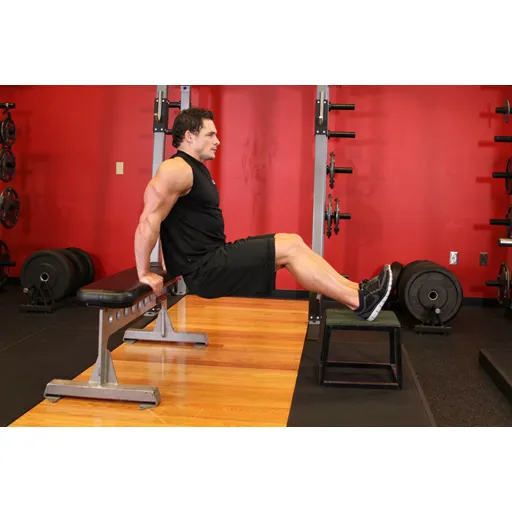
Chống đẩy tay sau trên ghế

Chống đẩy tay sau trên ghế

Tay sau — Không tạ

Hướng dẫn & lỗi thường gặp EN
  1. For this exercise you will need to place a bench behind your back. With the bench perpendicular to your body, and while looking away from it, hold on to the bench on its edge with the hands fully extended, separated at shoulder width. The legs will be extended forward, bent at the waist and perpendicular to your torso. This will be your starting position.
  2. Slowly lower your body as you inhale by bending at the elbows until you lower yourself far enough to where there is an angle slightly smaller than 90 degrees between the upper arm and the forearm. Tip: Keep the elbows as close as possible throughout the movement. Forearms should always be pointing down.
  3. Using your triceps to bring your torso up again, lift yourself back to the starting position.
  4. Repeat for the recommended amount of repetitions.

Lỗi thường gặp

  • Khuỷu giữ hướng ra sau, không bung ngang gây căng vai.
  • Hạ tới khi khuỷu ~90°, đủ sâu mà vai không bị kéo về trước quá mức.
Bench Press - With Bands

Bench Press - With Bands

Ngực — Dây kháng lực

Hướng dẫn & lỗi thường gặp EN
  1. Using a flat bench secure a band under the leg of the bench that is nearest to your head.
  2. Once the band is secure, grab it by both handles and lie down on the bench.
  3. Extend your arms so that you are holding the band handles in front of you at shoulder width.
  4. Once at shoulder width, rotate your wrists forward so that the palms of your hands are facing away from you. This will be your starting position.
  5. Bring down the handles slowly until your elbow forms a 90 degree angle. Keep full control at all times.
  6. As you breathe out, bring the handles up using your pectoral muscles. Lock your arms in the contracted position, squeeze your chest, hold for a second and then start coming down slowly. Tip: It should take at least twice as long to go down than to come up.
  7. Repeat the movement for the prescribed amount of repetitions of your training program.

Lỗi thường gặp

  • Khuỷu ~45° so với thân, hạ tạ tới giữa ngực theo kiểm soát.
  • Lưng và vai trên bám ghế, không ưỡn hông để nối lực.
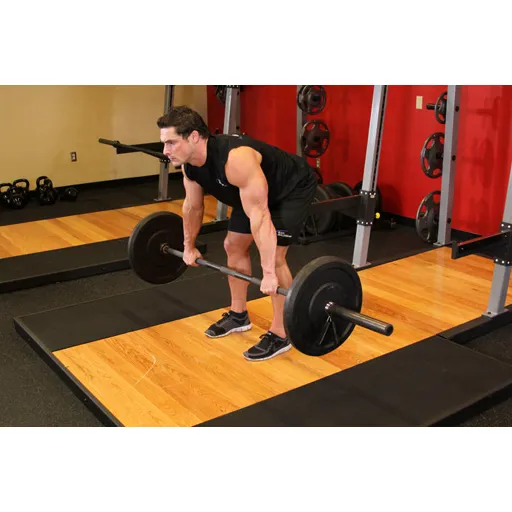
Kéo tạ đòn nghiêng người

Kéo tạ đòn nghiêng người

Lưng giữa — Tạ đòn

Hướng dẫn & lỗi thường gặp EN
  1. Holding a barbell with a pronated grip (palms facing down), bend your knees slightly and bring your torso forward, by bending at the waist, while keeping the back straight until it is almost parallel to the floor. Tip: Make sure that you keep the head up. The barbell should hang directly in front of you as your arms hang perpendicular to the floor and your torso. This is your starting position.
  2. Now, while keeping the torso stationary, breathe out and lift the barbell to you. Keep the elbows close to the body and only use the forearms to hold the weight. At the top contracted position, squeeze the back muscles and hold for a brief pause.
  3. Then inhale and slowly lower the barbell back to the starting position.
  4. Repeat for the recommended amount of repetitions.

Lỗi thường gặp

  • Gập người ~45° và giữ nguyên thế, không đứng dậy khi kéo tạ.
  • Kéo tạ về vùng bụng dưới, không kéo lên ngực làm hoạt động vai nhiều hơn lưng.
Bent Over Dumbbell Rear Delt Raise With Head On Bench

Bent Over Dumbbell Rear Delt Raise With Head On Bench

Vai — Tạ tay

Hướng dẫn & lỗi thường gặp EN
  1. Stand up straight while holding a dumbbell in each hand and with an incline bench in front of you.
  2. While keeping your back straight and maintaining the natural arch of your back, lean forward until your forehead touches the bench in front of you. Let the arms hang in front of you perpendicular to the ground. The palms of your hands should be facing each other and your torso should be parallel to the floor. This will be your starting position.
  3. Keeping your torso forward and stationary, and the arms straight with a slight bend at the elbows, lift the dumbbells straight to the side until both arms are parallel to the floor. Exhale as you lift the weights. Caution: avoid swinging the torso or bringing the arms back as opposed to the side.
  4. After a one second contraction at the top, slowly lower the dumbbells back to the starting position.
  5. Repeat the recommended amount of repetitions.

Lỗi thường gặp

  • Vai hạ thấp, không shrug lên gần tai khi đẩy hoặc nâng.
  • Khuỷu theo hướng tự nhiên của khớp, không khóa cứng ở đỉnh.
Bent Over Low-Pulley Side Lateral

Bent Over Low-Pulley Side Lateral

Vai — Cáp

Hướng dẫn & lỗi thường gặp EN
  1. Select a weight and hold the handle of the low pulley with your right hand.
  2. Bend at the waist until your torso is nearly parallel to the floor. Your legs should be slightly bent with your left hand placed on your lower left thigh. Your right arm should be hanging from your shoulder in front of you and with a slight bend at the elbow. This will be your starting position.
  3. Raise your right arm, elbow slightly bent, to the side until the arm is parallel to the floor and in line with your right ear. Breathe out as you perform this step.
  4. Slowly lower the weight back to the starting position as you breathe in.
  5. Repeat for the recommended amount of repetitions and repeat the movement with the other arm.

Lỗi thường gặp

  • Vai hạ thấp, không shrug lên gần tai khi đẩy hoặc nâng.
  • Khuỷu theo hướng tự nhiên của khớp, không khóa cứng ở đỉnh.
Bent Over One-Arm Long Bar Row

Bent Over One-Arm Long Bar Row

Lưng giữa — Tạ đòn

Hướng dẫn & lỗi thường gặp EN
  1. Put weight on one of the ends of an Olympic barbell. Make sure that you either place the other end of the barbell in the corner of two walls; or put a heavy object on the ground so the barbell cannot slide backward.
  2. Bend forward until your torso is as close to parallel with the floor as you can and keep your knees slightly bent.
  3. Now grab the bar with one arm just behind the plates on the side where the weight was placed and put your other hand on your knee. This will be your starting position.
  4. Pull the bar straight up with your elbow in (to maximize back stimulation) until the plates touch your lower chest. Squeeze the back muscles as you lift the weight up and hold for a second at the top of the movement. Breathe out as you lift the weight. Tip: Do not allow for any swinging of the torso. Only the arm should move.
  5. Slowly lower the bar to the starting position getting a nice stretch on the lats. Tip: Do not let the plates touch the floor. To ensure the best range of motion, I recommend using small plates (25-lb ones) as opposed to larger plates (like 35-45lb ones).
  6. Repeat for the recommended amount of repetitions and switch arms.

Lỗi thường gặp

  • Kéo về bụng dưới, khuỷu sát thân, vai hạ thấp.
  • Thân người giữ gập ổn định, không đứng dậy theo mỗi lần kéo.
Kéo tạ tay nghiêng người

Kéo tạ tay nghiêng người

Lưng giữa — Tạ tay

Hướng dẫn & lỗi thường gặp EN
  1. With a dumbbell in each hand (palms facing your torso), bend your knees slightly and bring your torso forward by bending at the waist; as you bend make sure to keep your back straight until it is almost parallel to the floor. Tip: Make sure that you keep the head up. The weights should hang directly in front of you as your arms hang perpendicular to the floor and your torso. This is your starting position.
  2. While keeping the torso stationary, lift the dumbbells to your side (as you breathe out), keeping the elbows close to the body (do not exert any force with the forearm other than holding the weights). On the top contracted position, squeeze the back muscles and hold for a second.
  3. Slowly lower the weight again to the starting position as you inhale.
  4. Repeat for the recommended amount of repetitions.

Lỗi thường gặp

  • Lưng song song hoặc trên sàn 45°, giữ ổn định — không giật thân người mỗi lần kéo.
  • Hai tay kéo đều nhịp, không kéo lệch tay mạnh hơn.
Bent Over Two-Dumbbell Row With Palms In

Bent Over Two-Dumbbell Row With Palms In

Lưng giữa — Tạ tay

Hướng dẫn & lỗi thường gặp EN
  1. With a dumbbell in each hand (palms facing each other), bend your knees slightly and bring your torso forward, by bending at the waist, while keeping the back straight until it is almost parallel to the floor. Tip: Make sure that you keep the head up. The weights should hang directly in front of you as your arms hang perpendicular to the floor and your torso. This is your starting position.
  2. While keeping the torso stationary, lift the dumbbells to your side as you breathe out, squeezing your shoulder blades together. On the top contracted position, squeeze the back muscles and hold for a second.
  3. Slowly lower the weight again to the starting position as you inhale.
  4. Repeat for the recommended amount of repetitions.

Lỗi thường gặp

  • Kéo về bụng dưới, khuỷu sát thân, vai hạ thấp.
  • Thân người giữ gập ổn định, không đứng dậy theo mỗi lần kéo.
Bent-Arm Barbell Pullover

Bent-Arm Barbell Pullover

Lưng (cơ lưng rộng) — Tạ đòn

Hướng dẫn & lỗi thường gặp EN
  1. Lie on a flat bench with a barbell using a shoulder grip width.
  2. Hold the bar straight over your chest with a bend in your arms. This will be your starting position.
  3. While keeping your arms in the bent arm position, lower the weight slowly in an arc behind your head while breathing in until you feel a stretch on the chest.
  4. At that point, bring the barbell back to the starting position using the arc through which the weight was lowered and exhale as you perform this movement.
  5. Hold the weight on the initial position for a second and repeat the motion for the prescribed number of repetitions.

Lỗi thường gặp

  • Kéo bằng khuỷu xuống về phía hông, không bẻ tay bứt tốc.
  • Ngực mở, vai hạ thấp — không shrug vai khi kéo.
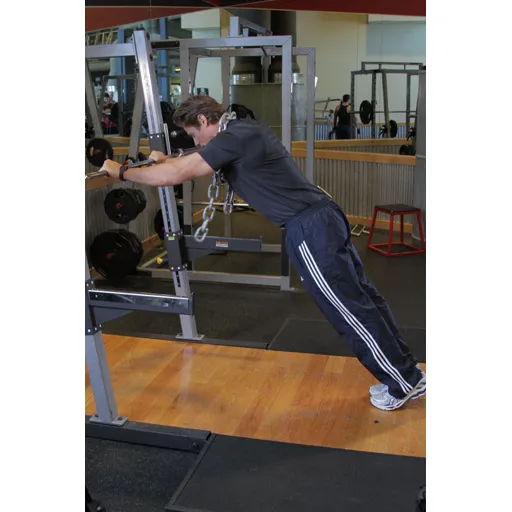
Body Tricep Press

Body Tricep Press

Tay sau — Không tạ

Hướng dẫn & lỗi thường gặp EN
  1. Position a bar in a rack at chest height.
  2. Standing, take a shoulder width grip on the bar and step a yard or two back, feet together and arms extended so that you are leaning on the bar. This will be your starting position.
  3. Begin by flexing the elbow, lowering yourself towards the bar.
  4. Pause, and then reverse the motion by extending the elbows.
  5. Progress from bodyweight by adding chains over your shoulders.

Lỗi thường gặp

  • Khuỷu giữ một điểm cố định, phần còn lại của cánh tay không di chuyển.
  • Duỗi hết ở đỉnh, siết tay sau rồi hạ chậm.
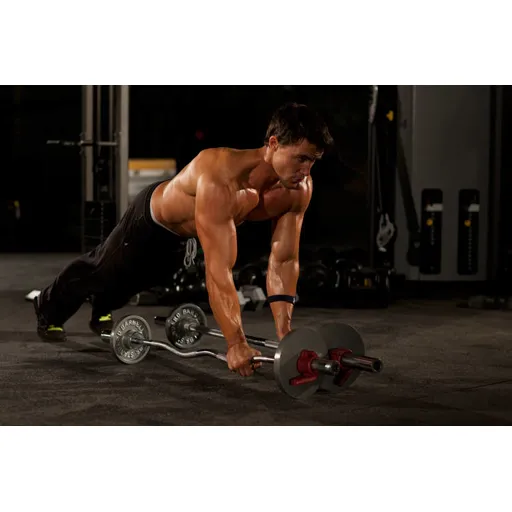
Bodyweight Flyes

Bodyweight Flyes

Ngực — Tạ đòn cong

Hướng dẫn & lỗi thường gặp EN
  1. Position two equally loaded EZ bars on the ground next to each other. Ensure they are able to roll.
  2. Assume a push-up position over the bars, supporting your weight on your toes and hands with your arms extended and body straight.
  3. Place your hands on the bars. This will be your starting position.
  4. Using a slow and controlled motion, move your hands away from the midline of your body, rolling the bars apart. Inhale during this portion of the motion.
  5. After moving the bars as far apart as you can, return to the starting position by pulling them back together. Exhale as you perform this movement.

Lỗi thường gặp

  • Khuỷu ~45° so với thân, hạ tạ tới giữa ngực theo kiểm soát.
  • Lưng và vai trên bám ghế, không ưỡn hông để nối lực.
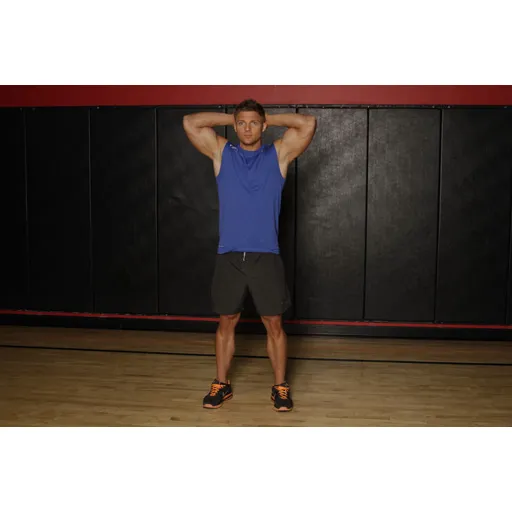
Squat không tạ

Squat không tạ

Đùi trước — Không tạ

Hướng dẫn & lỗi thường gặp EN
  1. Stand with your feet shoulder width apart. You can place your hands behind your head. This will be your starting position.
  2. Begin the movement by flexing your knees and hips, sitting back with your hips.
  3. Continue down to full depth if you are able,and quickly reverse the motion until you return to the starting position. As you squat, keep your head and chest up and push your knees out.

Lỗi thường gặp

  • Đi thấp ít nhất tới đùi song song sàn, không chỉ nhún nhẹ.
  • Cân bằng dồn giữa bàn chân, gót không nhấc lên.
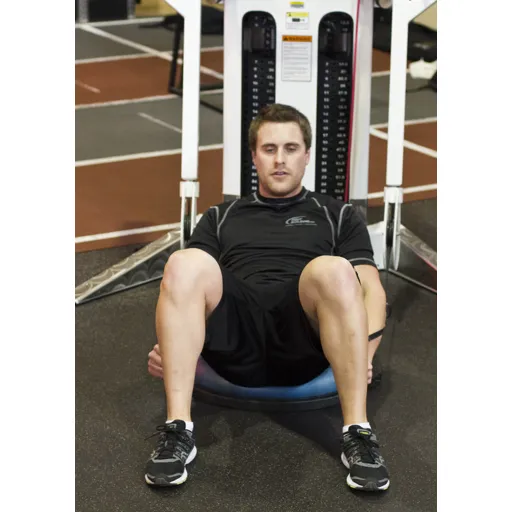
Bosu Ball Cable Crunch With Side Bends

Bosu Ball Cable Crunch With Side Bends

Bụng — Cáp

Hướng dẫn & lỗi thường gặp EN
  1. Connect a standard handle to each arm of a cable machine, and position them in the most downward position.
  2. Grab a Bosu Ball and position it in front and center of the cable machine.
  3. Lie down on the Bosu Ball with the small of your back arched around the ball. Your rear end should be close to the floor without touching it.
  4. With both hands, reach back and grab the handle of each cable.
  5. With your feet positioned in a wide stance, extend your arms straight out in front of you and in between your knees. Your hands should be at knee level.
  6. Keep your arms straight and in-line with the upward angle of the cable. Elevate your torso in a crunching motion without dropping or bending your arms.
  7. Maintain the rigid position with your arms. Slowly descend back to the starting position with your back arched around the Bosu Ball and your abdominals elongated.
  8. Repeat the same series of movements to failure.
  9. Once you reach failure, keep your abs tight and raise your torso into plank position so your back is elevated off the Bosu Ball.
  10. Lower your arms down to your side; keep them straight. Start doing alternating side bends; reach for your heels! This finishing movement will focus on your obliques.

Lỗi thường gặp

  • Gập bằng cơ bụng, không kéo cổ hoặc vung thân người.
  • Thở ra khi gập, lưng dưới ổn định suốt cử động.
Bottoms-Up Clean From The Hang Position

Bottoms-Up Clean From The Hang Position

Cẳng tay — Kettlebell

Hướng dẫn & lỗi thường gặp EN
  1. Initiate the exercise by standing upright with a kettlebell in one hand.
  2. Swing the kettlebell back forcefully and then reverse the motion forcefully. Crush the kettlebell handle as hard as possible and raise the kettlebell to your shoulder.

Lỗi thường gặp

  • Cổ tay giữ trung tính, không gập gập liên tục làm mỏi cẳng tay sớm.
  • Nắm chắc nhưng không siết quá mức làm tê tay.
Butt Lift (Bridge)

Butt Lift (Bridge)

Mông — Không tạ

Hướng dẫn & lỗi thường gặp EN
  1. Lie flat on the floor on your back with the hands by your side and your knees bent. Your feet should be placed around shoulder width. This will be your starting position.
  2. Pushing mainly with your heels, lift your hips off the floor while keeping your back straight. Breathe out as you perform this part of the motion and hold at the top for a second.
  3. Slowly go back to the starting position as you breathe in.

Lỗi thường gặp

  • Siết mông mạnh ở đỉnh chuyển động, không ưỡn lưng dưới thay thế.
  • Chuyển động chậm và hết biên độ, không vung theo quán tính.
Butterfly

Butterfly

Ngực — Máy

Hướng dẫn & lỗi thường gặp EN
  1. Sit on the machine with your back flat on the pad.
  2. Take hold of the handles. Tip: Your upper arms should be positioned parallel to the floor; adjust the machine accordingly. This will be your starting position.
  3. Push the handles together slowly as you squeeze your chest in the middle. Breathe out during this part of the motion and hold the contraction for a second.
  4. Return back to the starting position slowly as you inhale until your chest muscles are fully stretched.
  5. Repeat for the recommended amount of repetitions.

Lỗi thường gặp

  • Khuỷu ~45° so với thân, hạ tạ tới giữa ngực theo kiểm soát.
  • Lưng và vai trên bám ghế, không ưỡn hông để nối lực.
Cable Chest Press

Cable Chest Press

Ngực — Cáp

Hướng dẫn & lỗi thường gặp EN
  1. Adjust the weight to an appropriate amount and be seated, grasping the handles. Your upper arms should be about 45 degrees to the body, with your head and chest up. The elbows should be bent to about 90 degrees. This will be your starting position.
  2. Begin by extending through the elbow, pressing the handles together straight in front of you. Keep your shoulder blades retracted as you execute the movement.
  3. After pausing at full extension, return to th starting position, keeping tension on the cables.
  4. You can also execute this movement with your back off the pad, at an incline or decline, or alternate hands.

Lỗi thường gặp

  • Khuỷu ~45° so với thân, hạ tạ tới giữa ngực theo kiểm soát.
  • Lưng và vai trên bám ghế, không ưỡn hông để nối lực.
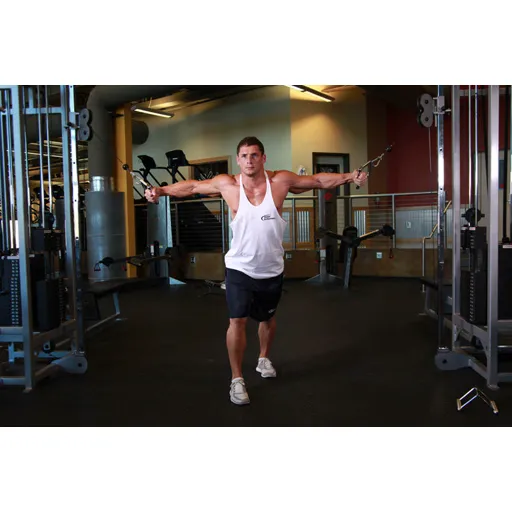
Cable Crossover

Cable Crossover

Ngực — Cáp

Hướng dẫn & lỗi thường gặp EN
  1. To get yourself into the starting position, place the pulleys on a high position (above your head), select the resistance to be used and hold the pulleys in each hand.
  2. Step forward in front of an imaginary straight line between both pulleys while pulling your arms together in front of you. Your torso should have a small forward bend from the waist. This will be your starting position.
  3. With a slight bend on your elbows in order to prevent stress at the biceps tendon, extend your arms to the side (straight out at both sides) in a wide arc until you feel a stretch on your chest. Breathe in as you perform this portion of the movement. Tip: Keep in mind that throughout the movement, the arms and torso should remain stationary; the movement should only occur at the shoulder joint.
  4. Return your arms back to the starting position as you breathe out. Make sure to use the same arc of motion used to lower the weights.
  5. Hold for a second at the starting position and repeat the movement for the prescribed amount of repetitions.

Lỗi thường gặp

  • Khuỷu ~45° so với thân, hạ tạ tới giữa ngực theo kiểm soát.
  • Lưng và vai trên bám ghế, không ưỡn hông để nối lực.
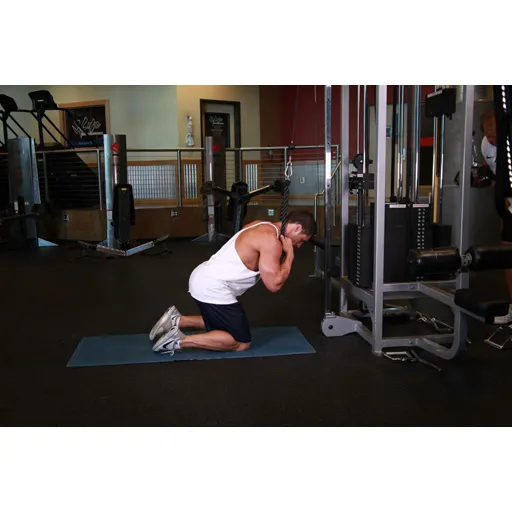
Gập bụng với cáp

Gập bụng với cáp

Bụng — Cáp

Hướng dẫn & lỗi thường gặp EN
  1. Kneel below a high pulley that contains a rope attachment.
  2. Grasp cable rope attachment and lower the rope until your hands are placed next to your face.
  3. Flex your hips slightly and allow the weight to hyperextend the lower back. This will be your starting position.
  4. With the hips stationary, flex the waist as you contract the abs so that the elbows travel towards the middle of the thighs. Exhale as you perform this portion of the movement and hold the contraction for a second.
  5. Slowly return to the starting position as you inhale. Tip: Make sure that you keep constant tension on the abs throughout the movement. Also, do not choose a weight so heavy that the lower back handles the brunt of the work.
  6. Repeat for the recommended amount of repetitions.

Lỗi thường gặp

  • Gập cột sống để cuộn người xuống, không kéo bằng tay hoặc khuỵu hông.
  • Hông giữ cố định, chỉ phần thân trên gập xuống.
Cable Deadlifts

Cable Deadlifts

Đùi trước — Cáp

Hướng dẫn & lỗi thường gặp EN
  1. Move the cables to the bottom of the towers and select an appropriate weight. Stand directly in between the uprights.
  2. To begin, squat down be flexing your hips and knees until you can reach the handles.
  3. After grasping them, begin your ascent. Driving through your heels extend your hips and knees keeping your hands hanging at your side. Keep your head and chest up throughout the movement.
  4. After reaching a full standing position, Return to the starting position and repeat.

Lỗi thường gặp

  • Đầu gối đi cùng hướng mũi chân, không gập vào trong.
  • Hạ chậm, không bật nảy ở đáy; gót (hoặc đệm) bám chắc suốt cú đẩy.
Cable Hammer Curls - Rope Attachment

Cable Hammer Curls - Rope Attachment

Tay trước — Cáp

Hướng dẫn & lỗi thường gặp EN
  1. Attach a rope attachment to a low pulley and stand facing the machine about 12 inches away from it.
  2. Grasp the rope with a neutral (palms-in) grip and stand straight up keeping the natural arch of the back and your torso stationary.
  3. Put your elbows in by your side and keep them there stationary during the entire movement. Tip: Only the forearms should move; not your upper arms. This will be your starting position.
  4. Using your biceps, pull your arms up as you exhale until your biceps touch your forearms. Tip: Remember to keep the elbows in and your upper arms stationary.
  5. After a 1 second contraction where you squeeze your biceps, slowly start to bring the weight back to the original position.
  6. Repeat for the recommended amount of repetitions.

Lỗi thường gặp

  • Khuỷu cố định sát thân, không đưa vai hoặc thân người vào nối lực.
  • Hạ tạ chậm bằng kiểm soát, không thả tay theo trọng lực.
Cable Hip Adduction

Cable Hip Adduction

Đùi trước — Cáp

Hướng dẫn & lỗi thường gặp EN
  1. Stand in front of a low pulley facing forward with one leg next to the pulley and the other one away.
  2. Attach the ankle cuff to the cable and also to the ankle of the leg that is next to the pulley.
  3. Now step out and away from the stack with a wide stance and grasp the bar of the pulley system.
  4. Stand on the foot that does not have the ankle cuff (the far foot) and allow the leg with the cuff to be pulled towards the low pulley. This will be your starting position.
  5. Now perform the movement by moving the leg with the ankle cuff in front of the far leg by using the inner thighs to abduct the hip. Breathe out during this portion of the movement.
  6. Slowly return to the starting position as you breathe in.
  7. Repeat for the recommended amount of repetitions and then repeat the same movement with the opposite leg.

Lỗi thường gặp

  • Đầu gối đi cùng hướng mũi chân, không gập vào trong.
  • Hạ chậm, không bật nảy ở đáy; gót (hoặc đệm) bám chắc suốt cú đẩy.
Cable Incline Pushdown

Cable Incline Pushdown

Lưng (cơ lưng rộng) — Cáp

Hướng dẫn & lỗi thường gặp EN
  1. Lie on incline an bench facing away from a high pulley machine that has a straight bar attachment on it.
  2. Grasp the straight bar attachment overhead with a pronated (overhand; palms down) shoulder width grip and extend your arms in front of you. The bar should be around 2 inches away from your upper thighs. This will be your starting position.
  3. Keeping the upper arms stationary, lift your arms back in a semi circle until the bar is straight over your head. Breathe in during this portion of the movement.
  4. Slowly go back to the starting position using your lats and hold the contraction once you reach the starting position. Breathe out during the execution of this movement.
  5. Repeat for the recommended amount of repetitions.

Lỗi thường gặp

  • Kéo bằng khuỷu xuống về phía hông, không bẻ tay bứt tốc.
  • Ngực mở, vai hạ thấp — không shrug vai khi kéo.
Cable Incline Triceps Extension

Cable Incline Triceps Extension

Tay sau — Cáp

Hướng dẫn & lỗi thường gặp EN
  1. Lie on incline an bench facing away from a high pulley machine that has a straight bar attachment on it.
  2. Grasp the straight bar attachment overhead with a pronated (overhand; palms down) narrow grip (less than shoulder width) and keep your elbows tucked in to your sides. Your upper arms should create around a 25 degree angle when measured from the floor.
  3. Keeping the upper arms stationary, extend the arms as you flex the triceps. Breathe out during this portion of the movement and hold the contraction for a second.
  4. Slowly go back to the starting position.
  5. Repeat for the recommended amount of repetitions.

Lỗi thường gặp

  • Khuỷu giữ một điểm cố định, phần còn lại của cánh tay không di chuyển.
  • Duỗi hết ở đỉnh, siết tay sau rồi hạ chậm.
Cable Internal Rotation

Cable Internal Rotation

Vai — Cáp

Hướng dẫn & lỗi thường gặp EN
  1. Sit next to a low pulley sideways (with legs stretched in front of you or crossed) and grasp the single hand cable attachment with the arm nearest to the cable. Tip: If you can adjust the pulley's height, you can use a flat bench to sit on instead.
  2. Position the elbow against your side with the elbow bent at 90° and the arm pointing towards the pulley. This will be your starting position.
  3. Pull the single hand cable attachment toward your body by internally rotating your shoulder until your forearm is across your abs. You will be creating an imaginary semi-circle. Tip: The forearm should be perpendicular to your torso at all times.
  4. Slowly go back to the initial position.
  5. Repeat for the recommended amount of repetitions and then repeat the movement with the next arm.

Lỗi thường gặp

  • Vai hạ thấp, không shrug lên gần tai khi đẩy hoặc nâng.
  • Khuỷu theo hướng tự nhiên của khớp, không khóa cứng ở đỉnh.
Cable Iron Cross

Cable Iron Cross

Ngực — Cáp

Hướng dẫn & lỗi thường gặp EN
  1. Begin by moving the pulleys to the high position, select the resistance to be used, and take a handle in each hand.
  2. Stand directly between both pulleys with your arms extended out to your sides. Your head and chest should be up while your arms form a "T". This will be your starting position.
  3. Keeping the elbows extended, pull your arms straight to your sides.
  4. Return your arms back to the starting position after a pause at the peak contraction.
  5. Continue the movement for the prescribed number of repetitions.

Lỗi thường gặp

  • Khuỷu ~45° so với thân, hạ tạ tới giữa ngực theo kiểm soát.
  • Lưng và vai trên bám ghế, không ưỡn hông để nối lực.
Cable Judo Flip

Cable Judo Flip

Bụng — Cáp

Hướng dẫn & lỗi thường gặp EN
  1. Connect a rope attachment to a tower, and move the cable to the lowest pulley position. Stand with your side to the cable with a wide stance, and grab the rope with both hands.
  2. Twist your body away from the pulley as you bring the rope over your shoulder like you're performing a judo flip.
  3. Shift your weight between your feet as you twist and crunch forward, pulling the cable downward.
  4. Return to the starting position and repeat until failure.
  5. Then, reposition and repeat the same series of movements on the opposite side.

Lỗi thường gặp

  • Gập bằng cơ bụng, không kéo cổ hoặc vung thân người.
  • Thở ra khi gập, lưng dưới ổn định suốt cử động.
Cable Lying Triceps Extension

Cable Lying Triceps Extension

Tay sau — Cáp

Hướng dẫn & lỗi thường gặp EN
  1. Lie on a flat bench and grasp the straight bar attachment of a low pulley with a narrow overhand grip. Tip: The easiest way to do this is to have someone hand you the bar as you lay down.
  2. With your arms extended, position the bar over your torso. Your arms and your torso should create a 90-degree angle. This will be your starting position.
  3. Lower the bar by bending at the elbow while keeping the upper arms stationary and elbows in. Go down until the bar lightly touches your forehead. Breathe in as you perform this portion of the movement.
  4. Flex the triceps as you lift the bar back to its starting position. Exhale as you perform this portion of the movement.
  5. Hold for a second at the contracted position and repeat for the recommended amount of repetitions.

Lỗi thường gặp

  • Khuỷu giữ một điểm cố định, phần còn lại của cánh tay không di chuyển.
  • Duỗi hết ở đỉnh, siết tay sau rồi hạ chậm.
Cable One Arm Tricep Extension

Cable One Arm Tricep Extension

Tay sau — Cáp

Hướng dẫn & lỗi thường gặp EN
  1. With your right hand, grasp a single handle attached to the high-cable pulley using a supinated (underhand; palms facing up) grip. You should be standing directly in front of the weight stack.
  2. Now pull the handle down so that your upper arm and elbow are locked in to the side of your body. Your upper arm and forearm should form an acute angle (less than 90-degrees). You can keep the other arm by the waist and you can have one leg in front of you and the other one back for better balance. This will be your starting position.
  3. As you contract the triceps, move the single handle attachment down to your side until your arm is straight. Breathe out as you perform this movement. Tip: Only the forearms should move. Your upper arms should remain stationary at all times.
  4. Squeeze the triceps and hold for a second in this contracted position.
  5. Slowly return the handle to the starting position.
  6. Repeat for the recommended amount of repetitions and then perform the same movement with the other arm.

Lỗi thường gặp

  • Khuỷu giữ một điểm cố định, phần còn lại của cánh tay không di chuyển.
  • Duỗi hết ở đỉnh, siết tay sau rồi hạ chậm.
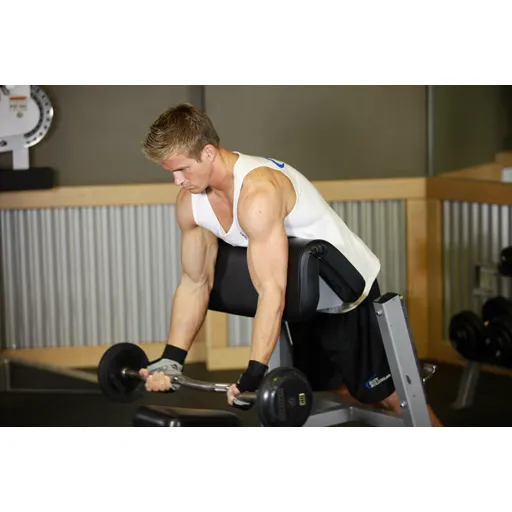
Cable Preacher Curl

Cable Preacher Curl

Tay trước — Cáp

Hướng dẫn & lỗi thường gặp EN
  1. Place a preacher bench about 2 feet in front of a pulley machine.
  2. Attach a straight bar to the low pulley.
  3. Sit at the preacher bench with your elbow and upper arms firmly on top of the bench pad and have someone hand you the bar from the low pulley.
  4. Grab the bar and fully extend your arms on top of the preacher bench pad. This will be your starting position.
  5. Now start pilling the weight up towards your shoulders and squeeze the biceps hard at the top of the movement. Exhale as you perform this motion. Also, hold for a second at the top.
  6. Now slowly lower the weight to the starting position.
  7. Repeat for the recommended amount of repetitions.

Lỗi thường gặp

  • Khuỷu cố định sát thân, không đưa vai hoặc thân người vào nối lực.
  • Hạ tạ chậm bằng kiểm soát, không thả tay theo trọng lực.
Cable Shrugs

Cable Shrugs

Vai - thang — Cáp

Hướng dẫn & lỗi thường gặp EN
  1. Grasp a cable bar attachment that is attached to a low pulley with a shoulder width or slightly wider overhand (palms facing down) grip.
  2. Stand erect close to the pulley with your arms extended in front of you holding the bar. This will be your starting position.
  3. Lift the bar by elevating the shoulders as high as possible as you exhale. Hold the contraction at the top for a second. Tip: The arms should remain extended at all times. Refrain from using the biceps to help lift the bar. Only the shoulders should be moving up and down.
  4. Lower the bar back to the original position.
  5. Repeat for the recommended amount of repetitions.

Lỗi thường gặp

  • Ưu tiên biên độ đầy đủ và nhịp chậm đều trước khi tăng tạ.
  • Giữ thân người ổn định, khu vực đang tập mới là nơi di chuyển chính.
Cable Wrist Curl

Cable Wrist Curl

Cẳng tay — Cáp

Hướng dẫn & lỗi thường gặp EN
  1. Start out by placing a flat bench in front of a low pulley cable that has a straight bar attachment.
  2. Use your arms to grab the cable bar with a narrow to shoulder width supinated grip (palms up) and bring them up so that your forearms are resting against the top of your thighs. Your wrists should be hanging just beyond your knees.
  3. Start out by curling your wrist upwards and exhaling. Keep the contraction for a second.
  4. Slowly lower your wrists back down to the starting position while inhaling.
  5. Your forearms should be stationary as your wrist is the only movement needed to perform this exercise.
  6. Repeat for the recommended amount of repetitions.

Lỗi thường gặp

  • Cổ tay giữ trung tính, không gập gập liên tục làm mỏi cẳng tay sớm.
  • Nắm chắc nhưng không siết quá mức làm tê tay.
Calf Press

Calf Press

Bắp chân — Máy

Hướng dẫn & lỗi thường gặp EN
  1. Adjust the seat so that your legs are only slightly bent in the start position. The balls of your feet should be firmly on the platform.
  2. Select an appropriate weight, and grasp the handles. This will be your starting position.
  3. Straighten the legs by extending the knees, just barely lifting the weight from the stack. Your ankle should be fully flexed, toes pointing up. Execute the movement by pressing downward through the balls of your feet as far as possible.
  4. After a brief pause, reverse the motion and repeat.

Lỗi thường gặp

  • Biên độ đầy đủ: hạ gót sâu, nâng cao nhất ở đỉnh, dừng ngắn ở hai đầu.
  • Di chuyển chậm đều, tránh bật nhịp theo quán tính.
Calf Press On The Leg Press Machine

Calf Press On The Leg Press Machine

Bắp chân — Máy

Hướng dẫn & lỗi thường gặp EN
  1. Using a leg press machine, sit down on the machine and place your legs on the platform directly in front of you at a medium (shoulder width) foot stance.
  2. Lower the safety bars holding the weighted platform in place and press the platform all the way up until your legs are fully extended in front of you without locking your knees. (Note: In some leg press units you can leave the safety bars on for increased safety. If your leg press unit allows for this, then this is the preferred method of performing the exercise.) Your torso and the legs should make perfect 90-degree angle. Now carefully place your toes and balls of your feet on the lower portion of the platform with the heels extending off. Toes should be facing forward, outwards or inwards as described at the beginning of the chapter. This will be your starting position.
  3. Press on the platform by raising your heels as you breathe out by extending your ankles as high as possible and flexing your calf. Ensure that the knee is kept stationary at all times. There should be no bending at any time. Hold the contracted position by a second before you start to go back down.
  4. Go back slowly to the starting position as you breathe in by lowering your heels as you bend the ankles until calves are stretched.
  5. Repeat for the recommended amount of repetitions.

Lỗi thường gặp

  • Biên độ đầy đủ: hạ gót sâu, nâng cao nhất ở đỉnh, dừng ngắn ở hai đầu.
  • Di chuyển chậm đều, tránh bật nhịp theo quán tính.
Calf Raise On A Dumbbell

Calf Raise On A Dumbbell

Bắp chân — Tạ tay

Hướng dẫn & lỗi thường gặp EN
  1. Hang on to a sturdy object for balance and stand on a dumbbell handle, preferably one with round plates so that it rolls as in this manner you have to work harder to stabilize yourself; thus increasing the effectiveness of the exercise.
  2. Now roll your foot slightly forward so that you can get a nice stretch of the calf. This will be your starting position.
  3. Lift the calf as you roll your foot over the top of the handle so that you get a full extension. Exhale during the execution of this movement. Contract the calf hard at the top and hold for a second. Tip: As you come up, roll the dumbbell slightly backward.
  4. Now inhale as you roll the dumbbell slightly forward as you come down to get a better stretch.
  5. Repeat for the recommended amount of repetitions.

Lỗi thường gặp

  • Biên độ đầy đủ: hạ gót sâu, nâng cao nhất ở đỉnh, dừng ngắn ở hai đầu.
  • Di chuyển chậm đều, tránh bật nhịp theo quán tính.
Calf Raises - With Bands

Calf Raises - With Bands

Bắp chân — Dây kháng lực

Hướng dẫn & lỗi thường gặp EN
  1. Grab an exercise band and stand on it with your toes making sure that the length of the band between the foot and the arms is the same for both sides.
  2. While holding the handles of the band, raise the arms to the side of your head as if you were getting ready to perform a shoulder press. The palms should be facing forward with the elbows bent and to the sides. This movement will create tension on the band. This will be your starting position.
  3. Keeping the hands by your shoulder, stand up on your toes as you exhale and contract the calves hard at the top of the movement.
  4. After a one second contraction, slowly go back down to the starting position.
  5. Repeat for the recommended amount of repetitions.

Lỗi thường gặp

  • Biên độ đầy đủ: hạ gót sâu, nâng cao nhất ở đỉnh, dừng ngắn ở hai đầu.
  • Di chuyển chậm đều, tránh bật nhịp theo quán tính.
Calf-Machine Shoulder Shrug

Calf-Machine Shoulder Shrug

Vai - thang — Máy

Hướng dẫn & lỗi thường gặp EN
  1. Position yourself on the calf machine so that the shoulder pads are above your shoulders. Your torso should be straight with the arms extended normally by your side. This will be your starting position.
  2. Raise your shoulders up towards your ears as you exhale and hold the contraction for a full second.
  3. Slowly return to the starting position as you inhale.
  4. Repeat for the recommended amount of repetitions.

Lỗi thường gặp

  • Ưu tiên biên độ đầy đủ và nhịp chậm đều trước khi tăng tạ.
  • Giữ thân người ổn định, khu vực đang tập mới là nơi di chuyển chính.
Chair Squat

Chair Squat

Đùi trước — Máy

Hướng dẫn & lỗi thường gặp EN
  1. To begin, first set the bar to a position that best matches your height. Once the bar is loaded, step under it and position it across the back of your shoulders.
  2. Take the bar with your hands facing forward, unlock it and lift it off the rack by extending your legs.
  3. Move your feet forward about 18 inches in front of the bar. Position your legs using a shoulder width stance with the toes slightly pointed out. Look forward at all times and maintain a neutral or slightly arched spine. This will be your starting position.
  4. Slowly lower the bar by bending the knees as you maintain a straight posture with the head up. Continue down until the angle between the upper and lower leg breaks 90 degrees.
  5. Begin to raise the bar as you exhale by pushing the floor with the heels of your feet, extending the knees and returning to the starting position.
  6. Repeat for the recommended amount of repetitions.

Lỗi thường gặp

  • Đầu gối đi cùng hướng mũi chân, không gập vào trong.
  • Hạ chậm, không bật nảy ở đáy; gót (hoặc đệm) bám chắc suốt cú đẩy.
Kéo xà ngửa

Kéo xà ngửa

Lưng (cơ lưng rộng) — Không tạ

Hướng dẫn & lỗi thường gặp EN
  1. Grab the pull-up bar with the palms facing your torso and a grip closer than the shoulder width.
  2. As you have both arms extended in front of you holding the bar at the chosen grip width, keep your torso as straight as possible while creating a curvature on your lower back and sticking your chest out. This is your starting position. Tip: Keeping the torso as straight as possible maximizes biceps stimulation while minimizing back involvement.
  3. As you breathe out, pull your torso up until your head is around the level of the pull-up bar. Concentrate on using the biceps muscles in order to perform the movement. Keep the elbows close to your body. Tip: The upper torso should remain stationary as it moves through space and only the arms should move. The forearms should do no other work other than hold the bar.
  4. After a second of squeezing the biceps in the contracted position, slowly lower your torso back to the starting position; when your arms are fully extended. Breathe in as you perform this portion of the movement.
  5. Repeat this motion for the prescribed amount of repetitions.

Lỗi thường gặp

  • Kéo đến khi cằm qua xà, không chỉ lắc lư cổ về phía xà.
  • Hạ người xuống hết zakresie, tay không khóa cứng ở đáy.
Đẩy ngực tay hẹp với tạ đòn

Đẩy ngực tay hẹp với tạ đòn

Tay sau — Tạ đòn

Hướng dẫn & lỗi thường gặp EN
  1. Lie back on a flat bench. Using a close grip (around shoulder width), lift the bar from the rack and hold it straight over you with your arms locked. This will be your starting position.
  2. As you breathe in, come down slowly until you feel the bar on your middle chest. Tip: Make sure that - as opposed to a regular bench press - you keep the elbows close to the torso at all times in order to maximize triceps involvement.
  3. After a second pause, bring the bar back to the starting position as you breathe out and push the bar using your triceps muscles. Lock your arms in the contracted position, hold for a second and then start coming down slowly again. Tip: It should take at least twice as long to go down than to come up.
  4. Repeat the movement for the prescribed amount of repetitions.
  5. When you are done, place the bar back in the rack.

Lỗi thường gặp

  • Khuỷu sát thân suốt cú đẩy, không để khuỷu xòe ra ngoài.
  • Thanh tạ hạ xuống vùng dưới ngực, khuỷu sát người khi hạ.
Close-Grip Dumbbell Press

Close-Grip Dumbbell Press

Tay sau — Tạ tay

Hướng dẫn & lỗi thường gặp EN
  1. Place a dumbbell standing up on a flat bench.
  2. Ensuring that the dumbbell stays securely placed at the top of the bench, lie perpendicular to the bench with only your shoulders lying on the surface. Hips should be below the bench and your legs bent with your feet firmly on the floor.
  3. Grasp the dumbbell with both hands and hold it straight over your chest at arm's length. Both palms should be pressing against the underside of the sides of the dumbbell. This will be your starting position.
  4. Initiate the movement by lowering the dumbbell to your chest.
  5. Return to the starting position by extending the elbows.

Lỗi thường gặp

  • Khuỷu giữ một điểm cố định, phần còn lại của cánh tay không di chuyển.
  • Duỗi hết ở đỉnh, siết tay sau rồi hạ chậm.
Close-Grip EZ Bar Curl

Close-Grip EZ Bar Curl

Tay trước — Tạ đòn

Hướng dẫn & lỗi thường gặp EN
  1. Stand up with your torso upright while holding an E-Z Curl Bar at the closer inner handle. The palm of your hands should be facing forward and they should be slightly tilted inwards due to the shape of the bar. The elbows should be close to the torso. This will be your starting position.
  2. While holding the upper arms stationary, curl the weights forward while contracting the biceps as you breathe out. Tip: Only the forearms should move.
  3. Continue the movement until your biceps are fully contracted and the bar is at shoulder level. Hold the contracted position for a second and squeeze the biceps hard.
  4. Slowly begin to bring the bar back to starting position as your breathe in.
  5. Repeat for the recommended amount of repetitions.

Lỗi thường gặp

  • Khuỷu cố định sát thân, không đưa vai hoặc thân người vào nối lực.
  • Hạ tạ chậm bằng kiểm soát, không thả tay theo trọng lực.
Close-Grip EZ-Bar Curl with Band

Close-Grip EZ-Bar Curl with Band

Tay trước — Tạ đòn cong

Hướng dẫn & lỗi thường gặp EN
  1. Attach a band to each end of the bar. Take the bar, placing a foot on the middle of the band. Stand upright with a narrow, supinated grip on the EZ bar. The elbows should be close to the torso. This will be your starting position.
  2. While keeping the upper arms in place, flex the elbows to execute the curl. Exhale as the weight is lifted.
  3. Continue the movement until your biceps are fully contracted and the bar is at shoulder level. Hold the contracted position for a second and squeeze the biceps hard.
  4. Slowly begin to bring the bar back to starting position as your breathe in.
  5. Repeat for the recommended amount of repetitions.

Lỗi thường gặp

  • Khuỷu cố định sát thân, không đưa vai hoặc thân người vào nối lực.
  • Hạ tạ chậm bằng kiểm soát, không thả tay theo trọng lực.
Close-Grip EZ-Bar Press

Close-Grip EZ-Bar Press

Tay sau — Tạ đòn cong

Hướng dẫn & lỗi thường gặp EN
  1. Lie on a flat bench with an EZ bar loaded to an appropriate weight.
  2. Using a narrow grip lift the bar and hold it straight over your torso with your elbows in. The arms should be perpendicular to the floor. This will be your starting position.
  3. Now lower the bar down to your lower chest as you breathe in. Keep the elbows in as you perform this movement.
  4. Using the triceps to push the bar back up, press it back to the starting position by extending the elbows as you exhale.
  5. Repeat.

Lỗi thường gặp

  • Khuỷu giữ một điểm cố định, phần còn lại của cánh tay không di chuyển.
  • Duỗi hết ở đỉnh, siết tay sau rồi hạ chậm.
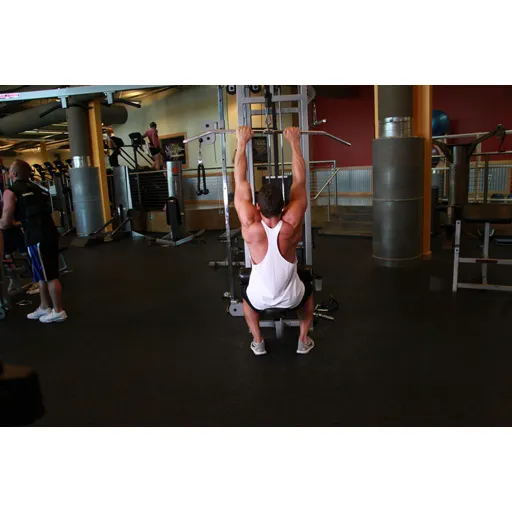
Kéo xô rộng tay cầm hẹp

Kéo xô rộng tay cầm hẹp

Lưng (cơ lưng rộng) — Cáp

Hướng dẫn & lỗi thường gặp EN
  1. Sit down on a pull-down machine with a wide bar attached to the top pulley. Make sure that you adjust the knee pad of the machine to fit your height. These pads will prevent your body from being raised by the resistance attached to the bar.
  2. Grab the bar with the palms facing forward using the prescribed grip. Note on grips: For a wide grip, your hands need to be spaced out at a distance wider than your shoulder width. For a medium grip, your hands need to be spaced out at a distance equal to your shoulder width and for a close grip at a distance smaller than your shoulder width.
  3. As you have both arms extended in front of you - while holding the bar at the chosen grip width - bring your torso back around 30 degrees or so while creating a curvature on your lower back and sticking your chest out. This is your starting position.
  4. As you breathe out, bring the bar down until it touches your upper chest by drawing the shoulders and the upper arms down and back. Tip: Concentrate on squeezing the back muscles once you reach the full contracted position. The upper torso should remain stationary (only the arms should move). The forearms should do no other work except for holding the bar; therefore do not try to pull the bar down using the forearms.
  5. After a second in the contracted position, while squeezing your shoulder blades together, slowly raise the bar back to the starting position when your arms are fully extended and the lats are fully stretched. Inhale during this portion of the movement.
  6. 6. Repeat this motion for the prescribed amount of repetitions.

Lỗi thường gặp

  • Kéo bằng khuỷu xuống về phía hông, không bẻ tay bứt tốc.
  • Ngực mở, vai hạ thấp — không shrug vai khi kéo.
Concentration Curls

Concentration Curls

Tay trước — Tạ tay

Hướng dẫn & lỗi thường gặp EN
  1. Sit down on a flat bench with one dumbbell in front of you between your legs. Your legs should be spread with your knees bent and feet on the floor.
  2. Use your right arm to pick the dumbbell up. Place the back of your right upper arm on the top of your inner right thigh. Rotate the palm of your hand until it is facing forward away from your thigh. Tip: Your arm should be extended and the dumbbell should be above the floor. This will be your starting position.
  3. While holding the upper arm stationary, curl the weights forward while contracting the biceps as you breathe out. Only the forearms should move. Continue the movement until your biceps are fully contracted and the dumbbells are at shoulder level. Tip: At the top of the movement make sure that the little finger of your arm is higher than your thumb. This guarantees a good contraction. Hold the contracted position for a second as you squeeze the biceps.
  4. Slowly begin to bring the dumbbells back to starting position as your breathe in. Caution: Avoid swinging motions at any time.
  5. Repeat for the recommended amount of repetitions. Then repeat the movement with the left arm.

Lỗi thường gặp

  • Khuỷu cố định sát thân, không đưa vai hoặc thân người vào nối lực.
  • Hạ tạ chậm bằng kiểm soát, không thả tay theo trọng lực.
Cross Over - With Bands

Cross Over - With Bands

Ngực — Dây kháng lực

Hướng dẫn & lỗi thường gặp EN
  1. Secure an exercise band around a stationary post.
  2. While facing away from the post, grab the handles on both ends of the band and step forward enough to create tension on the band.
  3. Raise your arms to the sides, parallel to the floor, perpendicular to your torso (your torso and the arms should resemble the letter "T") and with the palms facing forward. Have them extended with a slight bend at the elbows. This will be your starting position.
  4. While keeping your arms straight, bring them across your chest in a semicircular motion to the front as you exhale and flex your pecs. Hold the contraction for a second.
  5. Slowly return to the starting position as you inhale.
  6. Perform for the recommended amount of repetitions.

Lỗi thường gặp

  • Khuỷu ~45° so với thân, hạ tạ tới giữa ngực theo kiểm soát.
  • Lưng và vai trên bám ghế, không ưỡn hông để nối lực.
Dead bug

Dead bug

Bụng — Không tạ

Hướng dẫn & lỗi thường gặp EN
  1. Begin lying on your back with your hands extended above you toward the ceiling.
  2. Bring your feet, knees, and hips up to 90 degrees.
  3. Exhale hard to bring your ribcage down and flatten your back onto the floor, rotating your pelvis up and squeezing your glutes. Hold this position throughout the movement. This will be your starting position.
  4. Initiate the exercise by extending one leg, straightening the knee and hip to bring the leg just above the ground.
  5. Maintain the position of your lumbar and pelvis as you perform the movement, as your back is going to want to arch.
  6. Stay tight and return the working leg to the starting position.
  7. Repeat on the opposite side, alternating until the set is complete.

Lỗi thường gặp

  • Lưng dưới ép sát sàn suốt cử động, không ưỡn lưng khi duỗi chân.
  • Duỗi tay chân chậm, thở ra khi duỗi — không làm nhanh để trống nhịp thở.
Decline Barbell Bench Press

Decline Barbell Bench Press

Ngực — Tạ đòn

Hướng dẫn & lỗi thường gặp EN
  1. Secure your legs at the end of the decline bench and slowly lay down on the bench.
  2. Using a medium width grip (a grip that creates a 90-degree angle in the middle of the movement between the forearms and the upper arms), lift the bar from the rack and hold it straight over you with your arms locked. The arms should be perpendicular to the floor. This will be your starting position. Tip: In order to protect your rotator cuff, it is best if you have a spotter help you lift the barbell off the rack.
  3. As you breathe in, come down slowly until you feel the bar on your lower chest.
  4. After a second pause, bring the bar back to the starting position as you breathe out and push the bar using your chest muscles. Lock your arms and squeeze your chest in the contracted position, hold for a second and then start coming down slowly again. Tip: It should take at least twice as long to go down than to come up).
  5. Repeat the movement for the prescribed amount of repetitions.
  6. When you are done, place the bar back in the rack.

Lỗi thường gặp

  • Khuỷu ~45° so với thân, hạ tạ tới giữa ngực theo kiểm soát.
  • Lưng và vai trên bám ghế, không ưỡn hông để nối lực.
Decline Dumbbell Bench Press

Decline Dumbbell Bench Press

Ngực — Tạ tay

Hướng dẫn & lỗi thường gặp EN
  1. Secure your legs at the end of the decline bench and lie down with a dumbbell on each hand on top of your thighs. The palms of your hand will be facing each other.
  2. Once you are laying down, move the dumbbells in front of you at shoulder width.
  3. Once at shoulder width, rotate your wrists forward so that the palms of your hands are facing away from you. This will be your starting position.
  4. Bring down the weights slowly to your side as you breathe out. Keep full control of the dumbbells at all times. Tip: Throughout the motion, the forearms should always be perpendicular to the floor.
  5. As you breathe out, push the dumbbells up using your pectoral muscles. Lock your arms in the contracted position, squeeze your chest, hold for a second and then start coming down slowly. Tip: It should take at least twice as long to go down than to come up..
  6. Repeat the movement for the prescribed amount of repetitions of your training program.

Lỗi thường gặp

  • Khuỷu ~45° so với thân, hạ tạ tới giữa ngực theo kiểm soát.
  • Lưng và vai trên bám ghế, không ưỡn hông để nối lực.
Decline Dumbbell Flyes

Decline Dumbbell Flyes

Ngực — Tạ tay

Hướng dẫn & lỗi thường gặp EN
  1. Secure your legs at the end of the decline bench and lie down with a dumbbell on each hand on top of your thighs. The palms of your hand will be facing each other.
  2. Once you are laying down, move the dumbbells in front of you at shoulder width. The palms of the hands should be facing each other and the arms should be perpendicular to the floor and fully extended. This will be your starting position.
  3. With a slight bend on your elbows in order to prevent stress at the biceps tendon, lower your arms out at both sides in a wide arc until you feel a stretch on your chest. Breathe in as you perform this portion of the movement. Tip: Keep in mind that throughout the movement, the arms should remain stationary; the movement should only occur at the shoulder joint.
  4. Return your arms back to the starting position as you squeeze your chest muscles and breathe out. Tip: Make sure to use the same arc of motion used to lower the weights.
  5. Hold for a second at the contracted position and repeat the movement for the prescribed amount of repetitions.

Lỗi thường gặp

  • Khuỷu ~45° so với thân, hạ tạ tới giữa ngực theo kiểm soát.
  • Lưng và vai trên bám ghế, không ưỡn hông để nối lực.
Decline Dumbbell Triceps Extension

Decline Dumbbell Triceps Extension

Tay sau — Tạ tay

Hướng dẫn & lỗi thường gặp EN
  1. Secure your legs at the end of the decline bench and lie down with a dumbbell on each hand on top of your thighs. The palms of your hand will be facing each other.
  2. Once you are laying down, move the dumbbells in front of you at shoulder width. The palms of the hands should be facing each other and the arms should be perpendicular to the floor and fully extended. This will be your starting position.
  3. As you breathe in and you keep the upper arms stationary (and elbows in), bring the dumbbells down slowly by moving your forearms in a semicircular motion towards you until your thumbs are next to your ears. Breathe in as you perform this portion of the movement.
  4. Lift the dumbbells back to the starting position by contracting the triceps and exhaling.
  5. Repeat for the recommended amount of repetitions.

Lỗi thường gặp

  • Khuỷu giữ một điểm cố định, phần còn lại của cánh tay không di chuyển.
  • Duỗi hết ở đỉnh, siết tay sau rồi hạ chậm.
Decline EZ Bar Triceps Extension

Decline EZ Bar Triceps Extension

Tay sau — Tạ đòn

Hướng dẫn & lỗi thường gặp EN
  1. Secure your legs at the end of the decline bench and slowly lay down on the bench.
  2. Using a close grip (a grip that is slightly less than shoulder width), lift the EZ bar from the rack and hold it straight over you with your arms locked and elbows in. The arms should be perpendicular to the floor. This will be your starting position. Tip: In order to protect your rotator cuff, it is best if you have a spotter help you lift the barbell off the rack.
  3. As you breathe in and you keep the upper arms stationary, bring the bar down slowly by moving your forearms in a semicircular motion towards you until you feel the bar slightly touch your forehead. Breathe in as you perform this portion of the movement.
  4. Lift the bar back to the starting position by contracting the triceps and exhaling.
  5. Repeat until the recommended amount of repetitions is performed.

Lỗi thường gặp

  • Khuỷu giữ một điểm cố định, phần còn lại của cánh tay không di chuyển.
  • Duỗi hết ở đỉnh, siết tay sau rồi hạ chậm.
Decline Smith Press

Decline Smith Press

Ngực — Máy

Hướng dẫn & lỗi thường gặp EN
  1. Place a decline bench underneath the Smith machine. Now place the barbell at a height that you can reach when lying down and your arms are almost fully extended. Using a pronated grip that is wider than shoulder width, unlock the bar from the rack and hold it straight over you with your arms extended. This will be your starting position.
  2. As you inhale, lower the bar under control by allowing the elbows to flex, lightly contacting the torso.
  3. After a brief pause, bring the bar back to the starting position by extending the elbows, exhaling as you do so.
  4. Repeat the movement for the prescribed amount of repetitions.
  5. When the set is complete, lock the bar back in the rack.

Lỗi thường gặp

  • Khuỷu ~45° so với thân, hạ tạ tới giữa ngực theo kiểm soát.
  • Lưng và vai trên bám ghế, không ưỡn hông để nối lực.
Dip Machine

Dip Machine

Tay sau — Máy

Hướng dẫn & lỗi thường gặp EN
  1. Sit securely in a dip machine, select the weight and firmly grasp the handles.
  2. Now keep your elbows in at your sides in order to place emphasis on the triceps. The elbows should be bent at a 90 degree angle.
  3. As you contract the triceps, extend your arms downwards as you exhale. Tip: At the bottom of the movement, focus on keeping a little bend in your arms to keep tension on the triceps muscle.
  4. Now slowly let your arms come back up to the starting position as you inhale.
  5. Repeat for the recommended amount of repetitions.

Lỗi thường gặp

  • Khuỷu giữ một điểm cố định, phần còn lại của cánh tay không di chuyển.
  • Duỗi hết ở đỉnh, siết tay sau rồi hạ chậm.
Dips - Triceps Version

Dips - Triceps Version

Tay sau — Không tạ

Hướng dẫn & lỗi thường gặp EN
  1. To get into the starting position, hold your body at arm's length with your arms nearly locked above the bars.
  2. Now, inhale and slowly lower yourself downward. Your torso should remain upright and your elbows should stay close to your body. This helps to better focus on tricep involvement. Lower yourself until there is a 90 degree angle formed between the upper arm and forearm.
  3. Then, exhale and push your torso back up using your triceps to bring your body back to the starting position.
  4. Repeat the movement for the prescribed amount of repetitions.

Lỗi thường gặp

  • Khuỷu giữ một điểm cố định, phần còn lại của cánh tay không di chuyển.
  • Duỗi hết ở đỉnh, siết tay sau rồi hạ chậm.
Double Kettlebell Alternating Hang Clean

Double Kettlebell Alternating Hang Clean

Đùi sau — Kettlebell

Hướng dẫn & lỗi thường gặp EN
  1. Place two kettlebells between your feet. To get in the starting position, push your butt back and look straight ahead.
  2. Clean one kettlebell to your shoulder and hold on to the other kettlebell.
  3. With a fluid motion, lower the top kettlebell while driving the bottom kettlebell up.

Lỗi thường gặp

  • Gập người bằng hông, lưng trung tính — không cong lưng để tạ đi xa hơn.
  • Siết đùi sau ở đỉnh rồi hạ xuống bằng kiểm soát.
Double Kettlebell Jerk

Double Kettlebell Jerk

Vai — Kettlebell

Hướng dẫn & lỗi thường gặp EN
  1. Hold a kettlebell by the handle in each hand.
  2. Clean the kettlebells to your shoulders by extending through the legs and hips as you pull the kettlebells towards your shoulders. Rotate your wrists as you do so, so that the palms face forward. This will be your starting position.
  3. Dip your body by bending the knees, keeping your torso upright.
  4. Immediately reverse direction, driving through the heels, in essence jumping to create momentum.
  5. As you do so, press the kettlebells overhead to lockout by extending the arms, using your body's momentum to move the weights.
  6. Return your feet to the ground in a split fashion, with one foot forward and one foot back.
  7. Keeping the weights overhead, return to a standing position, bringing your feet together. Lower the weights to perform the next repetition.

Lỗi thường gặp

  • Vai hạ thấp, không shrug lên gần tai khi đẩy hoặc nâng.
  • Khuỷu theo hướng tự nhiên của khớp, không khóa cứng ở đỉnh.
Double Kettlebell Windmill

Double Kettlebell Windmill

Bụng — Kettlebell

Hướng dẫn & lỗi thường gặp EN
  1. Place a kettlebell in front of your front foot and clean and press a kettlebell overhead with your opposite arm. Clean the kettlebell to your shoulder by extending through the legs and hips as you pull the kettlebell towards your shoulders. Rotate your wrist as you do so, so that the palm faces forward.
  2. Keeping the kettlebell locked out at all times, push your butt out in the direction of the locked out kettlebell. Turn your feet out at a forty-five degree angle from the arm with the locked out kettlebell.
  3. Bending at the hip to one side, sticking your butt out, slowly lean until you can retrieve the kettlebell from the floor. Keep your eyes on the kettlebell that you hold over your head at all times.
  4. Pause for a second after retrieving the kettlebell from the ground and reverse the motion back to the starting position.

Lỗi thường gặp

  • Gập bằng cơ bụng, không kéo cổ hoặc vung thân người.
  • Thở ra khi gập, lưng dưới ổn định suốt cử động.
Downward Facing Balance

Downward Facing Balance

Mông — Bóng tập

Hướng dẫn & lỗi thường gặp EN
  1. Lie facedown on top of an exercise ball.
  2. While resting on your stomach on the ball, walk your hands forward along the floor and lift your legs, extending your elbows and knees.

Lỗi thường gặp

  • Siết mông mạnh ở đỉnh chuyển động, không ưỡn lưng dưới thay thế.
  • Chuyển động chậm và hết biên độ, không vung theo quán tính.
Dumbbell Bench Press

Dumbbell Bench Press

Ngực — Tạ tay

Hướng dẫn & lỗi thường gặp EN
  1. Lie down on a flat bench with a dumbbell in each hand resting on top of your thighs. The palms of your hands will be facing each other.
  2. Then, using your thighs to help raise the dumbbells up, lift the dumbbells one at a time so that you can hold them in front of you at shoulder width.
  3. Once at shoulder width, rotate your wrists forward so that the palms of your hands are facing away from you. The dumbbells should be just to the sides of your chest, with your upper arm and forearm creating a 90 degree angle. Be sure to maintain full control of the dumbbells at all times. This will be your starting position.
  4. Then, as you breathe out, use your chest to push the dumbbells up. Lock your arms at the top of the lift and squeeze your chest, hold for a second and then begin coming down slowly. Tip: Ideally, lowering the weight should take about twice as long as raising it.
  5. Repeat the movement for the prescribed amount of repetitions of your training program.

Lỗi thường gặp

  • Khuỷu ~45° so với thân, hạ tạ tới giữa ngực theo kiểm soát.
  • Lưng và vai trên bám ghế, không ưỡn hông để nối lực.
Cuộn tay với tạ tay

Cuộn tay với tạ tay

Tay trước — Tạ tay

Hướng dẫn & lỗi thường gặp EN
  1. Stand up straight with a dumbbell in each hand at arm's length. Keep your elbows close to your torso and rotate the palms of your hands until they are facing forward. This will be your starting position.
  2. Now, keeping the upper arms stationary, exhale and curl the weights while contracting your biceps. Continue to raise the weights until your biceps are fully contracted and the dumbbells are at shoulder level. Hold the contracted position for a brief pause as you squeeze your biceps.
  3. Then, inhale and slowly begin to lower the dumbbells back to the starting position.
  4. Repeat for the recommended amount of repetitions.

Lỗi thường gặp

  • Khuỷu bám hai bên thân, không đưa cả cánh tay ra trước khi cuộn.
  • Điều khiển tạ khi hạ xuống, không thả rơi tay tạ theo trọng lực.
Dumbbell Clean

Dumbbell Clean

Đùi sau — Tạ tay

Hướng dẫn & lỗi thường gặp EN
  1. Begin standing with a dumbbell in each hand with your feet shoulder width apart.
  2. Lower the weights to the floor by flexing at the hips and knees, pushing your hips back until the dumbbells reach the floor. This will be your starting position.
  3. To initiate the movement, violently jump upward by extending the hips, knees, and ankles to acclerate the weights upward. Maintaining a neutral grip on the dumbbells, keep the arms straight until full extension is reached.
  4. After full extension, rebend the hips and knees to receive the weight in a squat position. Allow the arms to bend, guiding the dumbbells to your shoulders.
  5. Upon receiving the weight in the squat position, extend the hips and knees to finish in a standing position with the weights on your shoulders.

Lỗi thường gặp

  • Gập người bằng hông, lưng trung tính — không cong lưng để tạ đi xa hơn.
  • Siết đùi sau ở đỉnh rồi hạ xuống bằng kiểm soát.
Dumbbell Incline Row

Dumbbell Incline Row

Lưng giữa — Tạ tay

Hướng dẫn & lỗi thường gặp EN
  1. Using a neutral grip, lean into an incline bench.
  2. Take a dumbbell in each hand with a neutral grip, beginning with the arms straight. This will be your starting position.
  3. Retract the shoulder blades and flex the elbows to row the dumbbells to your side.
  4. Pause at the top of the motion, and then return to the starting position.

Lỗi thường gặp

  • Kéo về bụng dưới, khuỷu sát thân, vai hạ thấp.
  • Thân người giữ gập ổn định, không đứng dậy theo mỗi lần kéo.
Dumbbell Incline Shoulder Raise

Dumbbell Incline Shoulder Raise

Vai — Tạ tay

Hướng dẫn & lỗi thường gặp EN
  1. Sit on an Incline Bench while holding a dumbbell on each hand on top of your thighs.
  2. Lift your legs up to kick the weights to your shoulders and lean back. Position the dumbbells above your shoulders with your arms extended. The arms should be perpendicular to the floor with your palms facing forward and knuckles pointing towards the ceiling. This will be your starting position.
  3. While keeping the arms straight and locked, lift the dumbbells by raising the shoulders from the bench as you breathe out.
  4. Bring back the dumbbells to the starting position as you breathe in.
  5. Repeat for the recommended amount of repetitions.

Lỗi thường gặp

  • Vai hạ thấp, không shrug lên gần tai khi đẩy hoặc nâng.
  • Khuỷu theo hướng tự nhiên của khớp, không khóa cứng ở đỉnh.
Buông chùng với tạ tay

Buông chùng với tạ tay

Đùi trước — Tạ tay

Hướng dẫn & lỗi thường gặp EN
  1. Stand with your torso upright holding two dumbbells in your hands by your sides. This will be your starting position.
  2. Step forward with your right leg around 2 feet or so from the foot being left stationary behind and lower your upper body down, while keeping the torso upright and maintaining balance. Inhale as you go down. Note: As in the other exercises, do not allow your knee to go forward beyond your toes as you come down, as this will put undue stress on the knee joint. Make sure that you keep your front shin perpendicular to the ground.
  3. Using mainly the heel of your foot, push up and go back to the starting position as you exhale.
  4. Repeat the movement for the recommended amount of repetitions and then perform with the left leg.

Lỗi thường gặp

  • Bước dài đủ để gối sau gần sàn mà gối trước không tràn qua mũi chân.
  • Thân giữ thẳng, không đổ về phía chân trước.
Dumbbell Seated One-Leg Calf Raise

Dumbbell Seated One-Leg Calf Raise

Bắp chân — Tạ tay

Hướng dẫn & lỗi thường gặp EN
  1. Place a block on the floor about 12 inches from a flat bench.
  2. Sit on a flat bench and place a dumbbell on your upper left thigh about 3 inches above your knee.
  3. Now place the ball of your left foot on the block. This will be your starting position.
  4. Raise your toes up as high as possible as you exhale and you contract your calf muscle. Hold the contraction for a second.
  5. Slowly return to the starting position, stretching as far down as possible.
  6. Repeat for your prescribed number of repetitions and then repeat with the right leg.

Lỗi thường gặp

  • Biên độ đầy đủ: hạ gót sâu, nâng cao nhất ở đỉnh, dừng ngắn ở hai đầu.
  • Di chuyển chậm đều, tránh bật nhịp theo quán tính.
Dumbbell Shrug

Dumbbell Shrug

Vai - thang — Tạ tay

Hướng dẫn & lỗi thường gặp EN
  1. Stand erect with a dumbbell on each hand (palms facing your torso), arms extended on the sides.
  2. Lift the dumbbells by elevating the shoulders as high as possible while you exhale. Hold the contraction at the top for a second. Tip: The arms should remain extended at all times. Refrain from using the biceps to help lift the dumbbells. Only the shoulders should be moving up and down.
  3. Lower the dumbbells back to the original position.
  4. Repeat for the recommended amount of repetitions.

Lỗi thường gặp

  • Ưu tiên biên độ đầy đủ và nhịp chậm đều trước khi tăng tạ.
  • Giữ thân người ổn định, khu vực đang tập mới là nơi di chuyển chính.
Dumbbell Side Bend

Dumbbell Side Bend

Bụng — Tạ tay

Hướng dẫn & lỗi thường gặp EN
  1. Stand up straight while holding a dumbbell on the left hand (palms facing the torso) as you have the right hand holding your waist. Your feet should be placed at shoulder width. This will be your starting position.
  2. While keeping your back straight and your head up, bend only at the waist to the right as far as possible. Breathe in as you bend to the side. Then hold for a second and come back up to the starting position as you exhale. Tip: Keep the rest of the body stationary.
  3. Now repeat the movement but bending to the left instead. Hold for a second and come back to the starting position.
  4. Repeat for the recommended amount of repetitions and then change hands.

Lỗi thường gặp

  • Gập bằng cơ bụng, không kéo cổ hoặc vung thân người.
  • Thở ra khi gập, lưng dưới ổn định suốt cử động.
Squat với tạ tay

Squat với tạ tay

Đùi trước — Tạ tay

Hướng dẫn & lỗi thường gặp EN
  1. Stand up straight while holding a dumbbell on each hand (palms facing the side of your legs).
  2. Position your legs using a shoulder width medium stance with the toes slightly pointed out. Keep your head up at all times as looking down will get you off balance and also maintain a straight back. This will be your starting position. Note: For the purposes of this discussion we will use the medium stance described above which targets overall development; however you can choose any of the three stances discussed in the foot stances section.
  3. Begin to slowly lower your torso by bending the knees as you maintain a straight posture with the head up. Continue down until your thighs are parallel to the floor. Tip: If you performed the exercise correctly, the front of the knees should make an imaginary straight line with the toes that is perpendicular to the front. If your knees are past that imaginary line (if they are past your toes) then you are placing undue stress on the knee and the exercise has been performed incorrectly.
  4. Begin to raise your torso as you exhale by pushing the floor with the heel of your foot mainly as you straighten the legs again and go back to the starting position.
  5. Repeat for the recommended amount of repetitions.

Lỗi thường gặp

  • Hai tạ thả dọc hai bên thân, không để tạ kéo người đổ về trước.
  • Gót bám sàn, hạ tới đùi song song sàn rồi đứng lên bằng gót.
Dumbbell Tricep Extension -Pronated Grip

Dumbbell Tricep Extension -Pronated Grip

Tay sau — Tạ tay

Hướng dẫn & lỗi thường gặp EN
  1. Lie down on a flat bench holding two dumbbells directly above your shoulders. Your arms should be fully extended and form a 90 degree angle from your torso and the floor.
  2. The palms of your hands should be facing forward, and your elbows should be tucked in. This will be your starting position.
  3. Now, inhale and slowly lower the dumbbells until they are near your ears. Be sure to keep your upper arms stationary and your elbows tucked in.
  4. Then, exhale and use your triceps to return the weight to the starting position.

Lỗi thường gặp

  • Khuỷu giữ một điểm cố định, phần còn lại của cánh tay không di chuyển.
  • Duỗi hết ở đỉnh, siết tay sau rồi hạ chậm.
EZ-Bar Curl

EZ-Bar Curl

Tay trước — Tạ đòn cong

Hướng dẫn & lỗi thường gặp EN
  1. Stand up straight while holding an EZ curl bar at the wide outer handle. The palms of your hands should be facing forward and slightly tilted inward due to the shape of the bar. Keep your elbows close to your torso. This will be your starting position.
  2. Now, while keeping your upper arms stationary, exhale and curl the weights forward while contracting the biceps. Focus on only moving your forearms.
  3. Continue to raise the weight until your biceps are fully contracted and the bar is at shoulder level. Hold the top contracted position for a moment and squeeze the biceps.
  4. Then inhale and slowly lower the bar back to the starting position.
  5. Repeat for the recommended amount of repetitions.

Lỗi thường gặp

  • Khuỷu cố định sát thân, không đưa vai hoặc thân người vào nối lực.
  • Hạ tạ chậm bằng kiểm soát, không thả tay theo trọng lực.
EZ-Bar Skullcrusher

EZ-Bar Skullcrusher

Tay sau — Tạ đòn cong

Hướng dẫn & lỗi thường gặp EN
  1. Using a close grip, lift the EZ bar and hold it with your elbows in as you lie on the bench. Your arms should be perpendicular to the floor. This will be your starting position.
  2. Keeping the upper arms stationary, lower the bar by allowing the elbows to flex. Inhale as you perform this portion of the movement. Pause once the bar is directly above the forehead.
  3. Lift the bar back to the starting position by extending the elbow and exhaling.
  4. Repeat.

Lỗi thường gặp

  • Khuỷu giữ một điểm cố định, phần còn lại của cánh tay không di chuyển.
  • Duỗi hết ở đỉnh, siết tay sau rồi hạ chậm.
Gập bụng trên bóng tập

Gập bụng trên bóng tập

Bụng — Bóng tập

Hướng dẫn & lỗi thường gặp EN
  1. Lie on an exercise ball with your lower back curvature pressed against the spherical surface of the ball. Your feet should be bent at the knee and pressed firmly against the floor. The upper torso should be hanging off the top of the ball. The arms should either be kept alongside the body or crossed on top of your chest as these positions avoid neck strains (as opposed to the hands behind the back of the head position).
  2. Lower your torso into a stretch position keeping the neck stationary at all times. This will be your starting position.
  3. With the hips stationary, flex the waist by contracting the abdominals and curl the shoulders and trunk upward until you feel a nice contraction on your abdominals. The arms should simply slide up the side of your legs if you have them at the side or just stay on top of your chest if you have them crossed. The lower back should always stay in contact with the ball. Exhale as you perform this movement and hold the contraction for a second.
  4. As you inhale, go back to the starting position.
  5. Repeat for the recommended amount of repetitions.

Lỗi thường gặp

  • Gập bằng bụng, không kéo cổ bằng tay khi gập lên.
  • Lưng dưới bám bóng, không trượt về trước trong lúc gập.
Exercise Ball Pull-In

Exercise Ball Pull-In

Bụng — Bóng tập

Hướng dẫn & lỗi thường gặp EN
  1. Place an exercise ball nearby and lay on the floor in front of it with your hands on the floor shoulder width apart in a push-up position.
  2. Now place your lower shins on top of an exercise ball. Tip: At this point your legs should be fully extended with the shins on top of the ball and the upper body should be in a push-up type of position being supported by your two extended arms in front of you. This will be your starting position.
  3. While keeping your back completely straight and the upper body stationary, pull your knees in towards your chest as you exhale, allowing the ball to roll forward under your ankles. Squeeze your abs and hold that position for a second.
  4. Now slowly straighten your legs, rolling the ball back to the starting position as you inhale.
  5. Repeat for the recommended amount of repetitions.

Lỗi thường gặp

  • Gập bằng cơ bụng, không kéo cổ hoặc vung thân người.
  • Thở ra khi gập, lưng dưới ổn định suốt cử động.
Extended Range One-Arm Kettlebell Floor Press

Extended Range One-Arm Kettlebell Floor Press

Ngực — Kettlebell

Hướng dẫn & lỗi thường gặp EN
  1. Lie on the floor and position a kettlebell for one arm to press. The kettlebell should be held by the handle. The leg on the same side that you are pressing should be bent, with the knee crossing over the midline of the body.
  2. Press the kettlebell by extending the elbow and adducting the arm, pressing it above your body. Return to the starting position.

Lỗi thường gặp

  • Khuỷu ~45° so với thân, hạ tạ tới giữa ngực theo kiểm soát.
  • Lưng và vai trên bám ghế, không ưỡn hông để nối lực.
External Rotation with Band

External Rotation with Band

Vai — Dây kháng lực

Hướng dẫn & lỗi thường gặp EN
  1. Choke the band around a post. The band should be at the same height as your elbow. Stand with your left side to the band a couple of feet away.
  2. Grasp the end of the band with your right hand, and keep your elbow pressed firmly to your side. We recommend you hold a pad or foam roll in place with your elbow to keep it firmly in position.
  3. With your upper arm in position, your elbow should be flexed to 90 degrees with your hand reaching across the front of your torso. This will be your starting position.
  4. Execute the movement by rotating your arm in a backhand motion, keeping your elbow in place.
  5. Continue as far as you are able, pause, and then return to the starting position.

Lỗi thường gặp

  • Vai hạ thấp, không shrug lên gần tai khi đẩy hoặc nâng.
  • Khuỷu theo hướng tự nhiên của khớp, không khóa cứng ở đỉnh.
Finger Curls

Finger Curls

Cẳng tay — Tạ đòn

Hướng dẫn & lỗi thường gặp EN
  1. Hold a barbell with both hands and your palms facing up; hands spaced about shoulder width.
  2. Place your feet flat on the floor, at a distance that is slightly wider than shoulder width apart. This will be your starting position.
  3. Lower the bar as far as possible by extending the fingers. Allowing the bar to roll down the hands, catch the bar with the final joint in the fingers.
  4. Now curl bar up as high as possible by closing your hands while exhaling. Hold the contraction at the top.

Lỗi thường gặp

  • Cổ tay giữ trung tính, không gập gập liên tục làm mỏi cẳng tay sớm.
  • Nắm chắc nhưng không siết quá mức làm tê tay.
Flutter Kicks

Flutter Kicks

Mông — Không tạ

Hướng dẫn & lỗi thường gặp EN
  1. On a flat bench lie facedown with the hips on the edge of the bench, the legs straight with toes high off the floor and with the arms on top of the bench holding on to the front edge.
  2. Squeeze your glutes and hamstrings and straighten the legs until they are level with the hips. This will be your starting position.
  3. Start the movement by lifting the left leg higher than the right leg.
  4. Then lower the left leg as you lift the right leg.
  5. Continue alternating in this manner (as though you are doing a flutter kick in water) until you have done the recommended amount of repetitions for each leg. Make sure that you keep a controlled movement at all times. Tip: You will breathe normally as you perform this movement.

Lỗi thường gặp

  • Siết mông mạnh ở đỉnh chuyển động, không ưỡn lưng dưới thay thế.
  • Chuyển động chậm và hết biên độ, không vung theo quán tính.
Freehand Jump Squat

Freehand Jump Squat

Đùi trước — Không tạ

Hướng dẫn & lỗi thường gặp EN
  1. Cross your arms over your chest.
  2. With your head up and your back straight, position your feet at shoulder width.
  3. Keeping your back straight and chest up, squat down as you inhale until your upper thighs are parallel, or lower, to the floor.
  4. Now pressing mainly with the ball of your feet, jump straight up in the air as high as possible, using the thighs like springs. Exhale during this portion of the movement.
  5. When you touch the floor again, immediately squat down and jump again.
  6. Repeat for the recommended amount of repetitions.

Lỗi thường gặp

  • Đầu gối đi cùng hướng mũi chân, không gập vào trong.
  • Hạ chậm, không bật nảy ở đáy; gót (hoặc đệm) bám chắc suốt cú đẩy.
Front Squats With Two Kettlebells

Front Squats With Two Kettlebells

Đùi trước — Kettlebell

Hướng dẫn & lỗi thường gặp EN
  1. Clean two kettlebells to your shoulders. Clean the kettlebells to your shoulders by extending through the legs and hips as you pull the kettlebells towards your shoulders. Rotate your wrists as you do so.
  2. Looking straight ahead at all times, squat as low as you can and pause at the bottom. As you squat down, push your knees out. You should squat between your legs, keeping an upright torso, with your head and chest up.
  3. Rise back up by driving through your heels and repeat.

Lỗi thường gặp

  • Đầu gối đi cùng hướng mũi chân, không gập vào trong.
  • Hạ chậm, không bật nảy ở đáy; gót (hoặc đệm) bám chắc suốt cú đẩy.
Đẩy hông về sau

Đẩy hông về sau

Mông — Không tạ

Hướng dẫn & lỗi thường gặp EN
  1. Kneel on the floor or an exercise mat and bend at the waist with your arms extended in front of you (perpendicular to the torso) in order to get into a kneeling push-up position but with the arms spaced at shoulder width. Your head should be looking forward and the bend of the knees should create a 90-degree angle between the hamstrings and the calves. This will be your starting position.
  2. As you exhale, lift up your right leg until the hamstrings are in line with the back while maintaining the 90-degree angle bend. Contract the glutes throughout this movement and hold the contraction at the top for a second. Tip: At the end of the movement the upper leg should be parallel to the floor while the calf should be perpendicular to it.
  3. Go back to the initial position as you inhale and now repeat with the left leg.
  4. Continue to alternate legs until all of the recommended repetitions have been performed.

Lỗi thường gặp

  • Đẩy chân ra sau bằng mông, không vung chân cao quá làm ưỡn lưng.
  • Siết bụng giữ thân ổn định, không xoay hông khi đẩy chân.
Squat goblet

Squat goblet

Đùi trước — Kettlebell

Hướng dẫn & lỗi thường gặp EN
  1. Stand holding a light kettlebell by the horns close to your chest. This will be your starting position.
  2. Squat down between your legs until your hamstrings are on your calves. Keep your chest and head up and your back straight.
  3. At the bottom position, pause and use your elbows to push your knees out. Return to the starting position, and repeat for 10-20 repetitions.

Lỗi thường gặp

  • Giữ tạ áp sát ngực, khuỷu hướng xuống thay vì bung ra ngoài làm mất thế cân bằng.
  • Đầu gối đi cùng hướng mũi chân, không gập vào trong khi đứng lên.
Hack Squat

Hack Squat

Đùi trước — Máy

Hướng dẫn & lỗi thường gặp EN
  1. Place the back of your torso against the back pad of the machine and hook your shoulders under the shoulder pads provided.
  2. Position your legs in the platform using a shoulder width medium stance with the toes slightly pointed out. Tip: Keep your head up at all times and also maintain the back on the pad at all times.
  3. Place your arms on the side handles of the machine and disengage the safety bars (which on most designs is done by moving the side handles from a facing front position to a diagonal position).
  4. Now straighten your legs without locking the knees. This will be your starting position. (Note: For the purposes of this discussion we will use the medium stance described above which targets overall development; however you can choose any of the three stances described in the foot positioning section).
  5. Begin to slowly lower the unit by bending the knees as you maintain a straight posture with the head up (back on the pad at all times). Continue down until the angle between the upper leg and the calves becomes slightly less than 90-degrees (which is the point in which the upper legs are below parallel to the floor). Inhale as you perform this portion of the movement. Tip: If you performed the exercise correctly, the front of the knees should make an imaginary straight line with the toes that is perpendicular to the front. If your knees are past that imaginary line (if they are past your toes) then you are placing undue stress on the knee and the exercise has been performed incorrectly.
  6. Begin to raise the unit as you exhale by pushing the floor with mainly with the heel of your foot as you straighten the legs again and go back to the starting position.
  7. Repeat for the recommended amount of repetitions.

Lỗi thường gặp

  • Đầu gối đi cùng hướng mũi chân, không gập vào trong.
  • Hạ chậm, không bật nảy ở đáy; gót (hoặc đệm) bám chắc suốt cú đẩy.
Hip Extension with Bands

Hip Extension with Bands

Mông — Dây kháng lực

Hướng dẫn & lỗi thường gặp EN
  1. Secure one end of the band to the lower portion of a post and attach the other to one ankle.
  2. Facing the attachment point of the band, hold on to the column to stabilize yourself.
  3. Keeping your head and your chest up, move the resisted leg back as far as you can while keeping the knee straight.
  4. Return the leg to the starting position.

Lỗi thường gặp

  • Siết mông mạnh ở đỉnh chuyển động, không ưỡn lưng dưới thay thế.
  • Chuyển động chậm và hết biên độ, không vung theo quán tính.
Hip Flexion with Band

Hip Flexion with Band

Đùi trước — Dây kháng lực

Hướng dẫn & lỗi thường gặp EN
  1. Secure one end of the band to the lower portion of a post and attach the other to one ankle.
  2. Face away from the attachment point of the band.
  3. Keeping your head and your chest up, raise your knee up to 90 degrees and pause.
  4. Return the leg to the starting position.

Lỗi thường gặp

  • Đầu gối đi cùng hướng mũi chân, không gập vào trong.
  • Hạ chậm, không bật nảy ở đáy; gót (hoặc đệm) bám chắc suốt cú đẩy.
Hyperextensions With No Hyperextension Bench

Hyperextensions With No Hyperextension Bench

Lưng dưới — Không tạ

Hướng dẫn & lỗi thường gặp EN
  1. With someone holding down your legs, slide yourself down to the edge a flat bench until your hips hang off the end of the bench. Tip: Your entire upper body should be hanging down towards the floor. Also, you will be in the same position as if you were on a hyperextension bench but the range of motion will be shorter due to the height of the flat bench vs. that of the hyperextension bench.
  2. With your body straight, cross your arms in front of you (my preference) or behind your head. This will be your starting position. Tip: You can also hold a weight plate for extra resistance in front of you under your crossed arms.
  3. Start bending forward slowly at the waist as far as you can while keeping your back flat. Inhale as you perform this movement. Keep moving forward until you almost touch the floor or you feel a nice stretch on the hamstrings (whichever comes first). Tip: Never round the back as you perform this exercise.
  4. Slowly raise your torso back to the initial position as you exhale. Tip: Avoid the temptation to arch your back past a straight line. Also, do not swing the torso at any time in order to protect the back from injury.
  5. Repeat for the recommended amount of repetitions.

Lỗi thường gặp

  • Lưng giữ trung tính suốt cử động, chuyển động đến từ hông.
  • Trọng lượng nhẹ trước, làm đúng hình dáng rồi mới tăng tạ.
Incline Bench Pull

Incline Bench Pull

Lưng giữa — Tạ đòn

Hướng dẫn & lỗi thường gặp EN
  1. Grab a dumbbell in each hand and lie face down on an incline bench that is set to an incline that is approximately 30 degrees.
  2. Let the arms hang to your sides fully extended as they point to the floor.
  3. Turn the wrists until your hands have a pronated (palms down) grip.
  4. Now flare the elbows out. This will be your starting position.
  5. As you breathe out, start to pull the dumbbells up as if you are doing a reverse bench press. You will do this by bending at the elbows and bringing the upper arms up as you let the forearms hang. Continue this motion until the upper arms are at the same level as your back. Tip: The elbows will come out to the side and your upper arms and torso should make the letter "T" at the top of the movement. Hold the contraction at the top for a second.
  6. Slowly go back down to the starting position as you breathe in.
  7. Repeat for the recommended amount of repetitions.

Lỗi thường gặp

  • Kéo về bụng dưới, khuỷu sát thân, vai hạ thấp.
  • Thân người giữ gập ổn định, không đứng dậy theo mỗi lần kéo.
Incline Push-Up

Incline Push-Up

Ngực — Không tạ

Hướng dẫn & lỗi thường gặp EN
  1. Stand facing bench or sturdy elevated platform. Place hands on edge of bench or platform, slightly wider than shoulder width.
  2. Position forefoot back from bench or platform with arms and body straight. Arms should be perpendicular to body. Keeping body straight, lower chest to edge of box or platform by bending arms.
  3. Push body up until arms are extended. Repeat.

Lỗi thường gặp

  • Khuỷu ~45° so với thân, hạ tạ tới giữa ngực theo kiểm soát.
  • Lưng và vai trên bám ghế, không ưỡn hông để nối lực.
Incline Push-Up Medium

Incline Push-Up Medium

Ngực — Không tạ

Hướng dẫn & lỗi thường gặp EN
  1. Stand facing a Smith machine bar or sturdy elevated platform at an appropriate height.
  2. Place your hands on the bar, with your hands about shoulder width apart.
  3. Position your feet back from the bar with arms and body straight. This will be your starting position.
  4. Keeping your body straight, lower your chest to the bar by bending the arms.
  5. Return to the starting position by extending the elbows, pressing yourself back up.

Lỗi thường gặp

  • Khuỷu ~45° so với thân, hạ tạ tới giữa ngực theo kiểm soát.
  • Lưng và vai trên bám ghế, không ưỡn hông để nối lực.
Incline Push-Up Reverse Grip

Incline Push-Up Reverse Grip

Ngực — Không tạ

Hướng dẫn & lỗi thường gặp EN
  1. Stand facing a Smith machine bar or sturdy elevated platform at an appropriate height.
  2. Place your hands on the bar palms up, with your hands about shoulder width apart.
  3. Position your feet back from the bar with arms and body straight. This will be your starting position.
  4. Keeping your body straight, lower your chest to the bar by bending the arms.
  5. Return to the starting position by extending the elbows, pressing yourself back up.

Lỗi thường gặp

  • Khuỷu ~45° so với thân, hạ tạ tới giữa ngực theo kiểm soát.
  • Lưng và vai trên bám ghế, không ưỡn hông để nối lực.
Isometric Neck Exercise - Front And Back

Isometric Neck Exercise - Front And Back

Cổ — Không tạ

Hướng dẫn & lỗi thường gặp EN
  1. With your head and neck in a neutral position (normal position with head erect facing forward), place both of your hands on the front side of your head.
  2. Now gently push forward as you contract the neck muscles but resisting any movement of your head. Start with slow tension and increase slowly. Keep breathing normally as you execute this contraction.
  3. Hold for the recommended number of seconds.
  4. Now release the tension slowly.
  5. Rest for the recommended amount of time and repeat with your hands placed on the back side of your head.

Lỗi thường gặp

  • Ưu tiên biên độ đầy đủ và nhịp chậm đều trước khi tăng tạ.
  • Giữ thân người ổn định, khu vực đang tập mới là nơi di chuyển chính.
Isometric Neck Exercise - Sides

Isometric Neck Exercise - Sides

Cổ — Không tạ

Hướng dẫn & lỗi thường gặp EN
  1. With your head and neck in a neutral position (normal position with head erect facing forward), place your left hand on the left side of your head.
  2. Now gently push towards the left as you contract the left neck muscles but resisting any movement of your head. Start with slow tension and increase slowly. Keep breathing normally as you execute this contraction.
  3. Hold for the recommended number of seconds.
  4. Now release the tension slowly.
  5. Rest for the recommended amount of time and repeat with your right hand placed on the right side of your head.

Lỗi thường gặp

  • Ưu tiên biên độ đầy đủ và nhịp chậm đều trước khi tăng tạ.
  • Giữ thân người ổn định, khu vực đang tập mới là nơi di chuyển chính.
JM Press

JM Press

Tay sau — Tạ đòn

Hướng dẫn & lỗi thường gặp EN
  1. Start the exercise the same way you would a close grip bench press. You will lie on a flat bench while holding a barbell at arms length (fully extended) with the elbows in. However, instead of having the arms perpendicular to the torso, make sure the bar is set in a direct line above the upper chest. This will be your starting position.
  2. Now beginning from a fully extended position lower the bar down as if performing a lying triceps extension. Inhale as you perform this movement. When you reach the half way point, let the bar roll back about one inch by moving the upper arms towards your legs until they are perpendicular to the torso. Tip: Keep the bend at the elbows constant as you bring the upper arms forward.
  3. As you exhale, press the bar back up by using the triceps to perform a close grip bench press.
  4. Now go back to the starting position and start over.
  5. Repeat for the recommended amount of repetitions.

Lỗi thường gặp

  • Khuỷu giữ một điểm cố định, phần còn lại của cánh tay không di chuyển.
  • Duỗi hết ở đỉnh, siết tay sau rồi hạ chậm.
Kettlebell Dead Clean

Kettlebell Dead Clean

Đùi sau — Kettlebell

Hướng dẫn & lỗi thường gặp EN
  1. Place kettlebell between your feet. To get in the starting position, push your butt back and look straight ahead.
  2. Clean the kettlebell to your shoulder. Clean the kettlebell to your shoulders by extending through the legs and hips as you raise the kettlebell towards your shoulder. The wrist should rotate as you do so.
  3. Lower the kettlebell, keeping the hamstrings loaded by keeping your back straight and your butt out.

Lỗi thường gặp

  • Gập người bằng hông, lưng trung tính — không cong lưng để tạ đi xa hơn.
  • Siết đùi sau ở đỉnh rồi hạ xuống bằng kiểm soát.
Kettlebell Figure 8

Kettlebell Figure 8

Bụng — Kettlebell

Hướng dẫn & lỗi thường gặp EN
  1. Place one kettlebell between your legs and take a wider than shoulder width stance. Bend over by pushing your butt out and keeping your back flat.
  2. Pick up a kettlebell and pass it to your other hand between your legs. The receiving hand should reach from behind the legs. Go back and forth for several repetitions.

Lỗi thường gặp

  • Gập bằng cơ bụng, không kéo cổ hoặc vung thân người.
  • Thở ra khi gập, lưng dưới ổn định suốt cử động.
Kettlebell Pirate Ships

Kettlebell Pirate Ships

Vai — Kettlebell

Hướng dẫn & lỗi thường gặp EN
  1. With a wide stance, hold a kettlebell with both hands. Allow it to hang at waist level with your arms extended. This will be your starting position.
  2. Initiate the movement by turning to one side, swinging the kettlebell to head height. Briefly pause at the top of the motion.
  3. Allow the bell to drop as you rotate to the opposite side, again raising the kettlebell to head height.
  4. Repeat for the desired amount of repetitions.

Lỗi thường gặp

  • Vai hạ thấp, không shrug lên gần tai khi đẩy hoặc nâng.
  • Khuỷu theo hướng tự nhiên của khớp, không khóa cứng ở đỉnh.
Kettlebell Sumo High Pull

Kettlebell Sumo High Pull

Vai - thang — Kettlebell

Hướng dẫn & lỗi thường gặp EN
  1. Place a kettlebell on the ground between your feet. Position your feet in a wide stance, and grasp the kettlebell with two hands. Set your hips back as far as possible, with your knees bent. Keep your chest and head up. This will be your starting position.
  2. Begin by extending the hips and knees, simultaneously pulling the kettlebell to your shoulders, raising your elbows as you do so. Reverse the motion to return to the starting position.

Lỗi thường gặp

  • Ưu tiên biên độ đầy đủ và nhịp chậm đều trước khi tăng tạ.
  • Giữ thân người ổn định, khu vực đang tập mới là nơi di chuyển chính.
Kneeling High Pulley Row

Kneeling High Pulley Row

Lưng (cơ lưng rộng) — Cáp

Hướng dẫn & lỗi thường gặp EN
  1. Select the appropriate weight using a pulley that is above your head. Attach a rope to the cable and kneel a couple of feet away, holding the rope out in front of you with both arms extended. This will be your starting position.
  2. Initiate the movement by flexing the elbows and fully retracting your shoulders, pulling the rope toward your upper chest with your elbows out.
  3. After pausing briefly, slowly return to the starting position.

Lỗi thường gặp

  • Kéo bằng khuỷu xuống về phía hông, không bẻ tay bứt tốc.
  • Ngực mở, vai hạ thấp — không shrug vai khi kéo.
Landmine 180's

Landmine 180's

Bụng — Tạ đòn

Hướng dẫn & lỗi thường gặp EN
  1. Position a bar into a landmine or securely anchor it in a corner. Load the bar to an appropriate weight.
  2. Raise the bar from the floor, taking it to shoulder height with both hands with your arms extended in front of you. Adopt a wide stance. This will be your starting position.
  3. Perform the movement by rotating the trunk and hips as you swing the weight all the way down to one side. Keep your arms extended throughout the exercise.
  4. Reverse the motion to swing the weight all the way to the opposite side.
  5. Continue alternating the movement until the set is complete.

Lỗi thường gặp

  • Gập bằng cơ bụng, không kéo cổ hoặc vung thân người.
  • Thở ra khi gập, lưng dưới ổn định suốt cử động.
Leg Extensions

Leg Extensions

Đùi trước — Máy

Hướng dẫn & lỗi thường gặp EN
  1. For this exercise you will need to use a leg extension machine. First choose your weight and sit on the machine with your legs under the pad (feet pointed forward) and the hands holding the side bars. This will be your starting position. Tip: You will need to adjust the pad so that it falls on top of your lower leg (just above your feet). Also, make sure that your legs form a 90-degree angle between the lower and upper leg. If the angle is less than 90-degrees then that means the knee is over the toes which in turn creates undue stress at the knee joint. If the machine is designed that way, either look for another machine or just make sure that when you start executing the exercise you stop going down once you hit the 90-degree angle.
  2. Using your quadriceps, extend your legs to the maximum as you exhale. Ensure that the rest of the body remains stationary on the seat. Pause a second on the contracted position.
  3. Slowly lower the weight back to the original position as you inhale, ensuring that you do not go past the 90-degree angle limit.
  4. Repeat for the recommended amount of times.

Lỗi thường gặp

  • Đầu gối đi cùng hướng mũi chân, không gập vào trong.
  • Hạ chậm, không bật nảy ở đáy; gót (hoặc đệm) bám chắc suốt cú đẩy.
Đẩy chân máy

Đẩy chân máy

Đùi trước — Máy

Hướng dẫn & lỗi thường gặp EN
  1. Using a leg press machine, sit down on the machine and place your legs on the platform directly in front of you at a medium (shoulder width) foot stance. (Note: For the purposes of this discussion we will use the medium stance described above which targets overall development; however you can choose any of the three stances described in the foot positioning section).
  2. Lower the safety bars holding the weighted platform in place and press the platform all the way up until your legs are fully extended in front of you. Tip: Make sure that you do not lock your knees. Your torso and the legs should make a perfect 90-degree angle. This will be your starting position.
  3. As you inhale, slowly lower the platform until your upper and lower legs make a 90-degree angle.
  4. Pushing mainly with the heels of your feet and using the quadriceps go back to the starting position as you exhale.
  5. Repeat for the recommended amount of repetitions and ensure to lock the safety pins properly once you are done. You do not want that platform falling on you fully loaded.

Lỗi thường gặp

  • Đầu gối giữ hướng mũi chân, không gập vào trong khi đẩy.
  • Hạ tới ~90° là đủ, không để hông cuộn rời đệm ở đáy chuyển động.
Leg-Over Floor Press

Leg-Over Floor Press

Ngực — Kettlebell

Hướng dẫn & lỗi thường gặp EN
  1. Lie on the floor with one kettlebell in place on your chest, holding it by the handle. Extend leg on working side over leg on non-working side.Your free arm can be extended out to your side for support.
  2. Press the kettlebll into a locked out position.
  3. Lower the weight until the elbow touches the ground, keeping the kettlebell above the elbow. Repeat for the desired number of repetitions.

Lỗi thường gặp

  • Khuỷu ~45° so với thân, hạ tạ tới giữa ngực theo kiểm soát.
  • Lưng và vai trên bám ghế, không ưỡn hông để nối lực.
Ép ngực máy đòn bẩy

Ép ngực máy đòn bẩy

Ngực — Máy

Hướng dẫn & lỗi thường gặp EN
  1. Load an appropriate weight onto the pins and adjust the seat for your height. The handles should be near the bottom or middle of the pectorals at the beginning of the motion.
  2. Your chest and head should be up and your shoulder blades retracted. This will be your starting position.
  3. Press the handles forward by extending through the elbow.
  4. After a brief pause at the top, return the weight just above the start position, keeping tension on the muscles by not returning the weight to the stops until the set is complete.

Lỗi thường gặp

  • Chỉnh tay cầm ngang giữa ngực, lưng và đầu bám ghế suốt cú đẩy.
  • Hạ chậm tới khi tay ngang thân, không bật nảy máy ở đáy.
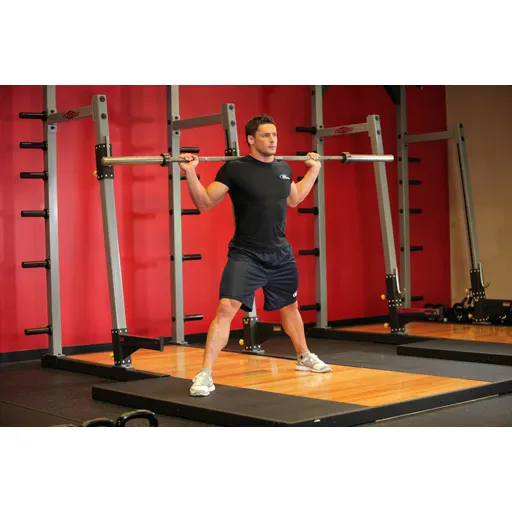
Leverage High Row

Leverage High Row

Lưng giữa — Máy

Hướng dẫn & lỗi thường gặp EN
  1. Load an appropriate weight onto the pins and adjust the seat height so that you can just reach the handles above you. Adjust the knee pad to help keep you down. Grasp the handles with a pronated grip. This will be your starting position.
  2. Pull the handles towards your torso, retracting your shoulder blades as you flex the elbow.
  3. Pause at the bottom of the motion, and then slowly return the handles to the starting position.
  4. For multiple repetitions, avoid completely returning the weight to the stops to keep tension on the muscles being worked.

Lỗi thường gặp

  • Kéo về bụng dưới, khuỷu sát thân, vai hạ thấp.
  • Thân người giữ gập ổn định, không đứng dậy theo mỗi lần kéo.
Leverage Iso Row

Leverage Iso Row

Lưng (cơ lưng rộng) — Máy

Hướng dẫn & lỗi thường gặp EN
  1. Load an appropriate weight onto the pins and adjust the seat height so that the handles are at chest level. Grasp the handles with either a neutral or pronated grip. This will be your starting position.
  2. Pull the handles towards your torso, retracting your shoulder blades as you flex the elbow.
  3. Pause at the bottom of the motion, and then slowly return the handles to the starting position. For multiple repetitions, avoid completely returning the weight to the stops to keep tension on the muscles being worked.

Lỗi thường gặp

  • Kéo bằng khuỷu xuống về phía hông, không bẻ tay bứt tốc.
  • Ngực mở, vai hạ thấp — không shrug vai khi kéo.
Leverage Shoulder Press

Leverage Shoulder Press

Vai — Máy

Hướng dẫn & lỗi thường gặp EN
  1. Load an appropriate weight onto the pins and adjust the seat for your height. The handles should be near the top of the shoulders at the beginning of the motion. Your chest and head should be up and handles held with a pronated grip. This will be your starting position.
  2. Press the handles upward by extending through the elbow.
  3. After a brief pause at the top, return the weight to just above the start position, keeping tension on the muscles by not returning the weight to the stops until the set is complete.

Lỗi thường gặp

  • Vai hạ thấp, không shrug lên gần tai khi đẩy hoặc nâng.
  • Khuỷu theo hướng tự nhiên của khớp, không khóa cứng ở đỉnh.
Leverage Shrug

Leverage Shrug

Vai - thang — Máy

Hướng dẫn & lỗi thường gặp EN
  1. Load the pins to an appropriate weight. Position yourself directly between the handles.
  2. Grasp the top handles with a comfortable grip, and then lower your hips as you take a breath. Look forward with your head and keep your chest up.
  3. Drive through the floor with your heels, extending your hips and knees as you rise to a standing position. Keep your arms straight throughout the movement, finishing with your shoulders back. This will be your starting position.
  4. Raise the weight by shrugging the shoulders towards your ears, moving straight up and down.
  5. Pause at the top of the motion, and then return the weight to the starting position.

Lỗi thường gặp

  • Ưu tiên biên độ đầy đủ và nhịp chậm đều trước khi tăng tạ.
  • Giữ thân người ổn định, khu vực đang tập mới là nơi di chuyển chính.
Lying Close-Grip Bar Curl On High Pulley

Lying Close-Grip Bar Curl On High Pulley

Tay trước — Cáp

Hướng dẫn & lỗi thường gặp EN
  1. Place a flat bench in front of a high pulley or lat pulldown machine.
  2. Hold the straight bar attachment using an underhand grip (palms up) that is about shoulder width.
  3. Lie on your back with your head over the end of the bench.
  4. Now extend your arms straight above your shoulders. Your torso and your arms should make a 90-degree angle and the elbows should be in. This will be your starting position.
  5. As you breathe out, curl the bar down in a semicircular motion until it touches your chin. Squeeze the biceps for a second at the top contracted position. Tip: As you execute this motion only the forearms should move. At no time should the upper arms be moving at all. They are to remain perpendicular throughout the movement.
  6. Return to starting position slowly.
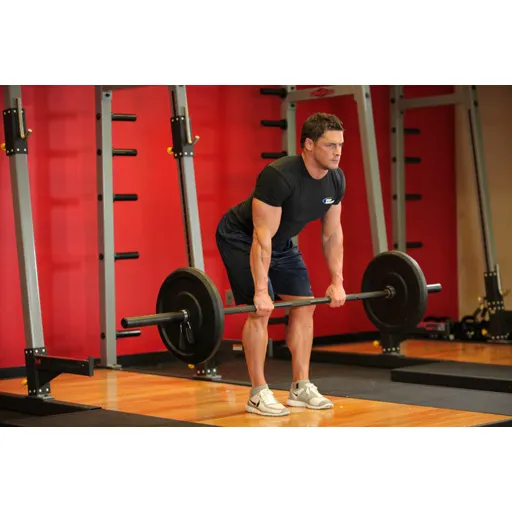
  7. Repeat for the recommended amount of repetitions.
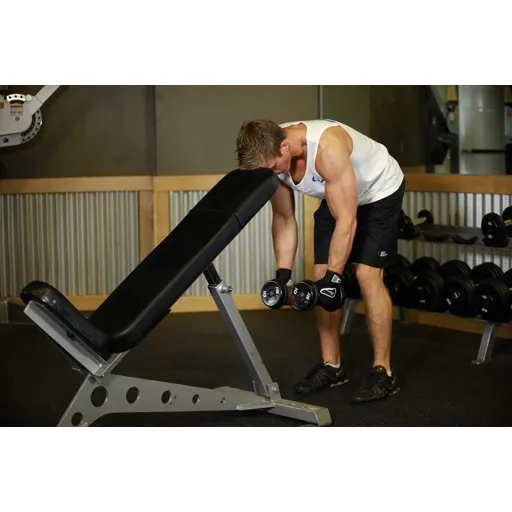
Lỗi thường gặp

  • Khuỷu cố định sát thân, không đưa vai hoặc thân người vào nối lực.
  • Hạ tạ chậm bằng kiểm soát, không thả tay theo trọng lực.
Lying Close-Grip Barbell Triceps Press To Chin

Lying Close-Grip Barbell Triceps Press To Chin

Tay sau — Tạ đòn cong

Hướng dẫn & lỗi thường gặp EN
  1. While holding a barbell or EZ Curl bar with a pronated grip (palms facing forward), lie on your back on a flat bench with your head off the end of the bench. Tip: If you are holding a barbell grab it using a shoulder-width grip and if you are using an E-Z Bar grab it on the inner handles.
  2. Extend your arms in front of you as you hold the barbell over your chest. The arms should be perpendicular to your torso (90-degree angle). This will be your starting position.
  3. As you inhale, lower the bar in a semi-circular motion by bending at the elbows and while keeping the upper arm stationary and elbows in. Keep lowering the bar until it lightly touches your chin.
  4. As you exhale bring the bar back up to the starting position by pushing the bar up in a semi-circular motion. Contract the triceps hard at the top of the movement for a second. Tip: Again, only the forearms should move. The upper arms should remain stationary at all times.
  5. Repeat for the recommended amount of repetitions.

Lỗi thường gặp

  • Khuỷu giữ một điểm cố định, phần còn lại của cánh tay không di chuyển.
  • Duỗi hết ở đỉnh, siết tay sau rồi hạ chậm.
Lying Leg Curls

Lying Leg Curls

Đùi sau — Máy

Hướng dẫn & lỗi thường gặp EN
  1. Adjust the machine lever to fit your height and lie face down on the leg curl machine with the pad of the lever on the back of your legs (just a few inches under the calves). Tip: Preferably use a leg curl machine that is angled as opposed to flat since an angled position is more favorable for hamstrings recruitment.
  2. Keeping the torso flat on the bench, ensure your legs are fully stretched and grab the side handles of the machine. Position your toes straight (or you can also use any of the other two stances described on the foot positioning section). This will be your starting position.
  3. As you exhale, curl your legs up as far as possible without lifting the upper legs from the pad. Once you hit the fully contracted position, hold it for a second.
  4. As you inhale, bring the legs back to the initial position. Repeat for the recommended amount of repetitions.

Lỗi thường gặp

  • Gập người bằng hông, lưng trung tính — không cong lưng để tạ đi xa hơn.
  • Siết đùi sau ở đỉnh rồi hạ xuống bằng kiểm soát.
Machine Bicep Curl

Machine Bicep Curl

Tay trước — Máy

Hướng dẫn & lỗi thường gặp EN
  1. Adjust the seat to the appropriate height and make your weight selection. Place your upper arms against the pads and grasp the handles. This will be your starting position.
  2. Perform the movement by flexing the elbow, pulling your lower arm towards your upper arm.
  3. Pause at the top of the movement, and then slowly return the weight to the starting position.
  4. Avoid returning the weight all the way to the stops until the set is complete to keep tension on the muscles being worked.

Lỗi thường gặp

  • Chỉnh ghế để khuỷu ôm trọn đệm cố định, không nhấc khuỷu khỏi đệm.
  • Cuộn chậm và siết ở đỉnh, không vung thân người khi tạ nặng.
Machine Preacher Curls

Machine Preacher Curls

Tay trước — Máy

Hướng dẫn & lỗi thường gặp EN
  1. Sit down on the Preacher Curl Machine and select the weight.
  2. Place the back of your upper arms (your triceps) on the preacher pad provided and grab the handles using an underhand grip (palms facing up). Tip: Make sure that when you place the arms on the pad you keep the elbows in. This will be your starting position.
  3. Now lift the handles as you exhale and you contract the biceps. At the top of the position make sure that you hold the contraction for a second. Tip: Only the forearms should move. The upper arms should remain stationary and on the pad at all times.
  4. Lower the handles slowly back to the starting position as you inhale.
  5. Repeat for the recommended amount of repetitions.

Lỗi thường gặp

  • Khuỷu cố định sát thân, không đưa vai hoặc thân người vào nối lực.
  • Hạ tạ chậm bằng kiểm soát, không thả tay theo trọng lực.
Machine Shoulder (Military) Press

Machine Shoulder (Military) Press

Vai — Máy

Hướng dẫn & lỗi thường gặp EN
  1. Sit down on the Shoulder Press Machine and select the weight.
  2. Grab the handles to your sides as you keep the elbows bent and in line with your torso. This will be your starting position.
  3. Now lift the handles as you exhale and you extend the arms fully. At the top of the position make sure that you hold the contraction for a second.
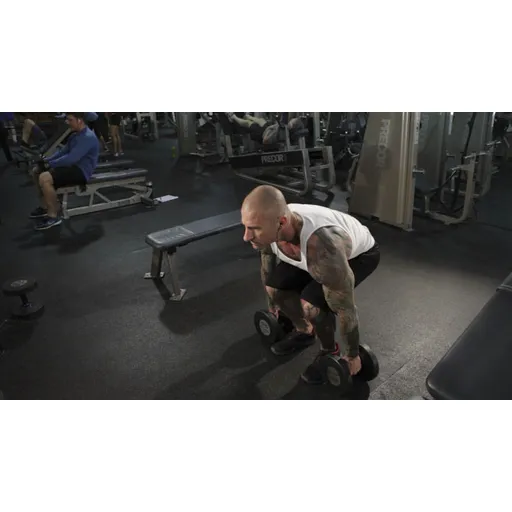
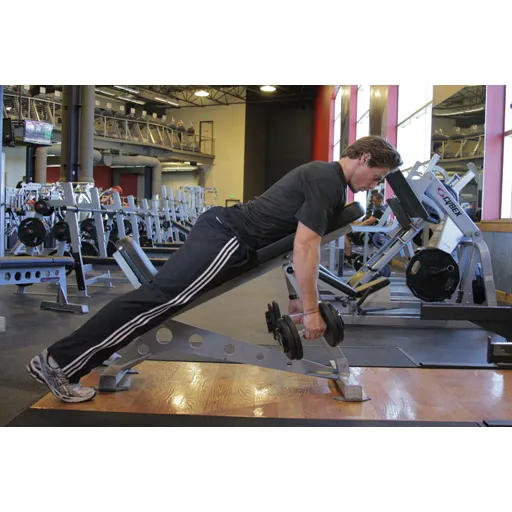
  4. Lower the handles slowly back to the starting position as you inhale.
  5. Repeat for the recommended amount of repetitions.

Lỗi thường gặp

  • Vai hạ thấp, không shrug lên gần tai khi đẩy hoặc nâng.
  • Khuỷu theo hướng tự nhiên của khớp, không khóa cứng ở đỉnh.
Machine Triceps Extension

Machine Triceps Extension

Tay sau — Máy

Hướng dẫn & lỗi thường gặp EN
  1. Adjust the seat to the appropriate height and make your weight selection. Place your upper arms against the pads and grasp the handles. This will be your starting position.
  2. Perform the movement by extending the elbow, pulling your lower arm away from your upper arm.
  3. Pause at the completion of the movement, and then slowly return the weight to the starting position.
  4. Avoid returning the weight all the way to the stops until the set is complete to keep tension on the muscles being worked.

Lỗi thường gặp

  • Khuỷu giữ một điểm cố định, phần còn lại của cánh tay không di chuyển.
  • Duỗi hết ở đỉnh, siết tay sau rồi hạ chậm.
Monster Walk

Monster Walk

abductors — Dây kháng lực

Hướng dẫn & lỗi thường gặp EN
  1. Place a band around both ankles and another around both knees. There should be enough tension that they are tight when your feet are shoulder width apart.
  2. To begin, take short steps forward alternating your left and right foot.
  3. After several steps, do just the opposite and walk backward to where you started.

Lỗi thường gặp

  • Ưu tiên biên độ đầy đủ và nhịp chậm đều trước khi tăng tạ.
  • Giữ thân người ổn định, khu vực đang tập mới là nơi di chuyển chính.
Natural Glute Ham Raise

Natural Glute Ham Raise

Đùi sau — Không tạ

Hướng dẫn & lỗi thường gặp EN
  1. Using the leg pad of a lat pulldown machine or a preacher bench, position yourself so that your ankles are under the pads, knees on the seat, and you are facing away from the machine. You should be upright and maintaining good posture.
  2. This will be your starting position. Lower yourself under control until your knees are almost completely straight.
  3. Remaining in control, raise yourself back up to the starting position.
  4. If you are unable to complete a rep, use a band, a partner, or push off of a box to aid in completing a repetition.

Lỗi thường gặp

  • Gập người bằng hông, lưng trung tính — không cong lưng để tạ đi xa hơn.
  • Siết đùi sau ở đỉnh rồi hạ xuống bằng kiểm soát.
One-Arm Kettlebell Row

One-Arm Kettlebell Row

Lưng giữa — Kettlebell

Hướng dẫn & lỗi thường gặp EN
  1. Place a kettlebell in front of your feet. Bend your knees slightly and then push your butt out as much as possible as you bend over to get in the starting position. Grab the kettlebell and pull it to your stomach, retracting your shoulder blade and flexing the elbow. Keep your back straight. Lower and repeat.

Lỗi thường gặp

  • Kéo về bụng dưới, khuỷu sát thân, vai hạ thấp.
  • Thân người giữ gập ổn định, không đứng dậy theo mỗi lần kéo.
One-Arm Medicine Ball Slam

One-Arm Medicine Ball Slam

Bụng — Bóng tạ

Hướng dẫn & lỗi thường gặp EN
  1. Start in a standing position with a staggered, athletic stance. Hold a medicine ball in one hand, on the same side as your back leg. This will be your starting position.
  2. Begin by winding the arm, raising the medicine ball above your head. As you do so, extend through the hips, knees, and ankles to load up for the slam.
  3. At peak extension, flex the shoulders, spine, and hips to throw the ball hard into the ground directly in front of you.
  4. Catch the ball on the bounce and continue for the desired number of repetitions.

Lỗi thường gặp

  • Gập bằng cơ bụng, không kéo cổ hoặc vung thân người.
  • Thở ra khi gập, lưng dưới ổn định suốt cử động.
One-Legged Cable Kickback

One-Legged Cable Kickback

Mông — Cáp

Hướng dẫn & lỗi thường gặp EN
  1. Hook a leather ankle cuff to a low cable pulley and then attach the cuff to your ankle.
  2. Face the weight stack from a distance of about two feet, grasping the steel frame for support.
  3. While keeping your knees and hips bent slightly and your abs tight, contract your glutes to slowly "kick" the working leg back in a semicircular arc as high as it will comfortably go as you breathe out. Tip: At full extension, squeeze your glutes for a second in order to achieve a peak contraction.
  4. Now slowly bring your working leg forward, resisting the pull of the cable until you reach the starting position.
  5. Repeat for the recommended amount of repetitions.
  6. Switch legs and repeat the movement for the other side.

Lỗi thường gặp

  • Siết mông mạnh ở đỉnh chuyển động, không ưỡn lưng dưới thay thế.
  • Chuyển động chậm và hết biên độ, không vung theo quán tính.
Palms-Down Dumbbell Wrist Curl Over A Bench

Palms-Down Dumbbell Wrist Curl Over A Bench

Cẳng tay — Tạ tay

Hướng dẫn & lỗi thường gặp EN
  1. Start out by placing two dumbbells on one side of a flat bench.
  2. Kneel down on both of your knees so that your body is facing the flat bench.
  3. Use your arms to grab both of the dumbbells with a pronated grip (palms facing down) and bring them up so that your forearms are resting against the flat bench. Your wrists should be hanging over the edge.
  4. Start out by curling your wrist upwards and exhaling.
  5. Slowly lower your wrists back down to the starting position while inhaling.
  6. Your forearms should be stationary as your wrist is the only movement needed to perform this exercise.
  7. Repeat for the recommended amount of repetitions.

Lỗi thường gặp

  • Cổ tay giữ trung tính, không gập gập liên tục làm mỏi cẳng tay sớm.
  • Nắm chắc nhưng không siết quá mức làm tê tay.
Palms-Down Wrist Curl Over A Bench

Palms-Down Wrist Curl Over A Bench

Cẳng tay — Tạ đòn

Hướng dẫn & lỗi thường gặp EN
  1. Start out by placing a barbell on one side of a flat bench.
  2. Kneel down on both of your knees so that your body is facing the flat bench.
  3. Use your arms to grab the barbell with a pronated grip (palms down) and bring them up so that your forearms are resting against the flat bench. Your wrists should be hanging over the edge.
  4. Start out by curling your wrist upwards and exhaling.
  5. Slowly lower your wrists back down to the starting position while inhaling.
  6. Your forearms should be stationary as your wrist is the only movement needed to perform this exercise.
  7. Repeat for the recommended amount of repetitions.

Lỗi thường gặp

  • Cổ tay giữ trung tính, không gập gập liên tục làm mỏi cẳng tay sớm.
  • Nắm chắc nhưng không siết quá mức làm tê tay.
Palms-Up Dumbbell Wrist Curl Over A Bench

Palms-Up Dumbbell Wrist Curl Over A Bench

Cẳng tay — Tạ tay

Hướng dẫn & lỗi thường gặp EN
  1. Start out by placing two dumbbells on one side of a flat bench.
  2. Kneel down on both of your knees so that your body is facing the flat bench.
  3. Use your arms to grab both of the dumbbells with a supinated grip (palms up) and bring them up so that your forearms are resting against the flat bench. Your wrists should be hanging over the edge.
  4. Start out by curling your wrist upwards and exhaling.
  5. Slowly lower your wrists back down to the starting position while inhaling. Make sure to inhale during this part of the exercise.
  6. Your forearms should be stationary as your wrist is the only movement needed to perform this exercise.
  7. Repeat for the recommended amount of repetitions.

Lỗi thường gặp

  • Cổ tay giữ trung tính, không gập gập liên tục làm mỏi cẳng tay sớm.
  • Nắm chắc nhưng không siết quá mức làm tê tay.
Physioball Hip Bridge

Physioball Hip Bridge

Mông — Bóng tập

Hướng dẫn & lỗi thường gặp EN
  1. Lay on a ball so that your upper back is on the ball with your hips unsupported. Both feet should be flat on the floor, hip width apart or wider. This will be your starting position.
  2. Begin by extending the hips using your glutes and hamstrings, raising your hips upward as you bridge.
  3. Pause at the top of the motion and return to the starting position.

Lỗi thường gặp

  • Siết mông mạnh ở đỉnh chuyển động, không ưỡn lưng dưới thay thế.
  • Chuyển động chậm và hết biên độ, không vung theo quán tính.
Plank

Plank

Bụng — Không tạ

Hướng dẫn & lỗi thường gặp EN
  1. Get into a prone position on the floor, supporting your weight on your toes and your forearms. Your arms are bent and directly below the shoulder.
  2. Keep your body straight at all times, and hold this position as long as possible. To increase difficulty, an arm or leg can be raised.

Lỗi thường gặp

  • Hông không tụt xuống cũng không nhô cao quá — thân giữ một đường thẳng.
  • Siết bụng và mông suốt thời gian giữ, tránh dồn lực lên thắt lưng.
Plie Dumbbell Squat

Plie Dumbbell Squat

Đùi trước — Tạ tay

Hướng dẫn & lỗi thường gặp EN
  1. Hold a dumbbell at the base with both hands and stand straight up. Move your legs so that they are wider than shoulder width apart from each other with your knees slightly bent.
  2. Your toes should be facing out. Note: Your arms should be stationary while performing the exercise. This is the starting position.
  3. Slowly bend the knees and lower your legs until your thighs are parallel to the floor. Make sure to inhale as this is the eccentric part of the exercise.
  4. Press mainly with the heel of the foot to bring the body back to the starting position while exhaling.
  5. Repeat for the recommended amount of repetitions.

Lỗi thường gặp

  • Đầu gối đi cùng hướng mũi chân, không gập vào trong.
  • Hạ chậm, không bật nảy ở đáy; gót (hoặc đệm) bám chắc suốt cú đẩy.
Power Clean

Power Clean

Đùi sau — Tạ đòn

Hướng dẫn & lỗi thường gặp EN
  1. Stand with your feet slightly wider than shoulder width apart and toes pointing out slightly.
  2. Squat down and grasp bar with a closed, pronated grip. Your hands should be slightly wider than shoulder width apart outside knees with elbows fully extended.
  3. Place the bar about 1 inch in front of your shins and over the balls of your feet.
  4. Your back should be flat or slightly arched, your chest held up and out and your shoulder blades should be retracted.
  5. Keep your head in a neutral position (in line with vertebral column and not tilted or rotated) with your eyes focused straight ahead. Inhale during this phase.
  6. Lift the bar from the floor by forcefully extending the hips and the knees as you exhale. Tip: The upper torso should maintain the same angle. Do not bend at the waist yet and do not let the hips rise before the shoulders (this would have the effect of pushing the glutes in the air and stretching the hamstrings.
  7. Keep elbows fully extended with the head in a neutral position and the shoulders over the bar.
  8. As the bar raises keep it as close to the shins as possible.
  9. As the bar passes the knees, thrust your hips forward and slightly bend the knees to avoid locking them. Tip: At this point your thighs should be against the bar.
  10. Keep the back flat or slightly arched, elbows fully extended and your head neutral. Tip: You will hold your breath until the next phase.
  11. Inhale and then forcefully and quickly extend your hips and knees and stand on your toes.
  12. Keep the bar as close to your body as possible. Tip: Your back should be flat with the elbows pointed out to the sides and your head in a neutral position. Also, keep your shoulders over the bar and arms straight as long as possible.
  13. When your lower body joints are fully extended, shrug the shoulders upward rapidly without letting the elbows flex yet. Exhale during this portion of the movement.
  14. As the shoulders reach their highest elevation flex your elbows to begin pulling your body under the bar.
  15. Continue to pull the arms as high and as long as possible. Tip: Due to the explosive nature of this phase, your torso will be erect or with an arched back, your head will be tilted back slightly and your feet may lose contact with the floor.
  16. After the lower body has fully extended and the bar reaches near maximal height, pull your body under the bar and rotate the arms around and under the bar.
  17. Simultaneously, flex the hips and knees into a quarter squat position.
  18. Once the arms are under the bar, inhale and then lift your elbows to position the upper arms parallel to the floor. Rack the bar across the front of your collar bones and front shoulder muscles.
  19. Catch the bar with an erect and tight torso, a neutral head position and flat feet. Exhale during this movement.
  20. Stand up by extending the hips and knees to a fully erect position.
  21. Lower the bar by gradually reducing the muscular tension of the arms to allow a controlled descent of the bar to the thighs. Inhale during this movement.
  22. Simultaneously flex the hips and knees to cushion the impact of the bar on the thighs.
  23. Squat down with the elbows fully extended until the bar touches the floor.
  24. Start over at Phase 1 and repeat for the recommended amount of repetitions.

Lỗi thường gặp

  • Gập người bằng hông, lưng trung tính — không cong lưng để tạ đi xa hơn.
  • Siết đùi sau ở đỉnh rồi hạ xuống bằng kiểm soát.
Pull Through

Pull Through

Mông — Cáp

Hướng dẫn & lỗi thường gặp EN
  1. Begin standing a few feet in front of a low pulley with a rope or handle attached. Face away from the machine, straddling the cable, with your feet set wide apart.
  2. Begin the movement by reaching through your legs as far as possible, bending at the hips. Keep your knees slightly bent. Keeping your arms straight, extend through the hip to stand straight up. Avoid pulling upward through the shoulders; all of the motion should originate through the hips.

Lỗi thường gặp

  • Siết mông mạnh ở đỉnh chuyển động, không ưỡn lưng dưới thay thế.
  • Chuyển động chậm và hết biên độ, không vung theo quán tính.
Pullups

Pullups

Lưng (cơ lưng rộng) — Không tạ

Hướng dẫn & lỗi thường gặp EN
  1. Grab the pull-up bar with the palms facing forward using the prescribed grip. Note on grips: For a wide grip, your hands need to be spaced out at a distance wider than your shoulder width. For a medium grip, your hands need to be spaced out at a distance equal to your shoulder width and for a close grip at a distance smaller than your shoulder width.
  2. As you have both arms extended in front of you holding the bar at the chosen grip width, bring your torso back around 30 degrees or so while creating a curvature on your lower back and sticking your chest out. This is your starting position.
  3. Pull your torso up until the bar touches your upper chest by drawing the shoulders and the upper arms down and back. Exhale as you perform this portion of the movement. Tip: Concentrate on squeezing the back muscles once you reach the full contracted position. The upper torso should remain stationary as it moves through space and only the arms should move. The forearms should do no other work other than hold the bar.
  4. After a second on the contracted position, start to inhale and slowly lower your torso back to the starting position when your arms are fully extended and the lats are fully stretched.
  5. Repeat this motion for the prescribed amount of repetitions.

Lỗi thường gặp

  • Kéo bằng khuỷu xuống về phía hông, không bẻ tay bứt tốc.
  • Ngực mở, vai hạ thấp — không shrug vai khi kéo.
Push-Ups With Feet On An Exercise Ball

Push-Ups With Feet On An Exercise Ball

Ngực — Bóng tập

Hướng dẫn & lỗi thường gặp EN
  1. Lie on the floor face down and place your hands about 36 inches apart from each other holding your torso up at arms length.
  2. Place your toes on top of an exercise ball. This will allow your body to be elevated.
  3. Lower yourself until your chest almost touches the floor as you inhale.
  4. Using your pectoral muscles, press your upper body back up to the starting position and squeeze your chest. Breathe out as you perform this step.
  5. After a second pause at the contracted position, repeat the movement for the prescribed amount of repetitions.

Lỗi thường gặp

  • Khuỷu ~45° so với thân, hạ tạ tới giữa ngực theo kiểm soát.
  • Lưng và vai trên bám ghế, không ưỡn hông để nối lực.
Chống đẩy

Chống đẩy

Ngực — Không tạ

Hướng dẫn & lỗi thường gặp EN
  1. Lie on the floor face down and place your hands about 36 inches apart while holding your torso up at arms length.
  2. Next, lower yourself downward until your chest almost touches the floor as you inhale.
  3. Now breathe out and press your upper body back up to the starting position while squeezing your chest.
  4. After a brief pause at the top contracted position, you can begin to lower yourself downward again for as many repetitions as needed.

Lỗi thường gặp

  • Thân giữ thẳng từ đầu đến gót, không dùng lực đánh hông đẩy lên.
  • Khuỷu khép ~45°, hạ ngực gần sàn thay vì chỉ nhún vai.
Rocking Standing Calf Raise

Rocking Standing Calf Raise

Bắp chân — Tạ đòn

Hướng dẫn & lỗi thường gặp EN
  1. This exercise is best performed inside a squat rack for safety purposes. To begin, first set the bar on a rack that best matches your height. Once the correct height is chosen and the bar is loaded, step under the bar and place it on the back of your shoulders (slightly below the neck).
  2. Hold on to the bar using both arms at each side and lift it off the rack by first pushing with your legs and at the same time straightening your torso.
  3. Step away from the rack and position your legs using a shoulder width medium stance with the toes slightly pointed out. Keep your head up at all times as looking down will get you off balance. Also maintain a straight back and keep the knees with a slight bend; never locked. This will be your starting position.
  4. Raise your heels as you breathe out by extending your ankles as high as possible and flexing your calf. Ensure that the knee is kept stationary at all times. There should be no bending (other than the slight initial bend we created during positioning) at any time. Hold the contracted position by a second before you start to go back down.
  5. Go back slowly to the starting position as you breathe in by lowering your heels as you bend the ankles until calves are stretched.
  6. Now lift your toes by contracting the tibia muscles in the front of the calves as you breathe out.
  7. Hold for a second and bring them back down as you breathe in.
  8. Repeat for the recommended amount of repetitions.

Lỗi thường gặp

  • Biên độ đầy đủ: hạ gót sâu, nâng cao nhất ở đỉnh, dừng ngắn ở hai đầu.
  • Di chuyển chậm đều, tránh bật nhịp theo quán tính.
Deadlift Romania

Deadlift Romania

Đùi sau — Tạ đòn

Hướng dẫn & lỗi thường gặp EN
  1. Put a barbell in front of you on the ground and grab it using a pronated (palms facing down) grip that a little wider than shoulder width. Tip: Depending on the weight used, you may need wrist wraps to perform the exercise and also a raised platform in order to allow for better range of motion.
  2. Bend the knees slightly and keep the shins vertical, hips back and back straight. This will be your starting position.
  3. Keeping your back and arms completely straight at all times, use your hips to lift the bar as you exhale. Tip: The movement should not be fast but steady and under control.
  4. Once you are standing completely straight up, lower the bar by pushing the hips back, only slightly bending the knees, unlike when squatting. Tip: Take a deep breath at the start of the movement and keep your chest up. Hold your breath as you lower and exhale as you complete the movement.
  5. Repeat for the recommended amount of repetitions.

Lỗi thường gặp

  • Gập người bằng khớp hông, lưng giữ thẳng — không cong lưng khi tạ qua đầu gối.
  • Đầu gối hơi chùng nhưng không gập sâu thành squat.
Seated Barbell Twist

Seated Barbell Twist

Bụng — Tạ đòn

Hướng dẫn & lỗi thường gặp EN
  1. Start out by sitting at the end of a flat bench with a barbell placed on top of your thighs. Your feet should be shoulder width apart from each other.
  2. Grip the bar with your palms facing down and make sure your hands are wider than shoulder width apart from each other. Begin to lift the barbell up over your head until your arms are fully extended.
  3. Now lower the barbell behind your head until it is resting along the base of your neck. This is the starting position.
  4. While keeping your feet and head stationary, move your waist from side to side so that your oblique muscles feel the contraction. Only move from side to side as far as your waist will allow you to go. Stretching or moving too far can cause an injury to occur. Tip: Use a slow and controlled motion.
  5. Remember to breathe out while twisting your body to the side and in when moving back to the starting position.
  6. Repeat for the recommended amount of repetitions.

Lỗi thường gặp

  • Gập bằng cơ bụng, không kéo cổ hoặc vung thân người.
  • Thở ra khi gập, lưng dưới ổn định suốt cử động.
Seated Cable Rows

Seated Cable Rows

Lưng giữa — Cáp

Hướng dẫn & lỗi thường gặp EN
  1. For this exercise you will need access to a low pulley row machine with a V-bar. Note: The V-bar will enable you to have a neutral grip where the palms of your hands face each other. To get into the starting position, first sit down on the machine and place your feet on the front platform or crossbar provided making sure that your knees are slightly bent and not locked.
  2. Lean over as you keep the natural alignment of your back and grab the V-bar handles.
  3. With your arms extended pull back until your torso is at a 90-degree angle from your legs. Your back should be slightly arched and your chest should be sticking out. You should be feeling a nice stretch on your lats as you hold the bar in front of you. This is the starting position of the exercise.
  4. Keeping the torso stationary, pull the handles back towards your torso while keeping the arms close to it until you touch the abdominals. Breathe out as you perform that movement. At that point you should be squeezing your back muscles hard. Hold that contraction for a second and slowly go back to the original position while breathing in.
  5. Repeat for the recommended amount of repetitions.

Lỗi thường gặp

  • Kéo về bụng dưới, khuỷu sát thân, vai hạ thấp.
  • Thân người giữ gập ổn định, không đứng dậy theo mỗi lần kéo.
Nâng gót ngồi

Nâng gót ngồi

Bắp chân — Máy

Hướng dẫn & lỗi thường gặp EN
  1. Sit on the machine and place your toes on the lower portion of the platform provided with the heels extending off. Choose the toe positioning of your choice (forward, in, or out) as per the beginning of this chapter.
  2. Place your lower thighs under the lever pad, which will need to be adjusted according to the height of your thighs. Now place your hands on top of the lever pad in order to prevent it from slipping forward.
  3. Lift the lever slightly by pushing your heels up and release the safety bar. This will be your starting position.
  4. Slowly lower your heels by bending at the ankles until the calves are fully stretched. Inhale as you perform this movement.
  5. Raise the heels by extending the ankles as high as possible as you contract the calves and breathe out. Hold the top contraction for a second.
  6. Repeat for the recommended amount of repetitions.

Lỗi thường gặp

  • Biên độ đủ rộng: hạ gót sâu rồi nâng cao nhất có thể ở đỉnh.
  • Di chuyển chậm và đều, không bật nhịp gót theo quán tính.
Seated Dumbbell Palms-Down Wrist Curl

Seated Dumbbell Palms-Down Wrist Curl

Cẳng tay — Tạ tay

Hướng dẫn & lỗi thường gặp EN
  1. Start out by placing two dumbbells on the floor in front of a flat bench.
  2. Sit down on the edge of the flat bench with your legs at about shoulder width apart. Make sure to keep your feet on the floor.
  3. Use your arms to grab both of the dumbbells and bring them up so that your forearms are resting against your thighs with the palms of the hands facing down. Your wrists should be hanging over the edge of your thighs.
  4. Start out by curling your wrist upwards and exhaling.
  5. Slowly lower your wrists back down to the starting position while inhaling. Make sure to inhale during this part of the exercise. Tip: Your forearms should be stationary as your wrist is the only movement needed to perform this exercise.
  6. Repeat for the recommended amount of repetitions.
  7. When finished, simply lower the dumbbells to the floor.

Lỗi thường gặp

  • Cổ tay giữ trung tính, không gập gập liên tục làm mỏi cẳng tay sớm.
  • Nắm chắc nhưng không siết quá mức làm tê tay.
Đẩy vai ngồi với tạ tay

Đẩy vai ngồi với tạ tay

Vai — Tạ tay

Hướng dẫn & lỗi thường gặp EN
  1. Grab a couple of dumbbells and sit on a military press bench or a utility bench that has a back support on it as you place the dumbbells upright on top of your thighs.
  2. Clean the dumbbells up one at a time by using your thighs to bring the dumbbells up to shoulder height at each side.
  3. Rotate the wrists so that the palms of your hands are facing forward. This is your starting position.
  4. As you exhale, push the dumbbells up until they touch at the top.
  5. After a second pause, slowly come down back to the starting position as you inhale.
  6. Repeat for the recommended amount of repetitions.

Lỗi thường gặp

  • Hạ tạ tới ngang tai, không hạ quá sâu làm vai xoay vượt tự nhiên.
  • Siết bụng, không ưỡn lưng ghế khi đẩy tạ lên.
Seated Leg Curl

Seated Leg Curl

Đùi sau — Máy

Hướng dẫn & lỗi thường gặp EN
  1. Adjust the machine lever to fit your height and sit on the machine with your back against the back support pad.
  2. Place the back of lower leg on top of padded lever (just a few inches under the calves) and secure the lap pad against your thighs, just above the knees. Then grasp the side handles on the machine as you point your toes straight (or you can also use any of the other two stances) and ensure that the legs are fully straight right in front of you. This will be your starting position.
  3. As you exhale, pull the machine lever as far as possible to the back of your thighs by flexing at the knees. Keep your torso stationary at all times. Hold the contracted position for a second.
  4. Slowly return to the starting position as you breathe in.
  5. Repeat for the recommended amount of repetitions.

Lỗi thường gặp

  • Gập người bằng hông, lưng trung tính — không cong lưng để tạ đi xa hơn.
  • Siết đùi sau ở đỉnh rồi hạ xuống bằng kiểm soát.
Seated One-arm Cable Pulley Rows

Seated One-arm Cable Pulley Rows

Lưng giữa — Cáp

Hướng dẫn & lỗi thường gặp EN
  1. To get into the starting position, first sit down on the machine and place your feet on the front platform or crossbar provided making sure that your knees are slightly bent and not locked.
  2. Lean over as you keep the natural alignment of your back and grab the single handle attachment with your left arm using a palms-down grip.
  3. With your arm extended pull back until your torso is at a 90-degree angle from your legs. Your back should be slightly arched and your chest should be sticking out. You should be feeling a nice stretch on your lat as you hold the bar in front of you. The right arm can be kept by the waist. This is the starting position of the exercise.
  4. Keeping the torso stationary, pull the handles back towards your torso while keeping the arms close to it as you rotate the wrist, so that by the time your hand is by your abdominals it is in a neutral position (palms facing the torso). Breathe out as you perform that movement. At that point you should be squeezing your back muscles hard.
  5. Hold that contraction for a second and slowly go back to the original position while breathing in. Tip: Remember to rotate the wrist as you go back to the starting position so that the palms are facing down again.
  6. Repeat for the recommended amount of repetitions and then perform the same movement with the right hand.

Lỗi thường gặp

  • Kéo về bụng dưới, khuỷu sát thân, vai hạ thấp.
  • Thân người giữ gập ổn định, không đứng dậy theo mỗi lần kéo.
Seated Two-Arm Palms-Up Low-Pulley Wrist Curl

Seated Two-Arm Palms-Up Low-Pulley Wrist Curl

Cẳng tay — Cáp

Hướng dẫn & lỗi thường gặp EN
  1. Put a bench in front of a low pulley machine that has a barbell or EZ Curl attachment on it.
  2. Move the bench far enough away so that when you bring the handle to the top of your thighs tension is created on the cable due to the weight stack being moved up.
  3. Now hold the handle with both hands, palms up, using a shoulder-width grip.
  4. Step back and sit on the bench with your feet about shoulder width apart, firmly on the floor.
  5. Lean forward and place the forearms on your thighs with the back of your wrists over your knees. This will be your starting position.
  6. Lower the bar as far as possible, while inhaling and keeping a tight grip.
  7. Now curl the bar up as high as possible while contracting the forearms. Tip: Only the wrist should move; not the forearms.
  8. After a second contraction at the top go back to the starting position as you inhale.
  9. Repeat for the recommended amount of repetitions.

Lỗi thường gặp

  • Cổ tay giữ trung tính, không gập gập liên tục làm mỏi cẳng tay sớm.
  • Nắm chắc nhưng không siết quá mức làm tê tay.
Nâng vai bên với tạ tay

Nâng vai bên với tạ tay

Vai — Tạ tay

Hướng dẫn & lỗi thường gặp EN
  1. Pick a couple of dumbbells and stand with a straight torso and the dumbbells by your side at arms length with the palms of the hand facing you. This will be your starting position.
  2. While maintaining the torso in a stationary position (no swinging), lift the dumbbells to your side with a slight bend on the elbow and the hands slightly tilted forward as if pouring water in a glass. Continue to go up until you arms are parallel to the floor. Exhale as you execute this movement and pause for a second at the top.
  3. Lower the dumbbells back down slowly to the starting position as you inhale.
  4. Repeat for the recommended amount of repetitions.

Lỗi thường gặp

  • Vai hạ thấp, không shrug lên gần tai khi đẩy hoặc nâng.
  • Khuỷu theo hướng tự nhiên của khớp, không khóa cứng ở đỉnh.
Smith Machine Behind the Back Shrug

Smith Machine Behind the Back Shrug

Vai - thang — Máy

Hướng dẫn & lỗi thường gặp EN
  1. With the bar at thigh level, load an appropriate weight.
  2. Stand with the bar behind you, taking a shoulder-width, pronated grip on the bar and unhook the weight. You should be standing up straight with your head and chest up and your arms extended. This will be your starting position.
  3. Initiate the movement by shrugging your shoulders straight up. Do not flex the arms or wrist during the movement.
  4. After a brief pause return the weight to the starting position.
  5. Repeat for the desired number of repetitions before engaging the hooks to rack the weight.

Lỗi thường gặp

  • Ưu tiên biên độ đầy đủ và nhịp chậm đều trước khi tăng tạ.
  • Giữ thân người ổn định, khu vực đang tập mới là nơi di chuyển chính.
Smith Machine Bent Over Row

Smith Machine Bent Over Row

Lưng giữa — Máy

Hướng dẫn & lỗi thường gặp EN
  1. Set the barbell attached to the smith machine to a height that is about 2 inches below your knees.
  2. Bend your knees slightly and bring your torso forward, by bending at the waist, while keeping the back straight until it is almost parallel to the floor. Tip: Make sure that you keep the head up.
  3. Now grasp the barbell using an overhand (pronated) grip and unlock it from the smith machine rack. Then let it hang directly in front of you as your arms hang extended perpendicular to the floor and your torso. This is your starting position.
  4. While keeping the torso stationary, lift the barbell as you breathe out, keeping the elbows close to the body and not doing any force with the forearm other than holding the weights. On the top contracted position, squeeze the back muscles and hold for a second.
  5. Slowly lower the weight again to the starting position as you inhale.
  6. Repeat for the recommended amount of repetitions.

Lỗi thường gặp

  • Kéo về bụng dưới, khuỷu sát thân, vai hạ thấp.
  • Thân người giữ gập ổn định, không đứng dậy theo mỗi lần kéo.
Smith Machine Close-Grip Bench Press

Smith Machine Close-Grip Bench Press

Tay sau — Máy

Hướng dẫn & lỗi thường gặp EN
  1. Place a flat bench underneath the smith machine. Place the barbell at a height that you can reach when lying down and your arms are almost fully extended. Once the weight you need is selected, lie down on the flat bench. Using a close and pronated grip (palms facing forward) that is around shoulder width, unlock the bar from the rack and hold it straight over you with your arms locked. This will be your starting position.
  2. As you breathe in, come down slowly until you feel the bar on your middle chest. Tip: Make sure that as opposed to a regular bench press, you keep the elbows close to the torso at all times in order to maximize triceps involvement.
  3. After a second pause, bring the bar back to the starting position as you breathe out and push the bar using your triceps muscles. Lock your arms in the contracted position, hold for a second and then start coming down slowly again. Tip: It should take at least twice as long to go down than to come up.
  4. Repeat the movement for the prescribed amount of repetitions.
  5. When you are done, lock the bar back in the rack.

Lỗi thường gặp

  • Khuỷu giữ một điểm cố định, phần còn lại của cánh tay không di chuyển.
  • Duỗi hết ở đỉnh, siết tay sau rồi hạ chậm.
Smith Machine Hip Raise

Smith Machine Hip Raise

Bụng — Máy

Hướng dẫn & lỗi thường gặp EN
  1. Position a bench in the rack and load the bar to an appropriate weight. Lie down on the bench, placing the bottom of your feet against the bar. Unlock the bar and extend your legs. You may need to use your hands to assist you. For added stability grasp the sides of the Smith Machine. This will be your starting position.
  2. Initiate the movement by rotating your pelvis, flexing your spine to raise your hips off of the bench. Maintain a slight bend in the knees throughout the motion.
  3. After a brief pause, return the hips to the bench.
  4. Repeat for the desired number of repetitions.

Lỗi thường gặp

  • Gập bằng cơ bụng, không kéo cổ hoặc vung thân người.
  • Thở ra khi gập, lưng dưới ổn định suốt cử động.
Speed Band Overhead Triceps

Speed Band Overhead Triceps

Tay sau — Dây kháng lực

Hướng dẫn & lỗi thường gặp EN
  1. For this exercise anchor a band to the ground. We used an incline bench and anchored the band to the base, standing over the bench. Alternatively, this could be performed standing on the band.
  2. To begin, pull the band behind your head, holding it with a pronated grip and your elbows up. This will be your starting position.
  3. To perform the movement, extend through the elbow to to straighten your arms, ensuring that you keep your upper arm in place.
  4. Pause, and then return to the starting position.

Lỗi thường gặp

  • Khuỷu giữ một điểm cố định, phần còn lại của cánh tay không di chuyển.
  • Duỗi hết ở đỉnh, siết tay sau rồi hạ chậm.
Spell Caster

Spell Caster

Bụng — Tạ tay

Hướng dẫn & lỗi thường gặp EN
  1. Hold a dumbbell in each hand with a pronated grip. Your feet should be wide with your hips and knees extended. This will be your starting position.
  2. Begin the movement by pulling both of the dumbbells to one side next to your hip, rotating your torso.
  3. Keeping your arms straight and the dumbbells parallel to the ground, rotate your torso to swing the weights to your opposite side.
  4. Continue alternating, rotating from one side to the other until the set is complete.

Lỗi thường gặp

  • Gập bằng cơ bụng, không kéo cổ hoặc vung thân người.
  • Thở ra khi gập, lưng dưới ổn định suốt cử động.
Spider Curl

Spider Curl

Tay trước — Tạ đòn cong

Hướng dẫn & lỗi thường gặp EN
  1. Start out by setting the bar on the part of the preacher bench that you would normally sit on. Make sure to align the barbell properly so that it is balanced and will not fall off.
  2. Move to the front side of the preacher bench (the part where the arms usually lay) and position yourself to lay at a 45 degree slant with your torso and stomach pressed against the front side of the preacher bench.
  3. Make sure that your feet (especially the toes) are well positioned on the floor and place your upper arms on top of the pad located on the inside part of the preacher bench.
  4. Use your arms to grab the barbell with a supinated grip (palms facing up) at about shoulder width apart or slightly closer from each other.
  5. Slowly begin to lift the barbell upwards and exhale. Hold the contracted position for a second as you squeeze the biceps.
  6. Slowly begin to bring the barbell back to the starting position as your breathe in. .
  7. Repeat for the recommended amount of repetitions.

Lỗi thường gặp

  • Khuỷu cố định sát thân, không đưa vai hoặc thân người vào nối lực.
  • Hạ tạ chậm bằng kiểm soát, không thả tay theo trọng lực.
Squats - With Bands

Squats - With Bands

Đùi trước — Dây kháng lực

Hướng dẫn & lỗi thường gặp EN
  1. To start out, make sure that the exercise band is at an even split between both the left and right side of the body. To do this, use your hands to grab both sides of the band and place both feet in the middle of the band. Your feet should be shoulder width apart from each other.
  2. When holding the bands, they should be the same height on each side. You should be using a pronated grip (palms facing forward) and have the handles of the bands next to your face for this exercise. This is the starting position.
  3. Slowly start to bend the knees and lower the legs so that your thighs are parallel to the floor while exhaling.
  4. Use the heel of your feet to push your body up to the starting position as you exhale.
  5. Repeat for the recommended amount of repetitions.

Lỗi thường gặp

  • Đầu gối đi cùng hướng mũi chân, không gập vào trong.
  • Hạ chậm, không bật nảy ở đáy; gót (hoặc đệm) bám chắc suốt cú đẩy.
Standing Barbell Calf Raise

Standing Barbell Calf Raise

Bắp chân — Tạ đòn

Hướng dẫn & lỗi thường gặp EN
  1. This exercise is best performed inside a squat rack for safety purposes. To begin, first set the bar on a rack that best matches your height. Once the correct height is chosen and the bar is loaded, step under the bar and place the bar on the back of your shoulders (slightly below the neck).
  2. Hold on to the bar using both arms at each side and lift it off the rack by first pushing with your legs and at the same time straightening your torso.
  3. Step away from the rack and position your legs using a shoulder width medium stance with the toes slightly pointed out. Keep your head up at all times as looking down will get you off balance and also maintain a straight back. The knees should be kept with a slight bend; never locked. This will be your starting position. Tip: For better range of motion you may also place the ball of your feet on a wooden block but be careful as this option requires more balance and a sturdy block.
  4. Raise your heels as you breathe out by extending your ankles as high as possible and flexing your calf. Ensure that the knee is kept stationary at all times. There should be no bending at any time. Hold the contracted position by a second before you start to go back down.
  5. Go back slowly to the starting position as you breathe in by lowering your heels as you bend the ankles until calves are stretched.
  6. Repeat for the recommended amount of repetitions.

Lỗi thường gặp

  • Biên độ đầy đủ: hạ gót sâu, nâng cao nhất ở đỉnh, dừng ngắn ở hai đầu.
  • Di chuyển chậm đều, tránh bật nhịp theo quán tính.
Standing Dumbbell Calf Raise

Standing Dumbbell Calf Raise

Bắp chân — Tạ tay

Hướng dẫn & lỗi thường gặp EN
  1. Stand with your torso upright holding two dumbbells in your hands by your sides. Place the ball of the foot on a sturdy and stable wooden board (that is around 2-3 inches tall) while your heels extend off and touch the floor. This will be your starting position.
  2. With the toes pointing either straight (to hit all parts equally), inwards (for emphasis on the outer head) or outwards (for emphasis on the inner head), raise the heels off the floor as you exhale by contracting the calves. Hold the top contraction for a second.
  3. As you inhale, go back to the starting position by slowly lowering the heels.
  4. Repeat for the recommended amount of times.

Lỗi thường gặp

  • Biên độ đầy đủ: hạ gót sâu, nâng cao nhất ở đỉnh, dừng ngắn ở hai đầu.
  • Di chuyển chậm đều, tránh bật nhịp theo quán tính.
Duỗi tay sau với tạ tay

Duỗi tay sau với tạ tay

Tay sau — Tạ tay

Hướng dẫn & lỗi thường gặp EN
  1. To begin, stand up with a dumbbell held by both hands. Your feet should be about shoulder width apart from each other. Slowly use both hands to grab the dumbbell and lift it over your head until both arms are fully extended.
  2. The resistance should be resting in the palms of your hands with your thumbs around it. The palm of the hands should be facing up towards the ceiling. This will be your starting position.
  3. Keeping your upper arms close to your head with elbows in and perpendicular to the floor, lower the resistance in a semicircular motion behind your head until your forearms touch your biceps. Tip: The upper arms should remain stationary and only the forearms should move. Breathe in as you perform this step.
  4. Go back to the starting position by using the triceps to raise the dumbbell. Breathe out as you perform this step.
  5. Repeat for the recommended amount of repetitions.

Lỗi thường gặp

  • Khuỷu giữ cố định một điểm, không xòe khuỷu khi duỗi tay.
  • Hạ tạ chậm sau đầu, không để tạ đung đưa xuống cổ.
Standing Dumbbell Upright Row

Standing Dumbbell Upright Row

Vai - thang — Tạ tay

Hướng dẫn & lỗi thường gặp EN
  1. Grasp a dumbbell in each hand with a pronated (palms forward) grip that is slightly less than shoulder width. The dumbbells should be resting on top of your thighs. Your arms should be extended with a slight bend at the elbows and your back should be straight. This will be your starting position.
  2. Use your side shoulders to lift the dumbbells as you exhale. The dumbbells should be close to the body as you move it up and the elbows should drive the motion. Continue to lift them until they nearly touch your chin. Tip: Your elbows should drive the motion. As you lift the dumbbells, your elbows should always be higher than your forearms. Also, keep your torso stationary and pause for a second at the top of the movement.
  3. Lower the dumbbells back down slowly to the starting position. Inhale as you perform this portion of the movement.
  4. Repeat for the recommended amount of repetitions.

Lỗi thường gặp

  • Ưu tiên biên độ đầy đủ và nhịp chậm đều trước khi tăng tạ.
  • Giữ thân người ổn định, khu vực đang tập mới là nơi di chuyển chính.
Stiff Leg Barbell Good Morning

Stiff Leg Barbell Good Morning

Lưng dưới — Tạ đòn

Hướng dẫn & lỗi thường gặp EN
  1. This exercise is best performed inside a squat rack for safety purposes. To begin, first set the bar on a rack that best matches your height. Once the correct height is chosen and the bar is loaded, step under the bar and place the back of your shoulders (slightly below the neck) across it.
  2. Hold on to the bar using both arms at each side and lift it off the rack by first pushing with your legs and at the same time straightening your torso.
  3. Step away from the rack and position your legs using a shoulder width medium stance. Keep your head up at all times as looking down will get you off balance and also maintain a straight back. This will be your starting position.
  4. Keeping your legs stationary, move your torso forward by bending at the hips while inhaling. Lower your torso until it is parallel with the floor.
  5. Begin to raise the bar as you exhale by elevating your torso back to the starting position.
  6. Repeat for the recommended amount of repetitions.

Lỗi thường gặp

  • Lưng giữ trung tính suốt cử động, chuyển động đến từ hông.
  • Trọng lượng nhẹ trước, làm đúng hình dáng rồi mới tăng tạ.
Stiff-Legged Dumbbell Deadlift

Stiff-Legged Dumbbell Deadlift

Đùi sau — Tạ tay

Hướng dẫn & lỗi thường gặp EN
  1. Grasp a couple of dumbbells holding them by your side at arm's length.
  2. Stand with your torso straight and your legs spaced using a shoulder width or narrower stance. The knees should be slightly bent. This is your starting position.
  3. Keeping the knees stationary, lower the dumbbells to over the top of your feet by bending at the waist while keeping your back straight. Keep moving forward as if you were going to pick something from the floor until you feel a stretch on the hamstrings. Exhale as you perform this movement
  4. Start bringing your torso up straight again by extending your hips and waist until you are back at the starting position. Inhale as you perform this movement.
  5. Repeat for the recommended amount of repetitions.

Lỗi thường gặp

  • Gập người bằng hông, lưng trung tính — không cong lưng để tạ đi xa hơn.
  • Siết đùi sau ở đỉnh rồi hạ xuống bằng kiểm soát.
Thigh Abductor

Thigh Abductor

abductors — Máy

Hướng dẫn & lỗi thường gặp EN
  1. To begin, sit down on the abductor machine and select a weight you are comfortable with. When your legs are positioned properly, grip the handles on each side. Your entire upper body (from the waist up) should be stationary. This is the starting position.
  2. Slowly press against the machine with your legs to move them away from each other while exhaling.
  3. Feel the contraction for a second and begin to move your legs back to the starting position while breathing in. Note: Remember to keep your upper body stationary to prevent any injuries from occurring.
  4. Repeat for the recommended amount of repetitions.

Lỗi thường gặp

  • Ưu tiên biên độ đầy đủ và nhịp chậm đều trước khi tăng tạ.
  • Giữ thân người ổn định, khu vực đang tập mới là nơi di chuyển chính.
Thigh Adductor

Thigh Adductor

adductors — Máy

Hướng dẫn & lỗi thường gặp EN
  1. To begin, sit down on the adductor machine and select a weight you are comfortable with. When your legs are positioned properly on the leg pads of the machine, grip the handles on each side. Your entire upper body (from the waist up) should be stationary. This is the starting position.
  2. Slowly press against the machine with your legs to move them towards each other while exhaling.
  3. Feel the contraction for a second and begin to move your legs back to the starting position while breathing in. Note: Remember to keep your upper body stationary and avoid fast jerking motions in order to prevent any injuries from occurring.
  4. Repeat for the recommended amount of repetitions.

Lỗi thường gặp

  • Ưu tiên biên độ đầy đủ và nhịp chậm đều trước khi tăng tạ.
  • Giữ thân người ổn định, khu vực đang tập mới là nơi di chuyển chính.
Two-Arm Kettlebell Row

Two-Arm Kettlebell Row

Lưng giữa — Kettlebell

Hướng dẫn & lỗi thường gặp EN
  1. Place two kettlebells in front of your feet. Bend your knees slightly and then push your butt out as much as possible as you bend over to get in the starting position.
  2. Grab both kettlebells and pull them to your stomach, retracting your shoulder blades and flexing the elbows. Keep your back straight. Lower and repeat.

Lỗi thường gặp

  • Kéo về bụng dưới, khuỷu sát thân, vai hạ thấp.
  • Thân người giữ gập ổn định, không đứng dậy theo mỗi lần kéo.
Upright Cable Row

Upright Cable Row

Vai - thang — Cáp

Hướng dẫn & lỗi thường gặp EN
  1. Grasp a straight bar cable attachment that is attached to a low pulley with a pronated (palms facing your thighs) grip that is slightly less than shoulder width. The bar should be resting on top of your thighs. Your arms should be extended with a slight bend at the elbows and your back should be straight. This will be your starting position.
  2. Use your side shoulders to lift the cable bar as you exhale. The bar should be close to the body as you move it up. Continue to lift it until it nearly touches your chin. Tip: Your elbows should drive the motion. As you lift the bar, your elbows should always be higher than your forearms. Also, keep your torso stationary and pause for a second at the top of the movement.
  3. Lower the bar back down slowly to the starting position. Inhale as you perform this portion of the movement.
  4. Repeat for the recommended amount of repetitions.

Lỗi thường gặp

  • Ưu tiên biên độ đầy đủ và nhịp chậm đều trước khi tăng tạ.
  • Giữ thân người ổn định, khu vực đang tập mới là nơi di chuyển chính.
Upright Row - With Bands

Upright Row - With Bands

Vai - thang — Dây kháng lực

Hướng dẫn & lỗi thường gặp EN
  1. To begin, stand on an exercise band so that tension begins at arm's length. Grasp the handles using a pronated (palms facing your thighs) grip that is slightly less than shoulder width. The handles should be resting on top of your thighs. Your arms should be extended with a slight bend at the elbows and your back should be straight. This will be your starting position.
  2. Use your side shoulders to lift the handles as you exhale. The handles should be close to the body as you move them up. Continue to lift the handles until they nearly touches your chin. Tip: Your elbows should drive the motion. As you lift the handles, your elbows should always be higher than your forearms. Also, keep your torso stationary and pause for a second at the top of the movement.
  3. Lower the handles back down slowly to the starting position. Inhale as you perform this portion of the movement.
  4. Repeat for the recommended amount of repetitions.

Lỗi thường gặp

  • Ưu tiên biên độ đầy đủ và nhịp chậm đều trước khi tăng tạ.
  • Giữ thân người ổn định, khu vực đang tập mới là nơi di chuyển chính.
V-Bar Pullup

V-Bar Pullup

Lưng (cơ lưng rộng) — Không tạ

Hướng dẫn & lỗi thường gặp EN
  1. Start by placing the middle of the V-bar in the middle of the pull-up bar (assuming that the pull-up station you are using does not have neutral grip handles). The V-Bar handles will be facing down so that you can hang from the pull-up bar through the use of the handles.
  2. Once you securely place the V-bar, take a hold of the bar from each side and hang from it. Stick your chest out and lean yourself back slightly in order to better engage the lats. This will be your starting position.
  3. Using your lats, pull your torso up while leaning your head back slightly so that you do not hit yourself with the chin-up bar. Continue until your chest nearly touches the V-bar. Exhale as you execute this motion.
  4. After a second hold on the contracted position, slowly lower your body back to the starting position as you breathe in.
  5. Repeat for the prescribed number of repetitions.

Lỗi thường gặp

  • Kéo bằng khuỷu xuống về phía hông, không bẻ tay bứt tốc.
  • Ngực mở, vai hạ thấp — không shrug vai khi kéo.
Weighted Ball Hyperextension

Weighted Ball Hyperextension

Lưng dưới — Bóng tập

Hướng dẫn & lỗi thường gặp EN
  1. To begin, lie down on an exercise ball with your torso pressing against the ball and parallel to the floor. The ball of your feet should be pressed against the floor to help keep you balanced. Place a weighted plate under your chin or behind your neck. This is the starting position.
  2. Slowly raise your torso up by bending at the waist and lower back. Remember to exhale during this movement.
  3. Hold the contraction on your lower back for a second and lower your torso back down to the starting position while inhaling.
  4. Repeat for the recommended amount of repetitions prescribed in your program.

Lỗi thường gặp

  • Lưng giữ trung tính suốt cử động, chuyển động đến từ hông.
  • Trọng lượng nhẹ trước, làm đúng hình dáng rồi mới tăng tạ.
Weighted Ball Side Bend

Weighted Ball Side Bend

Bụng — Bóng tập

Hướng dẫn & lỗi thường gặp EN
  1. To begin, lie down on an exercise ball with your left side of the torso (waist, hips and shoulder) pressed against the ball.
  2. Your feet should be on the floor while your legs are crossed and hanging from the ball. Hold a weighted plate with your right hand directly to the right side of your head. Tip: Make sure the smooth side of the plate is resting against your head.
  3. Place your left arm across your torso so that your palm is on your obliques. There should be a right angle between your left forearm and upper arm. This is the starting position.
  4. Raise the side of your torso up by laterally flexing at the waist while exhaling.
  5. Hold the contraction for a second and slowly lower yourself back down to the starting position while inhaling.
  6. Repeat for the recommended amount of repetitions.
  7. Switch sides and repeat the exercise.

Lỗi thường gặp

  • Gập bằng cơ bụng, không kéo cổ hoặc vung thân người.
  • Thở ra khi gập, lưng dưới ổn định suốt cử động.
Weighted Crunches

Weighted Crunches

Bụng — Bóng tạ

Hướng dẫn & lỗi thường gặp EN
  1. Lie flat on your back with your feet flat on the ground or resting on a bench with your knees bent at a 90 degree angle.
  2. Hold a weight to your chest, or you may hold it extended above your torso. This will be your starting position.
  3. Now, exhale and slowly begin to roll your shoulders off the floor. Your shoulders should come up off the floor about 4 inches while your lower back remains on the floor.
  4. At the top of the movement, flex your abdominals and hold for a brief pause.
  5. Then inhale and slowly lower yourself back down to the starting position.

Lỗi thường gặp

  • Gập bằng cơ bụng, không kéo cổ hoặc vung thân người.
  • Thở ra khi gập, lưng dưới ổn định suốt cử động.
Kéo xô rộng

Kéo xô rộng

Lưng (cơ lưng rộng) — Cáp

Hướng dẫn & lỗi thường gặp EN
  1. Sit down on a pull-down machine with a wide bar attached to the top pulley. Make sure that you adjust the knee pad of the machine to fit your height. These pads will prevent your body from being raised by the resistance attached to the bar.
  2. Grab the bar with the palms facing forward using the prescribed grip. Note on grips: For a wide grip, your hands need to be spaced out at a distance wider than shoulder width. For a medium grip, your hands need to be spaced out at a distance equal to your shoulder width and for a close grip at a distance smaller than your shoulder width.
  3. As you have both arms extended in front of you holding the bar at the chosen grip width, bring your torso back around 30 degrees or so while creating a curvature on your lower back and sticking your chest out. This is your starting position.
  4. As you breathe out, bring the bar down until it touches your upper chest by drawing the shoulders and the upper arms down and back. Tip: Concentrate on squeezing the back muscles once you reach the full contracted position. The upper torso should remain stationary and only the arms should move. The forearms should do no other work except for holding the bar; therefore do not try to pull down the bar using the forearms.
  5. After a second at the contracted position squeezing your shoulder blades together, slowly raise the bar back to the starting position when your arms are fully extended and the lats are fully stretched. Inhale during this portion of the movement.
  6. Repeat this motion for the prescribed amount of repetitions.

Lỗi thường gặp

  • Kéo bằng khuỷu tay xuống, không dùng tay kéo bứt hoặc ngả người quá sâu.
  • Thanh tạ kéo xuống trước ngực, không kéo ra sau gáy.